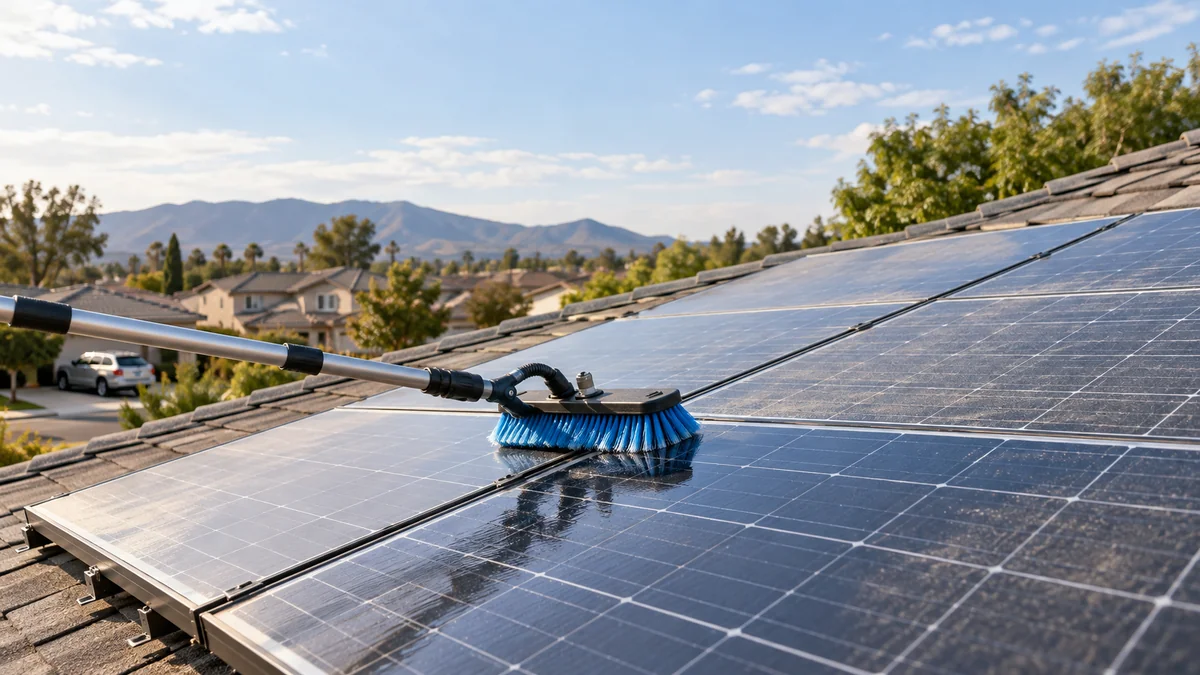
Cleaning solar panels can save money when soiling reduces valuable electricity by more than the cleaning costs. Light dust may produce too little recoverable energy to justify professional service, while bird droppings, agricultural dust, wildfire ash, or flat-roof buildup can make cleaning profitable. DIY cleaning usually has the fastest payback, provided roof access is safe.
Key Facts at a Glance
- Solar panel cleaning is financially worthwhile only when the value of recovered generation exceeds cleaning, water, equipment, and safety costs.
- Typical soiling losses range from about 2%-5% in clean, rainy locations to 10%-25% during persistent dust, ash, pollen, or bird-dropping contamination.
- A professional residential cleaning commonly costs about $100-$350 per visit, while a basic ground-based DIY setup often costs $30-$150.
- Rain removes loose dust more effectively from steeply tilted panels than from low-tilt or flat arrays, but rain does not reliably remove dried bird droppings, sap, salt film, or oily deposits.
- Cleaning frequency should follow measured output loss and local soiling conditions, not a universal monthly calendar.
- A safe, weather-adjusted production comparison is more reliable than judging panel cleanliness by appearance alone.
Does Cleaning Solar Panels Actually Save Money?
Yes, cleaning solar panels can save money, but the answer depends on four measurable variables: soiling loss, cleaning price, electricity value, and how long the improvement lasts. A $150 cleaning that restores $40 of annual energy has a negative return, whereas a $40 DIY wash that restores $180 of generation can pay back immediately.
The most important distinction is between energy recovered and panel efficiency. Cleaning does not upgrade the photovoltaic cells or make the inverter more efficient. It removes a surface obstruction, allowing the module to produce closer to its normal output under the same sunlight.
A useful decision rule is:
Net benefit = recovered kilowatt-hours × value per kilowatt-hour – cleaning cost
Include only electricity that has economic value. A homeowner with net metering may value exported energy near the retail tariff, while a homeowner with low export compensation may value self-consumed electricity much more than surplus generation.
Professional cleaning is often uneconomical for mild dust on a residential roof. It becomes more attractive when the array has heavy contamination, low rainfall, a shallow tilt, high electricity prices, or a large commercial energy value.
How Much Electricity Can Dirty Panels Lose?
Dirty solar panels commonly lose about 2%-5% under light, regularly washed-off dust, 5%-15% under persistent urban, coastal, or agricultural soiling, and 15%-25% during severe contamination. These are practical ranges, not universal constants, because particle composition, rainfall, module tilt, cleaning history, and measurement conditions change the result.
The National Renewable Energy Laboratory has documented soiling as a site-specific performance factor rather than a fixed percentage. Photovoltaic researchers commonly express the effect as a soiling ratio, meaning the output of a dirty reference surface divided by the output of a clean reference surface.
| Site condition | Typical soiling loss | Likely cleaning trigger | Common cause |
|---|---|---|---|
| Rainy suburban roof | 0%-5% | 5%-8% verified loss | Light dust and pollen |
| Urban or coastal property | 3%-12% | 6%-10% verified loss | Soot, salt aerosol, traffic dust |
| Agricultural property | 8%-20% | 5%-8% verified loss | Soil, crop dust, fertilizer residue |
| Desert or construction zone | 10%-25% | 3%-8% verified loss | Windblown mineral dust |
| Bird-dropping contamination | 5%-30% locally | Immediate spot cleaning | Droppings on active cell areas |
| Wildfire ash event | 5%-20% initially | After ash settles and access is safe | Fine ash and residue |
Annual loss can be lower than a short-term measurement suggests. A panel may lose 15% immediately after a dust event, then recover much of its output after rain. Conversely, a 5% daily loss that persists for eight dry months can exceed the financial effect of a brief 20% event.
Why does dirt reduce photovoltaic output?
Dirt reduces photovoltaic output by blocking, scattering, and reflecting sunlight before photons reach the solar cells. Dust particles lower glass transmission, while opaque bird droppings can shade small sections of a module and create electrical mismatch within cell substrings.
Most modern modules connect groups of cells in series and use bypass diodes to limit the effect of partial shading. A bird dropping does not automatically reduce the current of every cell in the entire panel, but it can reduce the affected substring, activate a bypass diode, and create disproportionate energy loss relative to its physical size.
Heavy localized deposits also create uneven heating. A persistent shaded cell may operate under electrical stress, although the risk depends on module design, bypass-diode behavior, deposit size, and operating conditions. Cleaning removes the obstruction, but it cannot repair pre-existing microcracks, delamination, or failed diodes.
How Do You Calculate the Financial Return?
Calculate the financial return by estimating recovered annual kilowatt-hours, multiplying that energy by its real economic value, and subtracting the full cleaning cost. The break-even loss is approximately:
Cleaning cost ÷ annual system value
For example, a 10-kilowatt system that normally generates 13,000 kilowatt-hours per year may lose 10% from persistent soiling, or 1,300 kilowatt-hours. If the household values that energy at $0.20 per kilowatt-hour, the gross annual loss is $260. A $40 DIY cleaning can be worthwhile; a $250 professional visit may require more than one year of benefit.
| System and tariff example | Estimated annual generation | Soiling loss | Energy value | Annual loss |
|---|---|---|---|---|
| 5 kW system, $0.15/kWh | 6,500 kWh | 5% | $0.15/kWh | $48.75 |
| 5 kW system, $0.25/kWh | 6,500 kWh | 10% | $0.25/kWh | $162.50 |
| 10 kW system, $0.20/kWh | 13,000 kWh | 10% | $0.20/kWh | $260 |
| 10 kW system, $0.30/kWh | 13,000 kWh | 15% | $0.30/kWh | $585 |
| 50 kW commercial system, $0.12/kWh | 65,000 kWh | 12% | $0.12/kWh | $936 |
These examples assume the listed loss persists for the full year. Do not apply a post-storm loss percentage to twelve months unless the contamination actually remains that long.
Why export credits change the result
Export compensation can reduce the value of recovered solar energy. If a utility pays $0.05 per kilowatt-hour for exports but charges $0.25 for imported electricity, a clean panel produces the greatest financial benefit when its output is consumed on-site or stored in a battery.
A battery does not make cleaning automatically profitable. Battery round-trip losses, replacement costs, and charging limits reduce the usable value of additional generation. Compare cleaning against the marginal value of the energy at the time the system produces it.
Which Cleaning Method Has the Best Payback?
DIY cleaning usually has the best financial payback, professional cleaning has the best safety profile, and robotic cleaning becomes financially plausible mainly for large, flat, dusty, or difficult-to-access arrays. Method selection should match the value of recovered energy and the physical risk of reaching the modules.
| Method | Typical initial or visit cost | Typical labor time | Best application | Main financial limitation |
|---|---|---|---|---|
| Ground-based DIY brush | $30-$150 | 30-120 minutes | Accessible low-rise arrays | Injury and damage risk |
| Roof-access DIY cleaning | $50-$200 | 1-3 hours | Safe, walkable service areas only | Fall exposure can erase savings |
| Professional residential service | $100-$350 | 1-3 hours on site | Steep roofs or valuable systems | Recurring service cost |
| Water-fed pure-water service | $150-$450 | 1-4 hours | Mineral-sensitive glass | Higher equipment and labor cost |
| Robotic cleaner | $1,500-$5,000 or more | 10-60 minutes per cycle | Large flat-roof portfolios | Capital cost and maintenance |
| Fixed spray or brush system | $500-$3,000 per array | Automated cycles | Repeated industrial soiling | Installation and water use |
Is professional solar panel cleaning worth it?
Professional cleaning is worth considering when a measurable output loss exceeds roughly 8%-10%, the array is unsafe to access, or severe contamination is expected to persist through the dry season. Professional service is rarely attractive solely because panels look dusty.
Ask the contractor for a written scope covering panel access, water treatment, detergents, insurance, roof protection, and post-cleaning verification. A low quote that excludes fall protection or uses untreated hard water may create a larger repair cost than the recovered electricity is worth.
Professional cleaning also has a diagnostic advantage. A competent crew may identify cracked glass, loose connectors, nesting, vegetation shading, or inverter faults while working. That inspection has value, but it should not be counted as energy savings unless it prevents a documented failure.
Are robotic cleaners financially sensible?
Robotic cleaners make sense when repeated cleaning is required across many modules and the value of recovered electricity exceeds ownership, charging, maintenance, and replacement costs. They are usually difficult to justify for a small residential array that needs washing once or twice annually.
Robots can also create new risks. Brushes may carry abrasive grit across glass, wheels can stress module frames, and poor route control can damage cable management. Confirm the manufacturer’s module compatibility, minimum tilt, turning radius, water requirements, and warranty conditions before purchase.
How Can You Clean Solar Panels Safely?
Clean solar panels during cool conditions with a soft, non-abrasive tool, low-pressure water, and the module manufacturer’s instructions. The safest residential approach is ground-based cleaning with a water-fed extension brush; a roof should not be entered solely to improve a small energy return.
Before you start
| Requirement | Practical specification |
|---|---|
| Best timing | Early morning, late afternoon, or overcast conditions |
| Typical DIY duration | 30-120 minutes for a small array |
| Basic cost | $30-$150 for brush, hose fittings, and squeegee |
| Water | Low-pressure supply, preferably low-mineral or deionized |
| Tools | Soft solar brush, microfiber pad, extension pole, hose |
| Prerequisite | Safe ground access or qualified roof access |
| Electrical action | Follow the inverter and module shutdown instructions |
Step 1: Inspect the array from the ground
Look for thick bird droppings, ash, leaves, broken glass, exposed wiring, nests, and shading. Do not touch damaged equipment or climb onto a roof to investigate an electrical fault.
You will know this step worked when you can identify the contamination pattern and confirm that cleaning, rather than inverter or shading trouble, is the likely problem. A common mistake is washing panels before checking whether a tree, snow, inverter alarm, or failed string explains the lower output.
Step 2: Remove loose debris gently
Use a soft-bristled brush on an extension pole to remove dry leaves and loose dust without pressing hard against the glass. Never use a metal scraper, abrasive pad, or stiff household broom.
You will know the step worked when loose material has been removed without dragging grit across the module. Do not dry-brush thick, sticky deposits because the particles can act like sandpaper.
Step 3: Rinse with low-pressure water
Rinse from the upper edge downward using cool or lukewarm water. Avoid pressure washers because concentrated water can damage seals, frames, connectors, or cable entries.
You will know the step worked when visible loose dust has left the surface and no gritty film remains. Spraying cold water onto very hot glass is a common mistake, although the severity of thermal stress depends on glass temperature, water temperature, module construction, and flow rate.
Step 4: Wash persistent deposits
Use a soft microfiber pad or manufacturer-approved solar brush. For dried bird droppings, soften the deposit with water for several minutes before wiping; use mild soap only when the module manufacturer permits it.
You will know the step worked when deposits lift without scrubbing pressure. Avoid ammonia, bleach, abrasive detergent, solvent, and household glass cleaner unless the manufacturer explicitly approves the product.
Step 5: Remove mineral-laden water
Use a rubber squeegee or rinse with low-mineral water before the surface dries. Hard-water spots can leave calcium and magnesium residue that scatters light and requires another cleaning.
You will know the step worked when the glass dries without white rings or streaks. Do not lean a ladder against modules or walk on the array, because point loads can create microcracks that may not become visible until later.
Step 6: Verify the result
Compare inverter output with a similar clear-weather period after cleaning, while accounting for irradiance, module temperature, cloud cover, and shading. A monitoring app can show a change, but it cannot prove the cause without a reasonable weather comparison.
You will know the cleaning paid off when normalized production rises and remains higher for the expected dry period. If output does not improve, investigate shading, inverter clipping, string faults, degradation, and soiling measurement error.
How Often Should Solar Panels Be Cleaned?
Most residential solar panels do not need a fixed monthly cleaning schedule. A typical clean suburban array may need no manual washing for a year or longer, while an agricultural, desert, construction, or low-tilt installation may require cleaning every 1-4 months during its dry season.
| Environment | Practical inspection interval | Typical cleaning interval | Trigger |
|---|---|---|---|
| Rainy suburban roof | Every 6-12 months | 12-24 months or as needed | Persistent visible film |
| Coastal property | Every 3-6 months | 6-12 months | Salt haze or residue |
| Farm or feedlot | Every 1-2 months | 1-4 months | Measured loss above 5%-8% |
| Desert property | Every 2-4 weeks | 1-3 months | Dust accumulation and tariff value |
| Construction area | After major dust events | As contamination persists | Cement or mineral residue |
| Commercial flat roof | Weekly to monthly monitoring | Monthly to quarterly | Soiling sensor or output loss |
Rain is not a guaranteed substitute for cleaning. Steep modules shed loose dust more effectively, but low-tilt modules can develop dirty lower edges after water evaporates. Rain also fails to remove many dried bird deposits, oily soot films, tree sap, and salt residue.
How Can You Tell Whether Dirt Is Reducing Output?
Measure output against a clean reference, comparable weather, or a modeled production baseline rather than relying on visual inspection. A panel can look dusty while losing little energy, and a small opaque deposit can cause a meaningful localized loss.
Use these methods:
- Compare the same inverter’s clear-day production before and after cleaning.
- Compare adjacent arrays with similar orientation, tilt, and equipment.
- Review performance ratio or normalized output, not raw monthly kilowatt-hours.
- Check module temperature, cloud cover, irradiance, and shading.
- Record the cleaning date and the first comparable production period afterward.
A year-over-year comparison is weak if the weather differs substantially. Winter sun angle, snow, cloud cover, heat, smoke, and inverter clipping can overwhelm the cleaning signal.
A practical household trigger is a persistent, weather-adjusted decline of about 5%-10% with visible contamination. Commercial operators may use soiling stations or reference cells because a small percentage loss across megawatts has a much larger financial effect.
What Problems Can Cleaning Cause?
Cleaning can cost more than the electricity it recovers when the operator uses unsafe roof access, hard water, abrasive tools, harsh chemicals, or excessive frequency. Panel washing is maintenance, not a harmless cosmetic activity.
| Mistake | Possible consequence | Safer correction |
|---|---|---|
| Pressure washing | Seal, frame, or connector damage | Use low-pressure rinse |
| Walking on modules | Microcracks and cell damage | Work from ground or approved walkways |
| Abrasive brush | Glass coating and surface scratches | Use soft solar brush |
| Hard water allowed to dry | Mineral spots and light scattering | Squeegee or use treated water |
| Harsh detergent | Coating or seal degradation | Follow module instructions |
| Cleaning hot glass | Thermal stress risk | Work during cool conditions |
| Ignoring damaged wiring | Shock or fire exposure | Stop and call a qualified technician |
| Overcleaning after every rain | Labor and water waste | Use output-based thresholds |
The most counterintuitive rule is that a clean-looking panel is not necessarily a profitable panel. Financial value comes from recovered kilowatt-hours, not visual brightness.
A second practitioner rule is to clean contamination that is sticky, opaque, or localized before worrying about a thin uniform dust film. Bird droppings, sap, and cement residue can create greater practical loss than an even layer of loose dust.
A third rule is to compare the cost of cleaning with the cost of not cleaning over the entire dry interval. A $200 service may be irrational before a rainy week but reasonable before four months of clear weather at a high tariff.
Does Cleaning Beat Other Ways to Improve Solar Output?
Cleaning should be compared with vegetation control, inverter repair, shade reduction, and module replacement. If a tree causes 15% shading every afternoon, washing a dusty surface may produce a smaller gain than trimming the tree or repairing a failed string.
| Intervention | Typical cost range | Potential issue addressed | Verification method |
|---|---|---|---|
| Panel cleaning | $30-$450 | Surface soiling | Post-cleaning normalized output |
| Vegetation trimming | $100-$1,000 | Seasonal shading | Shade survey and production curve |
| Inverter repair | $150-$1,500 | Conversion or string fault | Inverter diagnostics |
| Bird deterrent installation | $100-$800 | Repeated droppings | Fewer deposits and stable output |
| Module replacement | $200-$700 per module | Cracks or failed electronics | Electrical test and monitoring |
| Soiling sensor | $500-$5,000 | Measurement uncertainty | Clean and dirty reference readings |
Bird deterrents can outperform repeated spot cleaning where nesting causes daily contamination. Vegetation control may have a better return than washing when shading is predictable and substantial. Equipment diagnosis comes first when the inverter reports faults or production falls without visible soiling.
What Should Different Solar Owners Do?
Rainy suburban homeowner
Allow natural rainfall to handle light dust, inspect the array annually, and clean only when visible deposits persist or monitoring shows a sustained loss. Paying $200 for a professional visit to recover $50 of annual energy is unlikely to make financial sense.
Desert homeowner
Use monitoring and visual inspections after dust storms, then clean when the output loss exceeds the value threshold. Ground-based tools can provide strong returns, but roof safety remains more important than a short payback period.
Agricultural property owner
Expect more frequent soiling from dry soil, harvesting, livestock, and fertilizer dust. A cleaning plan tied to harvest periods and dry-weather forecasts often produces a better return than a fixed monthly schedule.
Coastal homeowner
Inspect for salt haze and mineral residue, especially where sea spray reaches the array. Rain may remove loose salt particles but may not remove concentrated deposits along the lower frame.
Commercial flat-roof operator
Use performance ratio tracking, reference modules, or a soiling sensor. Robotic or scheduled cleaning can be justified when a small percentage loss across a large array exceeds the equipment and labor cost.
Frequently Asked Questions
Can dirty solar panels damage the system?
Dirty solar panels usually reduce generation rather than directly damage the entire system. Localized bird droppings or thick debris can create uneven electrical behavior and heating, but module design, bypass diodes, deposit size, and duration determine the risk. Damage is more likely when contamination combines with poor wiring, cracked glass, or failed electronics.
Do solar panels need cleaning after rain?
Solar panels do not automatically need cleaning after every rain. Rain often removes loose dust from steeply tilted modules, but low-tilt arrays can retain dirty runoff at their lower edges. Inspect after the surface dries, then use monitoring to determine whether residual contamination causes a meaningful production loss.
Can I use tap water to clean photovoltaic modules?
Tap water can be used for rinsing if it has low mineral content and is removed before drying. Hard water can leave calcium and magnesium spots that scatter light and require additional cleaning. A squeegee, deionized-water system, or final low-mineral rinse reduces residue.
Does cleaning improve solar panel efficiency or only output?
Cleaning improves operating output by allowing more sunlight to reach the cells, but it does not permanently increase the photovoltaic cell’s rated conversion efficiency. The gain lasts only while the obstruction remains absent. Cleaning cannot reverse age-related degradation, cracked cells, delamination, inverter faults, or shading.
Is solar panel cleaning tax deductible?
The tax treatment of solar panel cleaning depends on ownership, jurisdiction, system use, and whether the array is residential or income-producing. Routine household maintenance is not automatically deductible. Business owners should retain invoices and ask a qualified tax professional whether cleaning qualifies as an operating expense.
Should I clean solar panels before selling my home?
Cleaning can improve presentation and remove obvious contamination, but it does not prove that the system produces more energy or has better equipment. Obtain recent inverter records, disclose faults, and clean only when the expected visual or production benefit exceeds the service cost.
The Bottom Line
Cleaning solar panels saves money when the value of recovered electricity exceeds the complete cost and risk of cleaning. Light dust on a steep, rainy residential roof often does not justify professional service, while persistent agricultural dust, desert contamination, bird droppings, wildfire ash, and low-tilt buildup can make cleaning profitable.
Use measured, weather-adjusted output whenever possible. For most homeowners, the best decision is to inspect periodically, clean safely when persistent loss reaches about 5%-10%, and choose DIY only when ground access eliminates meaningful fall risk. That is the practical answer to does cleaning solar panels actually save money on electricity: sometimes, but the meter, tariff, soiling duration, and cleaning cost decide the result.