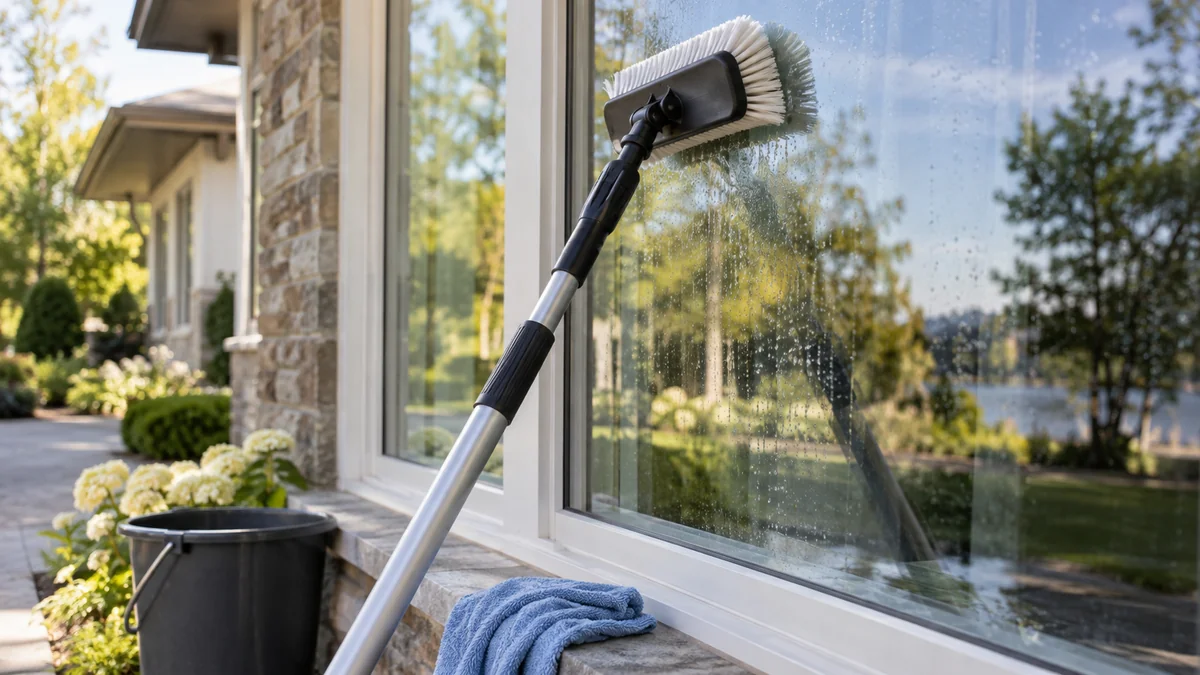
To clean hard to reach exterior windows, use a telescoping pole with a soft microfiber washer and squeegee, or a pure-water-fed pole for higher glass. Work from the ground on a cool, overcast day: remove dry debris, rinse away grit, wash with diluted neutral soap, squeegee before drying, and detail the edges. Stop when height, wind, access, or falling-object risk makes ground-based work unsafe.
Key Facts at a Glance
- A telescoping pole usually handles second-story windows from ground level, while a pure-water-fed pole can reach approximately 30-60 feet.
- A cool, shaded pane stays wet longer, reducing soap marks and squeegee lines.
- Dry brushing and rinsing remove abrasive grit before a scrubber touches the glass.
- Never use a pressure washer directly on window glass, perimeter seals, or window frames.
- Typical DIY cleaning of 15-20 second-story windows takes 2-3 hours and costs about $35-$95 for a basic pole kit.
- Mineral deposits require an acid-compatible treatment, but coated glass, natural stone, and metal frames may react badly to vinegar or stronger descalers.
Before You Start: Time, Cost, and Tools
A typical homeowner needs 2-3 hours to clean 15-20 accessible second-story windows with a telescoping pole. The job is moderate in difficulty because tool control, water management, and safe positioning matter more than physical reach. A basic setup costs approximately $35-$95, excluding a hose, bucket, replacement rubber, and mineral-stain treatment.
Equipment and quantities
| Item | Typical specification | Quantity or cost | Purpose |
|---|---|---|---|
| Telescoping pole | 8-24 feet, aluminum or carbon fiber | 1, $35-$150 | Reaches upper panes from the ground |
| Soft window washer | Microfiber or nylon, 10-14 inches | 1, $10-$30 | Loosens bonded dirt |
| Squeegee head | 10-14-inch replaceable rubber blade | 1, $12-$35 | Removes dirty water |
| Neutral dish soap | Low-foam, pH-neutral formula | 2-5 drops per gallon | Loosens oily film |
| Microfiber towels | Glass-specific, lint-free | 4-8 | Dries edges and the squeegee |
| Garden hose | Adjustable fan or shower nozzle | 1 | Flushes abrasive particles |
| Bucket | 3-5 gallons | 1 | Holds the cleaning solution |
| Eye protection | ANSI-rated safety glasses | 1 pair | Limits splash exposure |
Use a clean pole head and inspect the rubber blade before starting. A nick only 1-2 millimeters long can leave a continuous line across every pass, especially when the blade is used at a steep angle from the ground.
How the Exterior Window-Cleaning Method Works
Exterior window cleaning combines chemical loosening, controlled agitation, and rapid water removal. Diluted surfactant reduces surface tension and lifts oily pollution, a soft pad separates the remaining film, and a squeegee removes contaminated water before evaporation deposits residue.
Pure-water cleaning uses a different mechanism. Reverse-osmosis and deionization systems remove dissolved minerals, and a brush agitates the glass while the purified water carries away dirt. When the final rinse has very low total dissolved solids, often near 0-10 ppm at the brush, water can dry without the mineral spots left by ordinary tap water.
Glass is not literally porous like a sponge. The practical concern is microscopic surface contamination, previous mineral deposits, and surface damage that traps residue. Sprinkler water, masonry runoff, sea salt, and construction dust can etch or bond to glass when repeated exposure and sunlight concentrate them.
What determines a streak-free result?
A streak-free result depends on four controls: low solution concentration, a wet working surface, a clean blade, and overlapping strokes. Excess detergent creates foam and residue, while a dry blade skips over the pane and leaves parallel tracks.
The working angle also matters. A pole used from 20 feet away approaches the window at a shallow angle, so the washer may clean the center but miss the lower frame and corners. Move your feet rather than forcing the pole sideways, and keep the pole closer to vertical whenever the site allows.
Step 1: Plan the Weather and Work Area
Choose a calm, overcast period with no rain expected during the cleaning session, then clear furniture, toys, vehicles, and people from the area below the windows. Avoid hot glass because rapid evaporation can dry detergent before the squeegee reaches it.
A temperature around 10-24°C, or 50-75°F, is generally easier to manage than freezing conditions or strong heat. Wind creates two problems: it accelerates drying and can move a long pole unpredictably near roof edges, electrical conductors, and fragile landscaping.
Walk the entire work zone before filling the bucket. Identify overhead wires, sloped ground, retaining walls, balconies, roof edges, fragile awnings, and windows above public or neighbor-accessible areas. Do not begin if a dropped tool could strike someone.
You will know planning worked when the ground is stable, the pole can be extended without contacting hazards, and every pane can be reached without stepping onto a ladder or leaning around an obstruction.
Common mistake: starting with the highest window and discovering that the pole cannot be controlled at full extension. Test one low pane first, then confirm reach and balance.
Step 2: Remove Dry Debris
Attach a dry, soft-bristled brush or clean microfiber head and sweep cobwebs, leaves, bird droppings, and loose dust from the frame, sill, corners, and glass. Use light passes, particularly over dried droppings that may contain grit.
Do not scrub hardened bird droppings dry. Dry brushing is for loose material only. For bonded droppings, place a damp microfiber washer against the spot for 30-60 seconds, then lift the softened residue without grinding it across the pane.
Frames deserve attention because dirt in the upper channel can flow back onto clean glass. Clear weep holes only with a soft brush or manufacturer-approved method. Do not poke them with wire, which can damage drainage components.
You will know it worked when no loose webbing or sand remains in the corners and the first rinse produces mostly clean runoff rather than muddy streams.
Common mistake: using a stiff household broom. Its bristles can carry sand and scratch glass or painted frames.
Step 3: Rinse From the Ground
Rinse the entire window from top to bottom with a garden hose set to a broad fan or shower pattern. The rinse should flush grit away without forcing water behind the frame, siding, trim, or exterior seals.
A hose is not a substitute for washing. Its purpose is to remove loose abrasive particles before the microfiber pad makes contact. Keep the nozzle at least 30-60 centimeters from the pane when possible, and avoid a concentrated jet aimed at corners or seals.
Do not rinse electrical outlets, exterior lighting, damaged glazing putty, failed seals, or open wall joints. If the frame is already leaking, skip DIY washing and arrange an inspection.
You will know it worked when loose dirt has left the pane and the water runs without carrying visible sand or dark particles.
Common mistake: using a pressure washer. High pressure can drive water behind trim, damage silicone seals, break aged glazing compounds, and create interior moisture problems.
Step 4: Apply the Right Cleaning Solution
Mix 2-5 drops of low-foam, pH-neutral dish soap into 1 gallon of warm water. Dip the washer, wring it until wet but not dripping, and work from the top of the pane downward with overlapping horizontal and vertical passes.
The solution should lubricate the glass, not produce a thick layer of foam. Excess soap is difficult to rinse from a shallow pole angle and can leave a hazy film. Wash the frame and sill separately when possible, because frame grime can contaminate the washer.
White vinegar diluted approximately 1:1 with water can help with light mineral residue, but it is not universally safe. Keep vinegar away from natural limestone, marble, unsealed concrete, some anodized or delicate metals, and manufacturer-prohibited coatings. Never mix vinegar with chlorine bleach or other cleaning chemicals.
You will know it worked when the pane has an even wet film and the washer glides without catching on gritty particles.
Common mistake: using concentrated soap or an undiluted household cleaner. Stronger is not automatically cleaner, and residue increases streaking.
Step 5: Agitate the Pane and Edges
Scrub the pane with moderate pressure in overlapping strokes, giving extra attention to lower corners, muntins, frame junctions, and areas below sprinklers. Keep the washer saturated enough to float loosened dirt instead of dragging it across dry glass.
For large panes, divide the surface into sections no wider than you can squeegee before drying. A 12-inch washer is easier to control on a second-story window than a large 18-inch head when the pole is fully extended.
Use a fresh washer for heavily polluted glass. If the pad becomes gray or sandy, rinse it in clean water before returning to the pane. Separate the frame tool from the glass tool when mold, algae, or masonry dust is present.
You will know it worked when the wet pane looks uniformly clean, without dark bands that reappear after each scrub pass.
Common mistake: applying body weight through a long pole. Excess pressure bends the pole, reduces pad contact, and makes the head pivot unpredictably.
Step 6: Squeegee Before the Glass Dries
Attach a clean squeegee and pull from the top edge downward in straight, overlapping strokes. Overlap each pass by about 2-3 centimeters, wipe the blade dry after each stroke, and keep a dry microfiber towel available for the perimeter.
For narrow panes, one vertical pull may cover the width. For broad glass, begin at the upper corner and work across, maintaining a wet edge. A horizontal “fan” technique can work from a ladder or close position, but vertical strokes are usually easier to control from the ground.
A good rubber blade needs firm, continuous contact. Replace it when it has nicks, curls, hard spots, or a permanent bend. Do not expect a towel to polish away a poor squeegee pass; towel polishing often spreads residue over a larger area.
You will know it worked when the pane shows clear, even channels with no thin lines at the overlap points.
Common mistake: allowing the pane to dry before squeegeeing. Re-wet the section and remove the solution again rather than wiping dried detergent with a dry cloth.
Step 7: Detail the Perimeter and Inspect
Wrap a clean, dry microfiber towel around the pole tip or use a dedicated detailing head to wipe the top, sides, lower edge, frame junctions, and sill. Inspect the glass from two angles because a straight-on view can hide diagonal tracks and edge drips.
Water often returns from the upper frame after the pane appears clean. Make a final perimeter pass after 2-5 minutes, particularly around horizontal tracks, weep holes, and deep exterior glazing pockets.
If spots remain, identify the residue before repeating the entire process. Soap haze, mineral scale, silicone residue, paint, and permanent etching require different treatments. Repeated scrubbing without diagnosis increases the chance of scratching.
You will know it worked when the glass remains clear after the frame has stopped releasing runoff and no new drip marks appear.
Common mistake: using the same dirty towel for glass and frame edges. Keep separate towels so frame grime does not return to the pane.
Which Equipment Works Best?
The best equipment depends on height, window movement, glass thickness, and whether the operator can remain on the ground. A telescoping pole is the sensible choice for many two-story homes, while pure-water-fed systems offer better reach and faster frame rinsing for frequent or extensive work.
| System | Typical reach or specification | Typical cost | Best use | Main limitation |
|---|---|---|---|---|
| Telescoping pole | 8-30 feet, 2-5 pounds | $35-$150 | Second-story residential panes | Harder corner control at maximum extension |
| Magnetic cleaner | Glass thickness matched to model, safety tether | $30-$100 | Fixed high-rise glass cleaned from indoors | Exterior unit can fall or lose contact |
| Hose-end sprayer | Approximately 15-27 feet with adequate pressure | $20-$60 | Light maintenance rinses | Often leaves minerals when water dries |
| Pure-water-fed pole | Approximately 30-60 feet, 0-10 ppm final rinse | $250-$1,000-plus | Frequent work and delicate large façades | Filtration, transport, and water use |
| Robotic cleaner | Flat glass, power and backup battery required | $150-$600 | Large accessible fixed panes | Limited edge and frame cleaning |
When should you choose a pure-water-fed pole?
Choose a pure-water-fed pole when you clean many high windows, need frame rinsing, or have access to a reliable filtration system. The brush scrubs while purified water carries away dissolved contamination, eliminating the need to squeegee most panes.
Pure water is less useful when the pane has heavy grease, construction debris, paint, or thick mineral scale. Those contaminants may need a conventional detergent wash first. A pure-water system also becomes cumbersome when the operator must carry a heavy tank over steps, soft ground, or long distances.
Are magnetic window cleaners appropriate?
Magnetic cleaners are appropriate only for fixed panes that cannot open and whose glass thickness matches the tool’s specified range. Measure the complete glazing thickness, including the pane arrangement required by the manufacturer, rather than guessing from the window’s appearance.
Attach the safety tether to a structural interior anchor, not a lightweight curtain rod or movable chair. Start with slow movements and keep the external unit below the interior unit’s path. Magnetic cleaners are poor choices for uneven glass, deep frames, screens, leaded panes, or windows above people and vehicles.
Which Situations Need a Different Method?
Window design changes the safe cleaning method. Double-hung windows may tilt inward for interior access, fixed high-rise glass requires a magnetic system or professional access, and skylights often need roof-safe equipment rather than a longer pole.
| Window situation | Preferred method | Avoid | Typical decision |
|---|---|---|---|
| Second-story double-hung | 12-24-foot pole from stable ground | Leaning ladder sideways | DIY if every pane is reachable |
| Fixed condominium glass | Correctly sized magnetic cleaner or professional service | Untethered external pad | Use a professional above occupied areas |
| Skylight on a pitched roof | Interior cleaning plus roof-rated access | Walking on tiles or wet roofing | Hire a qualified technician for exterior work |
| Third-story residential pane | 24-30-foot pole or pure-water system | Improvised extension tools | Professional service often safer |
| Salt-exposed coastal glass | Frequent pure-water rinse and detergent wash | Letting salt dry repeatedly | Clean every 1-3 months as needed |
| Sprinkler-splashed pane | Mineral treatment after washing | Abrasive pads or razor scraping | Redirect sprinkler and test treatment first |
Fixed high-rise glass
For fixed high-rise glass, do not lean outside a window or place a body through a restricted opening. A tethered magnetic cleaner can work at low-risk locations when the tool matches the glazing thickness, but professional rope access, a suspended platform, or an insured building service is safer for exposed elevations.
Building rules also matter. Condominiums and rental properties may prohibit exterior devices, require approved contractors, or restrict work above entrances and sidewalks.
Skylights and roof windows
A telescoping pole can clean some low-pitched skylights from the ground, but it rarely gives reliable pressure or edge control on steep roofs. Wet roofing becomes slippery, and fragile tiles or acrylic domes can crack under concentrated force.
Clean the interior first so you can distinguish external dirt from fogging between panes. Condensation inside an insulated glass unit is a seal failure, not a cleaning problem.
Common Mistakes and How to Fix Them
| Problem | Likely cause | Recovery |
|---|---|---|
| White lines after drying | Dirty, nicked, or dry squeegee rubber | Re-wet, replace or clean the blade, and overlap passes |
| Cloudy gray crust | Hard-water mineral scale | Test diluted vinegar on a hidden area, dwell briefly, then rinse |
| Oily rainbow film | Silicone, polish, or traffic residue | Use a compatible glass degreaser and a separate washer |
| Dirt returns from the top | Dirty frame channel or delayed runoff | Detail the frame, wait several minutes, then wipe again |
| Scratches after cleaning | Sand under the pad or abrasive tool | Stop immediately and have the glass assessed |
| Magnetic pad drops | Incorrect glass thickness or excessive speed | Retrieve the tether, verify thickness, and replace the tool if mismatched |
How do you remove mineral deposits?
Remove light mineral deposits by washing the glass first, applying a tested mild acid solution to a small area, allowing a short dwell time, and rinsing completely. Ordinary dish soap does not dissolve calcium carbonate deposits because soap loosens organic grime rather than mineral scale.
Start with diluted white vinegar, not an aggressive undiluted acid. Use a dedicated calcium-lime remover only when its label permits glass and the surrounding frame materials. Never use pumice, steel wool, abrasive powder, or an untested razor on coated glass.
If the glass feels rough after treatment or remains cloudy under changing light, the surface may be etched. Cleaning cannot reverse etching. A glass restoration professional may polish some damage, but replacement is sometimes the only complete repair.
What should you do if a magnetic cleaner falls?
Keep the safety tether attached, clear people from below, and do not lean through the window to retrieve the external unit. Pull the device toward a safe retrieval point only when the manufacturer provides that procedure and the tether is intact.
Inspect the glass, frame, tether, magnets, and pad before reuse. A cracked casing or damaged magnet can fail again without warning. If the unit falls over a public walkway, notify building management and keep the area clear until the hazard is resolved.
Which Methods Damage Glass or Seals?
Pressure washers, abrasive pads, dry scraping, and improvised tools create the greatest damage risk. Pressure can force water behind seals, while grit trapped under a pad produces scratches that ordinary cleaning cannot remove.
Avoid ammonia or strong alkaline products unless the glass and frame manufacturer approves them. Some films, tint layers, sealants, painted frames, and anodized finishes react to aggressive chemistry. Do not mix cleaning agents, especially acids with chlorine products.
Ladders deserve separate caution. The U.S. Occupational Safety and Health Administration requires portable ladders to be used on stable, level surfaces and prohibits unsafe overreaching; a homeowner should treat a window as inaccessible when reaching requires lateral leaning, standing on an unsafe step, or moving a ladder while occupied.
What Does Exterior Window Cleaning Cost?
Typical DIY costs range from $35-$95 for a basic pole kit, while a pure-water-fed setup commonly costs $250-$1,000 or more. Professional residential cleaning often falls near $10-$18 per standard window, with total visits around $150-$450 before difficult access or restoration work.
| Service or setup | Typical price range | Typical time | Best value when |
|---|---|---|---|
| Basic pole kit | $35-$95 | 2-3 hours for 15-20 windows | One- or two-story home |
| Premium carbon-fiber pole | $150-$400 | 1.5-3 hours | Frequent upper-window cleaning |
| Pure-water equipment | $250-$1,000-plus | 1-2.5 hours | Many panes or recurring work |
| Residential professional visit | $150-$450 | 45-90 minutes | Safety, speed, or polished results matter |
| Difficult three-story access | $450-$800-plus | 1-3 hours | Boom, lift, or specialized pole required |
| High-rise commercial access | $500-$1,500-plus | Varies by façade | Rope access or suspended platform required |
Prices vary by region, pane size, screens, storm windows, frame condition, mineral restoration, travel, and access equipment. Ask whether the quote includes screens, tracks, hard-water treatment, insurance, and cleanup.
Know When to Stop DIY Work
Hire a professional when the window cannot be reached from stable ground, the pole contacts electrical infrastructure, wind prevents control, the glass is above a public path, or the pane requires roof access. Professional crews may carry work-at-height training, liability insurance, pure-water systems, lifts, and rope-access qualifications.
Do not improvise with a second pole taped to the first, stand on a roof edge, use a ladder on wet or sloped ground, or work beneath an unsecured magnetic device. The cost of a service visit is usually lower than the consequences of a fall, broken glazing unit, damaged façade, or injured bystander.
An honest limitation matters here: telescoping poles clean broad, reachable surfaces well, but they cannot guarantee perfect corner pressure on every architectural façade. Complex geometry, deep recesses, fragile coatings, and failed seals justify professional assessment even when the glass appears physically reachable.
Maintenance Schedule and Prevention
Clean exterior glass two to four times per year in ordinary residential settings, then increase frequency for coastal salt, heavy traffic, pollen, construction dust, or nearby trees. Sprinklers that wet windows may require monthly rinsing during the irrigation season.
Redirect sprinkler heads away from glass and masonry. Rinse salt or dust before it bakes onto the pane, repair leaking gutters that discharge onto windows, and trim branches that repeatedly deposit sap or bird waste.
A simple schedule works well:
- Inspect frames, seals, screens, and drainage channels each season.
- Rinse loose dust before pollen or grit becomes bonded.
- Wash glass when shade and weather permit.
- Treat mineral deposits early, before repeated drying creates scale.
- Record damaged seals, etched areas, and panes that need professional restoration.
Frequently Asked Questions
Can I clean outside windows with a hose alone?
A hose can rinse loose dust and pollen, but ordinary tap water often leaves mineral spots as it dries. Use a broad spray to flush grit, then wash with a microfiber tool and remove the dirty water with a squeegee. A pure-water rinse is the exception because demineralized water can dry with little visible spotting.
Is vinegar safe for all exterior windows?
Vinegar is not safe for every window assembly or surrounding material. Test diluted vinegar on an inconspicuous area, keep it away from limestone, marble, unsealed concrete, delicate metals, and prohibited coatings, and rinse thoroughly. Vinegar helps light mineral residue, but it will not repair etched glass or remove every construction contaminant.
How high can a homeowner safely clean with a pole?
A homeowner can often clean second-story windows from the ground with an 8-24-foot pole, but safe reach depends on terrain, pole weight, wind, overhead hazards, and control. Maximum advertised length is not a safe working length. Stop when the pole bends excessively or requires leaning into an unstable position.
Why do windows streak even with a new squeegee?
Streaks usually result from excessive detergent, a drying pane, dirty rinse water, insufficient blade overlap, or poor blade pressure. Re-wet the surface, reduce soap, wipe the blade after each pass, and work in smaller sections. Hot glass and direct sun make every one of these problems more severe.
How often should second-story windows be cleaned?
Most homes benefit from exterior window cleaning two to four times annually. Coastal homes, properties beside busy roads, and houses exposed to sprinklers may need monthly or quarterly attention. Cleaning earlier prevents mineral scale and organic deposits from bonding strongly enough to require restoration.
Is pure water better than soapy water?
Pure water is better for frequent maintenance, large façades, and frame cleaning because it can dry with minimal mineral residue. Soapy water is better for grease, heavy organic film, bird droppings, and initial deep cleaning. Many professional crews combine both methods rather than treating them as interchangeable.
The Bottom Line
The safest way to clean hard to reach exterior windows is to stay on stable ground, remove dry grit, rinse gently, scrub with diluted neutral soap, and squeegee while the glass remains wet. A telescoping pole suits most second-story homes; pure-water equipment suits frequent or higher work; magnetic tools suit only correctly matched fixed panes. Stop and hire a professional whenever height, wind, glass design, electrical hazards, or falling-object exposure exceeds your control.