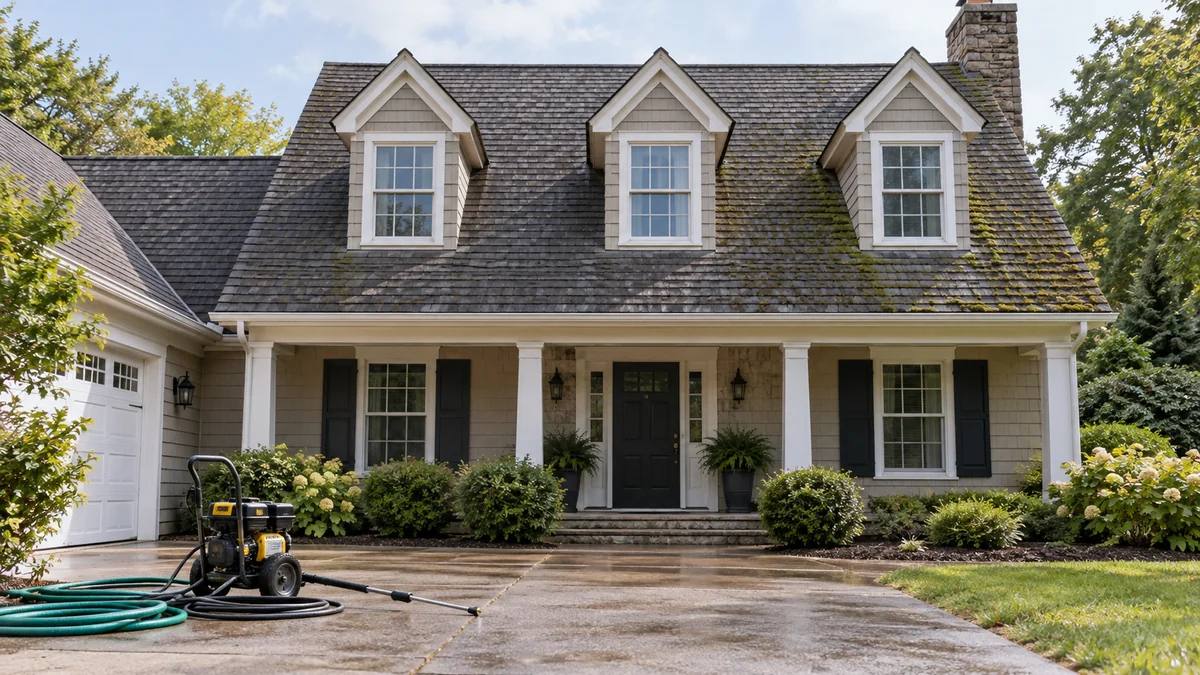
No, you should not pressure wash asphalt roof shingles with a conventional pressure washer. High-pressure water can remove mineral granules, damage the asphalt coating, drive water beneath shingle laps, and create warranty or leak problems. Asphalt shingle cleaning should follow the specific manufacturer’s instructions, usually with a carefully controlled low-pressure chemical treatment rather than mechanical blasting.
Key Facts at a Glance
- Conventional pressure washing commonly operates at 1,500-3,000 PSI, far beyond what asphalt shingle manufacturers generally recommend for cleaning.
- Mineral granules protect asphalt shingles from ultraviolet radiation, weathering, and fire exposure; lost granules cannot be restored by rinsing.
- Low pressure does not automatically make a cleaning job safe because nozzle design, spray distance, flow rate, roof condition, and chemical strength also matter.
- The Asphalt Roofing Manufacturers Association, or ARMA, advises against power washing asphalt shingles and describes non-pressure chemical cleaning as the safer approach.
- Black streaks usually come from algae, often identified as Gloeocapsa species, while moss and lichen require different treatment and may not disappear immediately.
- A roof with brittle, curling, cracked, loose, or missing shingles should be inspected before any cleaning begins.
Can You Pressure Wash Asphalt Roof Shingles?
You can physically aim a pressure washer at asphalt shingles, but you should not use conventional pressure-washing force to clean them. The concentrated stream can dislodge ceramic-coated mineral granules, cut or lift shingle edges, damage exposed asphalt, and force water into areas designed to shed rain rather than receive upward spray.
The risk exists even when the roof looks intact afterward. Granule loss may collect in gutters instead of appearing on the roof, and small tears can become leaks only after wind-driven rain or freeze-thaw cycles. A pressure washer can also worsen an existing defect that a visual inspection from the ground would not reveal.
ARMA’s guidance on algae discoloration recommends avoiding power washing asphalt shingles. However, “soft washing” is not a universal license to apply any chemical at any pressure. The shingle manufacturer’s published maintenance instructions take priority, particularly for newer roofs, specialty coatings, impact-rated products, and roofs still covered by warranty.
Why Does Pressure Washing Damage Shingles?
Pressure washing damages asphalt shingles through concentrated hydraulic force, granule impact, edge lifting, and water intrusion. Mineral granules are bonded to the shingle’s weathering surface, but a narrow high-velocity spray can remove them faster than ordinary rainfall.
The danger increases when an operator uses a zero-degree or 15-degree nozzle, stands close to the roof, sprays upward, or repeatedly works one stained area. Shingle courses overlap in a direction that helps rain move downward. Spraying from below or across the laps can push water under those overlaps and toward the underlayment, decking, vents, or attic insulation.
Roof age changes the risk. An asphalt shingle roof near the end of its service life may already have brittle sealant strips and weakened granule adhesion. Cleaning can expose that weakness, making the roof appear to have “failed after washing” even though deterioration began earlier.
What Happens to Mineral Granules?
Mineral granules shield the asphalt coating from ultraviolet radiation and provide part of the shingle’s fire and weather resistance. When a pressure washer removes those granules, the exposed asphalt can weather faster, become more vulnerable to heat, and lose the textured surface that helps protect the shingle.
Granule loss is not always uniform. A small amount in a gutter may represent normal aging, but large quantities after cleaning indicate that the roof has been abraded or degraded. Dark bare patches, exposed fiberglass mat, and unusually smooth areas are reasons to stop work and request a roofing inspection.
| Roof condition | Cleaning risk | Recommended action | Typical consequence |
|---|---|---|---|
| New, flat asphalt shingles | Moderate | Follow manufacturer instructions | Warranty documentation may matter |
| 10-15-year-old shingles | High | Inspect before treatment | Brittle sealant and granule loss |
| Curling or cracked shingles | Very high | Do not clean mechanically | Leak or breakage risk |
| Missing or loose shingles | Very high | Repair before cleaning | Water entry during application |
| Heavy moss or lichen | High | Use a qualified roof cleaner | Roots may detach granules |
What Pressure Is Safe for Asphalt Shingles?
There is no single universally safe PSI for every asphalt shingle roof. Professional roof cleaners often describe low-pressure application in the approximate range of 50-150 PSI, but PSI alone does not establish safety, and some manufacturers specify different methods or prohibit particular chemicals.
A pressure washer set below 300 PSI can still damage shingles if it uses a narrow nozzle, excessive flow, close distance, or an upward spray angle. Conversely, a garden hose can cause problems when directed beneath shingle laps or used to flood vulnerable roof penetrations. Pressure is only one part of the exposure.
For that reason, avoid marketing claims that promise a “safe 300 PSI roof wash” without explaining the equipment and technique. Ask for the actual operating pressure at the nozzle, nozzle type, spray direction, chemical concentration, rinse plan, and manufacturer guidance being followed.
| Cleaning approach | Typical operating description | Main action | Asphalt shingle suitability |
|---|---|---|---|
| Conventional power washing | 1,500-3,000+ PSI | Mechanical blasting | Not recommended |
| Low-pressure chemical application | Often 50-150 PSI | Chemical treatment | May be suitable if manufacturer-approved |
| Garden-hose rinse | Approximately household supply pressure | Gentle flushing | Use only where appropriate |
| Soft brushing | No hydraulic pressure | Physical agitation | Avoid aggressive brushing |
| Dry debris removal | 0 PSI | Manual or blower removal | Suitable for loose leaves |
How Does Soft Washing Asphalt Shingles Work?
Soft washing treats biological growth with a cleaning solution delivered at low pressure, allowing chemistry and dwell time to do most of the work. The operator protects surrounding surfaces, applies from the ridge downward without forcing liquid beneath laps, keeps the solution wet for the product’s specified dwell time, and rinses or allows approved residue to weather away.
The active ingredient varies. Sodium hypochlorite is widely used for algae and organic growth, while sodium percarbonate and other oxygen-based products generally work more slowly and may require repeat applications. Neither option is automatically safe for every roof, plant, painted surface, metal fixture, or water system.
A professional should identify the roof material and growth before mixing chemicals. Black streaks, moss, lichen, pollen, and embedded dirt do not respond identically. A treatment that removes algae may kill moss without immediately removing its visible structure.
Is a 50/50 Bleach Mixture Safe?
A universal 50/50 bleach-and-water roof mixture is not a safe instruction for every property. Household bleach varies in sodium hypochlorite concentration, and a 50/50 mixture may create an unnecessarily strong solution that damages vegetation, corrodes metal, harms painted surfaces, or violates a product label.
Professional roof cleaners commonly discuss a lower active chlorine concentration at the roof surface, often around 1%-3%, but the correct mixture depends on the starting chemical, roof growth, temperature, dwell time, and manufacturer directions. A label or technical data sheet should control the dilution.
Never mix bleach with ammonia, acids, vinegar, or other cleaners. Toxic gases can form. Protect or remove pets, cover sensitive plants where appropriate, prevent chemical contact with copper and unpainted aluminum, and control runoff before application.
How Long Should the Solution Dwell?
Typical dwell time is 10-20 minutes, but the product label and surface conditions determine the correct period. The solution should remain wet long enough to kill or loosen growth without drying into concentrated residue under intense sun or wind.
You will know the treatment is progressing when black algae streaks fade, green growth changes color, or moss loses its healthy appearance. You will not necessarily see a clean roof immediately. Thick moss and lichen can remain attached after they are dead and may release gradually through rain and wind.
Which Roof-Cleaning Method Should You Choose?
For black algae streaks on sound asphalt shingles, a manufacturer-compatible low-pressure chemical treatment is usually the most practical option. For loose leaves, use a soft blower or careful manual removal. For heavy moss, roof damage, or an old roof, inspection and repair may be more appropriate than cleaning.
| Method | Best use | Typical time | Main risk | Typical cost |
|---|---|---|---|---|
| Professional soft wash | Algae and moderate organic growth | 2-4 hours | Chemical runoff | $300-$1,000 |
| Oxygen-based cleaner | Lower-chlorine preference | 4-24 hours | Slower results | $75-$250 DIY |
| Leaf blower or soft removal | Dry leaves and twigs | 30-90 minutes | Granule disturbance | $0-$75 |
| Zinc or copper strip | Preventive algae control | Months to years | Corrosion or runoff | $50-$250 installed |
| Roof replacement | Severe aging or damage | 1-3 days | High capital cost | Several thousand dollars |
Copper or zinc strips can reduce new algae growth when rain carries metal ions down the roof, but they do not repair damaged shingles or instantly remove existing stains. Their compatibility with gutters, flashing, plants, and local runoff requirements should be checked first.
How Should a Professional Clean an Asphalt Shingle Roof?
A professional cleaning should begin with documentation, roof inspection, landscape protection, controlled application, and a post-treatment check. The operator should not begin by climbing onto a visibly fragile roof or selecting a nozzle based only on the stain’s appearance.
Step 1: Inspect the Roof and Confirm Instructions
Check the roof age, shingle type, slope, granule condition, flashing, vents, skylights, gutters, and existing leaks. Photograph pre-existing damage and locate cracked, curled, loose, or missing shingles.
Find the manufacturer’s maintenance instructions. ARMA guidance is useful industry information, but it does not replace the instructions for the specific shingle product.
Step 2: Protect Landscaping and Property
Pre-wet plants, grass, and soil near the drip line with clean water. Cover or move delicate items, close windows, protect painted surfaces, and plan where gutter discharge will go.
A professional should account for downspouts, storm drains, ponds, rainwater tanks, pets, vehicles, and neighboring property. Chemical runoff is a site-management issue, not an afterthought.
Step 3: Apply From the Ridge Downward
Apply the approved solution with low pressure, working downward and avoiding upward spray beneath shingle edges. Keep the nozzle far enough away to prevent concentrated impact and avoid walking on fragile shingles whenever possible.
The success checkpoint is controlled wetting without visible granule movement, shingle lifting, or uncontrolled runoff. A common mistake is treating a roof like a driveway and increasing pressure when stains do not disappear immediately.
Step 4: Observe the Dwell Period
Keep the solution within its specified dwell range and prevent premature drying when the product requires a wet surface. Do not leave an unknown chemical mixture on the roof for hours without label support.
Dead moss may remain attached. Scraping it away can remove granules and damage shingle surfaces, so removal should follow the product directions and the roof’s condition.
Step 5: Rinse Carefully and Recheck
Rinse only as directed, using low pressure and downward flow. Check gutters for excessive granules, inspect plants for chemical stress, flush affected surfaces with clean water, and document remaining stains.
Persistent black streaks may need a later treatment rather than stronger pressure. If bare spots, torn tabs, or leaks appear, stop cleaning and call a roofer.
When Should You Avoid Cleaning the Roof?
Avoid roof cleaning when shingles are brittle, cracked, curling, actively leaking, heavily granule-shedding, or near replacement age unless a roofing professional has approved the work. Cleaning cannot restore lost granules, seal failed shingles, or correct inadequate flashing.
Avoid DIY work when the roof is steep, two stories high, wet, icy, near overhead electrical lines, or inaccessible without walking on the shingles. Falls are a greater immediate hazard than cosmetic staining. A ground-based inspection and professional estimate may be the safer financial decision.
Rainwater harvesting requires special caution. Chemical treatment can contaminate collection surfaces and storage tanks, so the system may need to be isolated, flushed, or professionally decontaminated according to local guidance.
Solar panels, skylights, painted siding, cedar elements, and metal gutters also change the procedure. Confirm chemical compatibility before application.
How Much Does Asphalt Shingle Cleaning Cost?
Typical professional roof cleaning costs about $300-$1,000, or roughly $0.20-$0.60 per square foot, although steepness, access, roof height, growth severity, region, and plant protection can move the price substantially. A 2,000-square-foot roof commonly requires about 2-4 hours for setup, treatment, rinsing, and cleanup.
DIY material costs often fall around $75-$250 when protective equipment, sprayers, cleaner, plant protection, and runoff controls are included. That estimate excludes fall-protection equipment and the cost of repairing damage caused by unsafe access.
| Project factor | Typical range | Cost effect |
|---|---|---|
| Small single-story roof | $300-$500 | Lower access labor |
| Large or steep roof | $600-$1,000+ | More labor and safety controls |
| Moderate algae growth | 2-3 hours | Standard treatment |
| Heavy moss or lichen | 3-6 hours or repeat visits | Slower release |
| DIY chemical supplies | $75-$250 | Excludes fall protection |
| Roof inspection | $100-$300 typical | May prevent unnecessary cleaning |
Cleaning every 2-3 years may be reasonable in shaded, humid environments, but frequency should follow visible growth and manufacturer guidance. More frequent treatment is not automatically better because repeated chemical exposure and roof access create additional risks.
What Common Roof-Cleaning Mistakes Cause Damage?
The most damaging mistakes are using high pressure, spraying upward, scrubbing with stiff tools, applying excessive chemical strength, and ignoring pre-existing roof defects. Each mistake combines physical or chemical exposure with a failure to verify the roof’s condition.
- Using a zero-degree or 15-degree nozzle: The narrow stream concentrates force and can strip granules.
- Spraying from the eave upward: Water can enter beneath overlapping shingle courses.
- Scrubbing with a stiff brush: Abrasion removes granules even when water pressure is low.
- Cleaning a failing roof: Treatment can break fragile tabs and expose existing defects.
- Letting chemicals dry on plants or siding: Concentrated residue can scorch foliage or stain surfaces.
- Increasing pressure because stains remain: Biological discoloration may need more dwell time, not more force.
- Assuming dead moss must be removed immediately: Mechanical removal can cause more damage than leaving dead growth to release naturally.
What If Black Streaks Remain?
If black streaks remain after an approved treatment, wait for the product’s recommended response period and inspect the roof before repeating anything. Thick algae colonies, shaded areas, low temperatures, and insufficient dwell time can all slow visible improvement.
Do not escalate to a pressure washer. A qualified cleaner may perform a targeted second application, while a roofer should evaluate stains that may actually be asphalt weathering, exposed underlayment, or material discoloration rather than algae.
What If Moss Still Clings to the Shingles?
Moss can remain attached for days or weeks after treatment, especially when rhizoids have grown around granules. Do not pull, scrape, or rake firmly across the roof because living and dead moss can remove the shingle surface with it.
Large moss masses can conceal lifted edges and trapped moisture. A roofer should determine whether the shingles remain serviceable before any attempt at removal.
The Bottom Line
You should not pressure wash asphalt roof shingles with conventional high-pressure equipment. Use a manufacturer-approved low-pressure cleaning method, usually a carefully controlled chemical treatment, only after checking roof condition, chemical compatibility, runoff controls, and warranty instructions. If the roof is damaged, steep, old, or heavily moss-covered, inspection should come before cleaning.
FAQ
Can I Use a Garden Hose on Asphalt Shingles?
A garden hose is less aggressive than a pressure washer, but it is not automatically risk-free. Use downward flow only, avoid forcing water beneath shingle laps, and do not use the hose to flood vents, skylights, flashing, or damaged areas. A hose can rinse approved residue when the manufacturer’s instructions allow it.
Will Pressure Washing Void My Roof Warranty?
Pressure washing can conflict with manufacturer maintenance requirements and may make a warranty claim difficult, particularly when granule loss or mechanical damage is visible. Warranty language varies by product, so obtain the exact installation and care documents and ask the manufacturer or authorized contractor before cleaning.
Is Soft Washing Better Than Pressure Washing?
Soft washing is generally better suited to asphalt shingles because it uses chemical action rather than concentrated mechanical force. The method still carries risks from incorrect dilution, runoff, overspray, corrosion, and poor roof access. Soft washing is safer only when the roof, product, equipment, and procedure are appropriate.
Can I Clean Roof Moss Myself?
You may be able to treat limited moss from a safe ground-based position, but climbing onto a moss-covered roof creates serious fall and shingle-damage risks. Use a product labeled for asphalt shingles, follow its dwell and runoff instructions, and hire a professional when the roof is steep, tall, fragile, or heavily covered.
How Often Should Asphalt Shingles Be Cleaned?
Many homeowners need cleaning about every 2-3 years in shaded or humid conditions, while sunny, dry roofs may need it less often. Clean based on biological growth and roof condition rather than a rigid calendar. Repeated access and chemical exposure can cause unnecessary wear.
Should I Replace an Old Roof Instead of Cleaning It?
Replacement may be more sensible when shingles are near the end of their expected service life, curl or crack, shed substantial granules, or leak. Cleaning improves appearance and may remove biological growth, but it cannot restore weathered asphalt, failed sealant, damaged flashing, or missing granules.