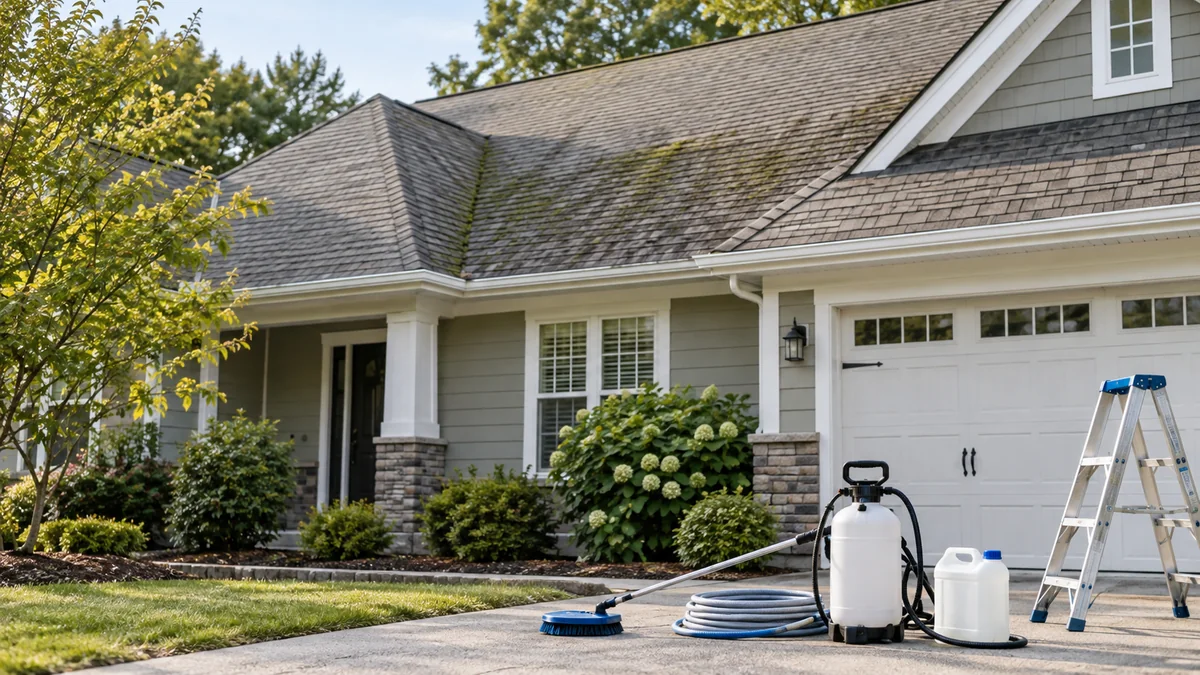
To clean roof shingles with bleach, apply a properly diluted sodium hypochlorite solution at low pressure, allow about 10-20 minutes of dwell time, then rinse from the ridge downward without scrubbing or pressure washing. Protect plants, metal, pets, and storm drains first. Roof pitch, shingle condition, weather, and runoff control determine whether the job is suitable for DIY work.
Key Facts at a Glance
- A final sodium hypochlorite concentration of about 1.5%-3% is a typical range for asphalt-shingle algae cleaning.
- A 6% household bleach product mixed with three parts water produces approximately 1.5% sodium hypochlorite before accounting for product variation.
- Pressure washing can remove protective ceramic granules from asphalt shingles and may shorten roof life.
- Bleach runoff can injure vegetation, corrode some metals, harm aquatic life, and stain exterior finishes.
- Moss and lichen may remain physically attached after treatment even when the organisms are dead.
- A typical DIY cleaning job takes 2-5 hours and costs about $50-$150 before roof-access equipment.
What Does Bleach Remove From Roof Shingles?
Bleach removes or kills many surface organisms associated with dark roof staining, including blue-green algae, mold, mildew, and some moss and lichen. The most common dark streaking on asphalt shingles is associated with Gloeocapsa magma, although visual diagnosis from the ground cannot confirm the organism.
Bleach is less useful for removing embedded rust, tree sap, soot, roof granule loss, cracked shingles, or stains caused by deteriorated materials. Cleaning cannot restore missing granules or repair leaks. A roof with exposed asphalt mat, loose tabs, active leaks, or brittle shingles needs inspection before chemical treatment.
How Sodium Hypochlorite Works
Sodium hypochlorite oxidizes organic pigments and damages living cells on the shingle surface. The chemical action reduces the dark appearance without requiring abrasive brushing, which is why professional soft washing uses low pressure rather than mechanical force.
Cleaning does not permanently prevent algae. Spores can return when shade, moisture, and airborne debris remain. A treated roof may look dramatically better immediately, while thick moss or lichen gradually loosens over several rainfall cycles.
Is Bleach Safe for Asphalt Shingles?
Diluted bleach can be compatible with asphalt shingles when the roof manufacturer permits chemical cleaning and the operator controls concentration, dwell time, runoff, and pressure. Undiluted bleach, excessive dwell time, repeated aggressive treatments, and mechanical scrubbing can damage roofing components or nearby materials.
Roofing manufacturers differ. GAF, Owens Corning, and CertainTeed publish maintenance guidance for their products, so the shingle warranty and installation instructions should take priority over a generic cleaning recipe. Some manufacturers recommend specialized cleaners or professional service rather than household bleach.
Bleach is a poor choice for a roof with failing adhesive strips, exposed fiberglass mat, badly corroded flashing, or unknown historic materials. It is also unsuitable for enclosed spaces where fumes cannot disperse safely.
Material Compatibility
| Roof material | Bleach suitability | Main risk | Safer decision |
|---|---|---|---|
| Asphalt shingles | Often acceptable when diluted | Granule loss, flashing corrosion, runoff | Check manufacturer guidance first |
| Cedar or wood shakes | Highly variable | Fiber damage, discoloration, moisture retention | Use a wood-specific cleaner |
| Concrete tile | Often tolerates diluted solutions | Porous staining, plant damage, fragile edges | Follow tile manufacturer instructions |
| Clay tile | Product-dependent | Surface discoloration and breakage | Use a tile specialist |
| Metal roofing | Usually unnecessary for algae | Coating damage and corrosion at fasteners | Use manufacturer-approved detergent |
A roof-cleaning solution should never be assumed compatible merely because a nearby roof received bleach treatment. Coating type, age, fasteners, sealants, and drainage conditions change the risk.
Before You Start: Safety, Weather, and Materials
Do not walk on a wet, bleach-treated roof unless you are trained, properly equipped, and protected by a correctly installed fall-arrest system. A roof can become substantially more slippery after chemical application, and a ladder is not a substitute for fall protection.
Minimum Preparation Checklist
- Check the roof from the ground for missing shingles, sagging decking, exposed underlayment, and heavy moss.
- Read the shingle warranty and cleaning instructions.
- Choose a cool, overcast, dry period with little wind and no rain forecast during the dwell and rinse period.
- Keep children and pets away from the work area.
- Wear chemical-resistant gloves, eye protection, long sleeves, long pants, and slip-resistant footwear.
- Use a respirator only according to its manufacturer’s instructions and chemical-safety requirements. A basic dust mask does not protect against bleach vapor.
- Keep clean water available for accidental skin or eye exposure.
- Never mix bleach with ammonia, acids, vinegar, toilet-bowl cleaner, or other cleaning products. These combinations can release toxic gases.
- Disconnect or protect rain barrels, ponds, irrigation systems, and sensitive electrical equipment.
- Identify where each downspout discharges before applying any chemical.
The American Ladder Institute and the Occupational Safety and Health Administration both emphasize proper ladder setup and fall protection, but neither makes roof access safe for every homeowner. If the roof is steep, high, fragile, or wet, work from the ground with suitable equipment or hire an insured contractor.
How Much Time and Money Does the Job Need?
| Project condition | Typical active time | Typical DIY cost | Professional range |
|---|---|---|---|
| Small single-story roof, light algae | 1-3 hours | $40-$90 | $250-$500 |
| Average 2,000-square-foot roof | 2-5 hours | $50-$150 | $300-$800 |
| Heavy moss or lichen | 3-6 hours plus weathering | $75-$200 | $500-$1,200 |
| Steep or two-story roof | Not recommended for casual DIY | $150-$400 equipment rental | $600-$1,500 or more |
Prices vary by region, roof pitch, access, water availability, chemical disposal, and repair needs. These are typical planning ranges, not guaranteed quotes.
How Do You Mix Bleach for Roof Shingles?
Use the sodium hypochlorite percentage on the product label to calculate the final concentration. A practical starting range for asphalt-shingle algae is approximately 1.5%-3% sodium hypochlorite at the roof surface, but the label, manufacturer instructions, and site conditions control the final choice.
For a simple dilution, use:
Final concentration = starting concentration × bleach fraction in the mixture
A one-to-three mixture means one part bleach and three parts water, producing four total parts. A 6% product therefore produces approximately 1.5% sodium hypochlorite before considering measurement error or product age.
| Starting bleach strength | Bleach | Water | Approximate final strength |
|---|---|---|---|
| 6% household bleach | 1 gallon | 3 gallons | 1.5% |
| 6% household bleach | 1 gallon | 1 gallon | 3% |
| 10% sodium hypochlorite | 1 gallon | 5 gallons | 1.7% |
| 12.5% sodium hypochlorite | 1 gallon | 5 gallons | 2.1% |
Use a dedicated, clearly labeled chemical sprayer. Add only a bleach-compatible surfactant if the product label or manufacturer recommends it. Dish soap is not automatically safe for roofing, plants, gutters, seals, or wastewater systems, and excessive surfactant can increase runoff rather than improve cleaning.
Never mix different bleach products in the same container. Sodium hypochlorite loses strength with age, heat, sunlight, and contamination, so a stored solution may be weaker than its label indicates.
Step-by-Step: Clean Roof Shingles With Bleach
Step 1: Inspect the Roof and Set the Work Boundary
Inspect the roof, gutters, siding, plants, pavement, windows, air-conditioning equipment, and downspouts before mixing chemicals. Photograph existing damage so later discoloration is not confused with cleaning damage.
Mark a no-entry area below the roof edge. Cover or move outdoor furniture, toys, grills, vehicles, and decorative metal items. If the roof has loose shingles, visible leaks, or extensive moss, stop and arrange an inspection.
Success checkpoint: You know the roof material, drainage path, chemical destination, and emergency rinse route.
Common mistake: Beginning chemical work before noticing a downspout that empties into a vegetable garden.
Step 2: Wet and Protect Vegetation
Thoroughly wet grass, shrubs, garden beds, and trees with clean water before applying bleach. A wet leaf surface reduces immediate absorption, but pre-wetting does not make bleach harmless.
Use breathable covers for especially sensitive plants only during active spraying, then remove them so heat does not build underneath. Keep tarps from trapping concentrated runoff against leaves or soil. Assign a helper to rinse accidental overspray immediately.
Success checkpoint: Every nearby plant is wet, and clean water is ready at the roof perimeter.
Common mistake: Covering dry plants with plastic and leaving the cover in place while the sun heats them.
Step 3: Control Gutters and Downspouts
Disconnect or redirect downspouts where practical, and place collection containers or temporary extensions so concentrated runoff does not enter flowerbeds, ponds, or storm drains. Do not discharge bleach solution into a waterway.
The correct disposal method depends on local rules, roof size, chemical volume, and drainage design. A professional should manage large commercial quantities or sites near sensitive waterways.
Success checkpoint: Runoff has a planned path that avoids people, pets, plants, fish, and storm drains.
Common mistake: Protecting the roof but allowing the first concentrated rinse to flow into a pond.
Step 4: Mix a Measured Solution
Measure bleach and water with dedicated containers. Add water to the sprayer first, then add the bleach carefully to reduce splashing, unless the equipment manufacturer specifies another loading order.
For a common small job, one gallon of 6% bleach plus three gallons of water creates four gallons at approximately 1.5% sodium hypochlorite. Do not guess the ratio by filling a container “about one-quarter full.”
Success checkpoint: The container is labeled with contents, concentration, date, and hazard information.
Common mistake: Using a metal sprayer or unverified pump that corrodes internally and contaminates the solution.
Step 5: Apply From a Safe Position
Apply the solution with a low-pressure pump sprayer or soft-wash system. Work in sections about 6-10 feet wide, and spray evenly from the ridge area toward the eave without creating heavy streams of runoff.
Avoid walking on treated shingles. A long-reach system can reduce fall exposure, although it cannot eliminate overspray or runoff hazards. Low pressure means chemical application rather than forceful impact; the goal is wet coverage, not blasting.
Success checkpoint: The stained surface is uniformly wet, with minimal liquid reaching the gutter edge.
Common mistake: Increasing pressure because the stain does not disappear instantly.
Step 6: Allow Controlled Dwell Time
Allow approximately 10-20 minutes of dwell time, watching the roof continuously. Shorten the interval during warm, sunny, dry, or windy conditions because rapid drying can leave residue and reduce controlled treatment.
Do not let concentrated solution dry on shingles, flashing, siding, windows, or plants. If the roof begins drying, follow the product label rather than repeatedly adding stronger chemical. A second controlled application is safer than an uncontrolled high-strength mixture.
Success checkpoint: Dark organic staining has lightened, and the solution remains wet enough to rinse.
Common mistake: Leaving the roof unattended while the mixture dries into salt deposits.
Step 7: Rinse Thoroughly With Low Pressure
Rinse from the ridge downward using a garden hose or low-pressure system. Keep the spray directed down the roof plane, not beneath shingle tabs, under flashing, into attic vents, or toward open windows.
Rinse gutters, downspouts, siding, windows, and metal surfaces separately if they received overspray. Continue until visible suds, chemical odor, and loose organic debris have been removed.
Success checkpoint: Water runs clear enough to show no persistent foam or visible residue.
Common mistake: Rinsing upward, which can drive water under shingles and into the roof assembly.
Step 8: Flood and Inspect the Surrounding Area
After rinsing the roof, wash plants, soil, walkways, siding, gutters, and equipment with clean water. Inspect metal flashing, painted surfaces, and vegetation for residue or discoloration.
The roof may look uneven immediately because thick moss and lichen can remain attached after death. Do not scrape aggressively while shingles are wet. Recheck the roof after several rain events and arrange repairs if growth has exposed damaged areas.
Success checkpoint: No visible chemical residue remains on adjacent surfaces, and runoff has stopped entering sensitive areas.
Common mistake: Judging the treatment a failure because dead lichen has not detached the same day.
Which Roof-Cleaning Method Should You Choose?
Diluted sodium hypochlorite is usually the fastest option for dark algae streaks on compatible asphalt shingles, but it carries the greatest runoff and corrosion-management burden. Oxygen bleach and manufacturer-approved cleaners reduce some chemical risks, while professional soft washing reduces fall exposure and application errors.
| Method | Typical result time | Main strength | Main limitation |
|---|---|---|---|
| Diluted sodium hypochlorite | 10-30 minutes for algae color | Fast organic stain treatment | Plant, metal, and runoff hazards |
| Oxygen bleach, sodium percarbonate | Several hours to days | Lower chlorine concern | Slower on heavy black streaks |
| Manufacturer-approved roof cleaner | Product-dependent, often 15-60 minutes | Warranty-aligned option | Higher product cost |
| Professional soft washing | Same day, with follow-up | Safer access and runoff control | Typical cost of $300-$1,200 |
| Pressure washing | Immediate visible stripping | Removes loose surface debris | Granule loss and shingle damage risk |
Is Oxygen Bleach a Better Alternative?
Oxygen bleach can be preferable where chlorine runoff is difficult to control, but it is not equivalent to sodium hypochlorite. Sodium percarbonate releases hydrogen peroxide and sodium carbonate in water; performance depends on concentration, temperature, dwell time, and the type of growth.
Oxygen bleach is often a reasonable option for light staining and some wood or composite surfaces when the manufacturer permits it. It may disappoint on dense black algae streaks, mature moss, or lichen because oxidation and detachment occur more slowly.
Why Should You Avoid Pressure Washing?
Pressure washing can remove asphalt-shingle granules, force water beneath shingle edges, damage flashing, and strip protective coatings. The roof can appear clean while its remaining service life has been reduced.
A garden hose rinse is not the same as pressure washing. The safe technique uses enough water to remove chemical residue while avoiding concentrated impact on the shingle surface.
Common Problems and How to Fix Them
| Problem | Likely cause | Corrective action |
|---|---|---|
| Stains remain after 20 minutes | Heavy growth, weak solution, or fast drying | Rinse, reassess, and repeat only within label limits |
| Solution runs to the gutter immediately | Excess volume, steep slope, or little surface wetting control | Use smaller sections and lower application volume |
| Plants show brown spots | Concentrated overspray or inadequate rinsing | Flood plants and soil promptly with clean water |
| White residue remains | Solution dried before rinsing | Rinse adjacent surfaces thoroughly; avoid scraping shingles |
| Metal gutters discolor | Chemical contact or aged coating | Rinse immediately and inspect for corrosion |
| Moss remains attached | Dead growth has not weathered away | Do not scrape aggressively; inspect after rainfall |
A second application is not automatically the right response to persistent staining. First verify whether the mark is algae, rust, soot, granule shadowing, or a material defect. Chemical strength cannot solve a misdiagnosed stain.
When Should You Hire a Professional?
Hire a licensed and insured roof-cleaning contractor when the roof is steeper than approximately 6:12, higher than one story, fragile, wet, heavily moss-covered, or difficult to protect from runoff. Professional service is also preferable when the home has a pond, sensitive landscaping, solar equipment, complex drainage, or residents with respiratory sensitivity.
Ask for proof of insurance, chemical handling procedures, plant-protection methods, equipment pressure, and the contractor’s plan for runoff. A credible quote should identify the roof material and explain whether repairs are excluded.
Do not hire a contractor who promises to pressure wash asphalt shingles, refuses to explain chemical concentration, or treats every roof with the same undiluted product. The lowest price can become expensive if granules, plants, siding, or gutters are damaged.
How Can You Prevent Black Streaks From Returning?
Reduce shade and moisture rather than relying on repeated bleach applications. Trim branches that keep the roof damp, clean gutters so water does not back up, and remove leaf debris from valleys and roof-to-wall intersections.
Zinc or copper strips near the ridge can release metal ions during rainfall that inhibit some algae and moss growth. Strips do not repair an existing infestation, and their effectiveness depends on roof geometry, rainfall, exposure, and complete water contact across the affected area.
A typical maintenance interval is inspection twice per year, especially after leaf fall and severe weather. Recleaning frequency varies widely. A shaded, humid roof may show recurrence within one to three years, while a sunny roof may remain cleaner for longer.
FAQ
Can I Clean Roof Shingles With Bleach Before Rain?
Avoid starting when rain is likely during the application, dwell, and rinse period. Rain can dilute the solution, redirect contaminated runoff, and prevent controlled plant protection. After the roof has been fully rinsed, additional clean rainfall is generally less concerning, but local drainage and environmental rules still apply.
How Often Can Asphalt Shingles Be Treated With Bleach?
There is no universal safe interval because roof age, concentration, climate, and manufacturer instructions differ. Repeated annual bleach treatments are not a sound default. Investigate shade, debris, drainage, and recurrence causes first, then use the mildest manufacturer-compatible treatment that solves the problem.
Will Bleach Remove Moss From a Roof?
Bleach can kill or weaken moss, but it may not remove the physical mat immediately. Dead moss can remain attached for weeks and may conceal damaged shingles underneath. Avoid scraping or pressure washing; inspect the roof after weathering and repair lifted or broken shingles.
Can I Use Pool Chlorine Instead of Household Bleach?
Pool chlorine is usually a stronger sodium hypochlorite solution, commonly around 10%-12.5%, so it requires more dilution and careful measurement. Never substitute it at the same volume as 5%-6% household bleach. Read the current label because concentration and additives vary by product.
Does Bleach Damage Gutters?
Bleach can discolor or corrode some gutter metals, fasteners, sealants, and painted coatings, especially when concentrated solution sits without rinsing. Redirect runoff where possible, rinse gutters and downspouts thoroughly, and test an inconspicuous area when the material and coating are unknown.
Is Roof Cleaning Covered by a Shingle Warranty?
Routine cleaning may be addressed in the manufacturer’s maintenance instructions, but warranties usually do not cover damage caused by improper chemicals, pressure washing, foot traffic, poor installation, or neglected repairs. Keep product labels, photographs, contractor records, and the cleaning date for future warranty questions.
The Bottom Line
The safest way to clean roof shingles with bleach is to use a measured, manufacturer-compatible sodium hypochlorite dilution, apply it at low pressure, keep the surface wet for about 10-20 minutes, and rinse thoroughly while controlling every drop of runoff. Do not pressure wash, mix bleach with other chemicals, or walk a steep or fragile roof. When access or drainage is hazardous, professional soft washing is the better decision.