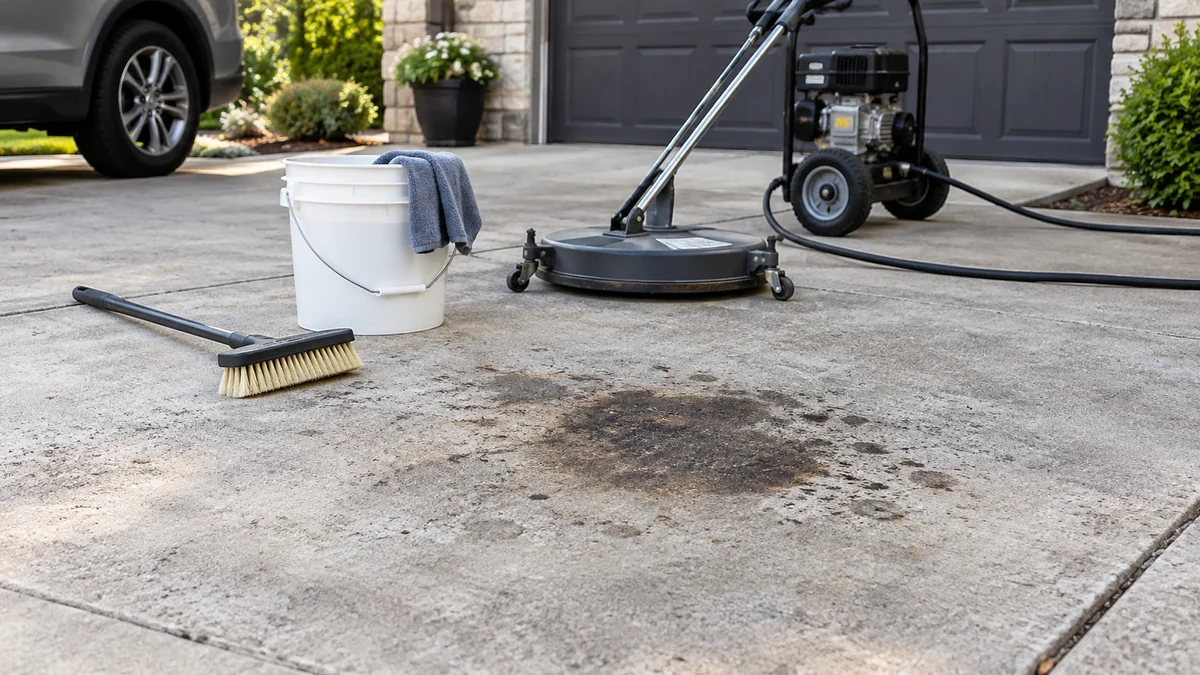
Title tag: how to remove dried oil stains from concrete driveway safely
Meta description: Break down old petroleum stains with a nylon brush, degreaser, or poultice, then rinse without harming concrete or polluting drains.
How to Remove Dried Oil Stains From Concrete Driveway
To remove dried oil stains from a concrete driveway, scrape away residue, apply a concrete-safe alkaline degreaser, scrub with a nylon brush, and rinse without sending contaminated water into a storm drain. For dark, old stains that remain after two treatments, use a labeled commercial poultice or oil-stain remover, then allow the concrete to dry before judging the result.
Key Facts at a Glance
- Dried oil is usually embedded below the concrete surface, so pressure washing alone rarely removes the full stain.
- A concrete-safe alkaline degreaser is the best first-line treatment for most unsealed gray driveways.
- A poultice can draw dissolved oil out of pores, but solvent-based products require ventilation, ignition control, protective equipment, and label compliance.
- Dish soap and baking soda may reduce a fresh surface film, but they usually cannot remove a deeply absorbed, years-old petroleum stain in one attempt.
- Never use muriatic acid to dissolve oil. Acid can etch cement paste while leaving petroleum residue behind.
- A faint shadow may remain because the cleaned patch is lighter than surrounding weathered concrete, not because oil is still present.
What Makes Dried Oil Difficult to Remove?
Dried oil stains become difficult when petroleum liquid moves into concrete pores and the lighter components evaporate. The remaining heavier hydrocarbons cling to cement paste and aggregate, so a surface rinse removes loose dirt while leaving the dark material below the surface.
Concrete is porous rather than waterproof. Its capillaries pull liquid inward, particularly when the slab is unsealed, rough, weathered, or warm. Engine oil, gear oil, hydraulic fluid, and grease also differ in viscosity, so a thick grease deposit may remain near the surface while thin motor oil travels farther.
Time alone does not establish a precise penetration depth. Claims that ordinary driveway oil always reaches a particular depth after six months are not reliable because porosity, spill volume, temperature, surface sealing, and concrete age vary substantially. A better field test is simple: place a dry white cloth over the area and press firmly. A greasy transfer indicates removable surface residue; no transfer with a persistent dark mark suggests absorbed discoloration.
Which fluids leave the hardest stains?
Engine oil and hydraulic oil commonly produce broad brown-black marks. Grease creates a raised, sticky deposit that should be scraped first. Brake fluid can damage some coatings and painted surfaces, while transmission fluid may leave a red or amber tint that remains visible after most oil is removed.
Identify the fluid before choosing a treatment. If the stain came from an unknown chemical, avoid mixing cleaners and consult the product safety information before proceeding.
What Is the Best First Method?
A concrete-safe alkaline degreaser is the best starting method for most dried oil stains because it combines surfactants with alkalinity, loosens petroleum residue, and avoids the fire risk of volatile solvents. Use a poultice only after degreasing fails or when a dark stain has clearly penetrated the slab.
The removal process has three jobs:
- Emulsification: the cleaner breaks oil into smaller droplets.
- Desorption: the loosened oil moves out of the concrete pores.
- Suspension: detergent and rinse water carry the droplets away instead of redepositing them.
A stiff nylon or polypropylene brush supplies mechanical action without scoring the surface. A pressure washer can improve rinsing, but only after the cleaner has loosened the oil.
Method comparison
| Method | Typical cost | Working time | Best use | Main limitation |
|---|---|---|---|---|
| Alkaline concrete degreaser | $10-$30 | 30-90 minutes per treatment | Most unsealed gray concrete | May lighten weathered or colored surfaces |
| Dish soap and baking soda | $5-$15 | 20-60 minutes | Fresh or shallow residue | Weak against old absorbed petroleum |
| Commercial poultice | $25-$70 | 12-48 hours | Persistent embedded stains | Requires careful handling and repeat applications |
| Microbial cleaner | $20-$60 | Several days to weeks | Low-toxicity maintenance cleaning | Slow and temperature-dependent |
| Professional cleaning | $150-$500 typical | 1-4 hours onsite | Large, severe, or runoff-sensitive areas | Cost rises with square footage and restoration needs |
Prices are typical consumer ranges in the United States, not fixed quotes. Local labor, driveway size, product concentration, and waste-handling requirements can change the total.
Before You Start
Prepare the driveway and protect yourself before applying any chemical. Choose a dry day with moderate temperatures, confirm that runoff will not enter a storm drain, and test every cleaner on a hidden section.
Materials and equipment
- 1 bottle of concrete-safe alkaline degreaser
- 1 stiff nylon deck brush, preferably 8-18 inches wide
- Plastic scraper or putty knife
- Absorbent material such as clay granules or oil-absorbent pads
- Garden hose with adjustable nozzle
- Bucket, measuring cup, and disposable rags
- Chemical-resistant gloves, eye protection, and work clothing
- Plastic sheeting only when the product label specifically permits covering
- Wet vacuum or absorbent socks if runoff must be contained
Avoid mixing degreaser with bleach, acids, ammonia, solvents, or other cleaners. Keep gasoline, cigarettes, pilot lights, electrical sparks, and vehicles with hot exhaust systems away from solvent products.
Surface checks
Determine whether the driveway is bare concrete, sealed concrete, painted concrete, stamped concrete, or decorative concrete. A water-drop test helps: if water beads for several minutes, a sealer may be present. Sealed surfaces usually need a cleaner approved for that coating, while aggressive solvents can soften or cloud some sealers.
Step 1: Remove Surface Oil and Debris
Sweep the driveway, then scrape hardened sludge with a plastic tool. Do not begin with water, because water can spread loose oil across clean concrete and enlarge the treatment area.
Apply absorbent granules or pads to any greasy residue and leave them for the label’s stated time, commonly 15-30 minutes. Press absorbent material into the residue rather than grinding it into the slab. Collect it with a dustpan and place it in a sealed container for disposal according to local rules.
You will know the step worked when: the surface feels dry rather than slippery, and the scraper removes no thick black or gummy material.
Common mistake: using a metal scraper or wire brush. Metal can scratch the cement paste and expose aggregate, creating a damaged patch that resembles a cleaning failure.
Step 2: Test the Cleaner
Dilute the concrete degreaser exactly as the manufacturer specifies. Products vary widely, and a stronger mixture is not automatically more effective. Apply a small amount to an inconspicuous area, scrub for the label’s dwell time, and rinse completely.
Wait until the test area dries. Colored, stamped, painted, and sealed concrete can change tone when a cleaner removes accumulated dirt or reacts with a coating. If the test produces whitening, tackiness, gloss loss, or color transfer, stop and select a milder compatible product.
You will know the step worked when: the test area is clean without a ring, softened coating, roughened texture, or altered color.
Common mistake: judging a wet test patch immediately. Wet concrete often appears darker, so wait several hours before comparing color.
Step 3: Apply the Alkaline Degreaser
Wet the stained area lightly if the product label calls for pre-wetting, then apply enough diluted degreaser to keep the surface visibly wet during the dwell period. A typical driveway treatment uses roughly 1-2 quarts of working solution per 10-20 square feet, but the label rate takes priority.
Extend the application 2-4 inches beyond the visible boundary. Old oil often has a thin, nearly invisible edge. Work in small sections so the cleaner does not dry before brushing.
You will know the step worked when: the surface develops a uniform wet film, and loose oil begins to appear as a brown or gray suspension.
Common mistake: applying cleaner to a hot slab in direct sun. Rapid drying stops the chemical reaction and can leave a bright outline around the treated area.
Step 4: Scrub and Allow Dwell Time
Scrub with a stiff nylon brush using overlapping strokes. Concentrate on the stain’s center first, then work outward so oil is not pushed into clean concrete. Follow the product label, with 10-30 minutes being a common dwell range for consumer degreasers.
Do not allow the cleaner to dry. Add small amounts of solution if needed, but do not flood the driveway. Agitation releases oil from the pore openings, while dwell time gives surfactants and alkaline ingredients time to act.
You will know the step worked when: the foam or slurry turns gray-brown and the surface no longer has a slick appearance.
Common mistake: substituting a wire brush for more cleaning power. Nylon pressure and a second application are safer than cutting grooves into the concrete.
Step 5: Rinse and Contain the Runoff
Rinse from the cleanest edge toward the dirty collection area. Use a moderate fan spray rather than a concentrated jet, and keep the nozzle moving. A pressure washer may help, but start with the widest fan tip, low pressure, and a distance of at least 12 inches, then adjust only if the concrete remains intact.
Pressure settings are not universally safe. Older, soft, cracked, or surface-scaled concrete can be damaged at pressures that are harmless on sound concrete. Never direct oily runoff toward a curb, street, storm drain, lawn, garden, or neighboring property.
Use absorbent socks, a wet vacuum, or temporary barriers to collect dirty water where local rules require containment. Let the area dry for 24 hours before deciding whether the treatment succeeded.
You will know the step worked when: no oily sheen remains in the rinse water and the dry concrete feels clean rather than greasy.
Common mistake: pressure washing cold water onto an untreated stain. High pressure can spread surface oil and remove weak cement paste without extracting the embedded residue.
Step 6: Repeat or Use a Poultice
Repeat the degreaser treatment once after the concrete dries if the stain has visibly lightened. Two controlled treatments are usually more informative than one excessively strong application. If the stain remains dark with no oily transfer, a commercial poultice or oil-stain remover may be appropriate.
A poultice combines an absorbent solid with a product that dissolves or loosens oil. The absorbent must dry while touching the stain, allowing contaminated liquid to migrate into the powder. Commercial products are preferable to improvised solvent mixtures because their labels specify compatibility, ventilation, application thickness, and disposal.
If the label permits a homemade water-based poultice, use an absorbent such as diatomaceous earth or finely crushed unscented clay granules with the approved cleaner. Do not improvise acetone, xylene, gasoline, paint thinner, or other volatile-solvent recipes on a residential driveway unless the product manufacturer specifically directs that use.
You will know the step worked when: the dry absorbent becomes darker or oily and the concrete lightens after removal.
Common mistake: covering solvent paste with plastic automatically. Plastic can trap flammable vapor and increase exposure. Cover only when the product label explicitly requires it, and never cover a solvent product near ignition sources.
Which Removal Method Fits Your Situation?
The right method depends on stain depth, concrete condition, environmental restrictions, and the acceptable risk of cosmetic change.
| Situation | Recommended method | Typical duration | Avoid |
|---|---|---|---|
| Fresh spill under 24 hours | Absorbent granules, then degreaser | 15-45 minutes | Hosing oil into the street |
| Dried stain on bare gray concrete | Alkaline degreaser, repeat once | 1-2 hours per visit | Acid and wire brushes |
| Years-old dark stain | Commercial poultice after degreasing | 12-48 hours | Unlabeled solvent mixtures |
| Colored or stamped concrete | Compatibility test and mild cleaner | 1-3 hours | Strong alkaline or solvent products without testing |
| Large fleet or repeated leaks | Professional containment cleaning | 1-4 hours onsite | Uncontrolled driveway runoff |
| Cold weather below product limits | Delay or use approved cleaner | Days to weeks | Microbial products in freezing conditions |
Are baking soda and dish soap enough?
Baking soda and dish soap can reduce a shallow oil film, but they are not dependable for a deeply absorbed dried stain. Make a thick paste with the detergent and powder, scrub for 5-10 minutes, allow 15-30 minutes of contact, and rinse while containing the runoff.
This low-cost method makes sense when the stain is recent, the concrete is decorative, or chemical risk must remain low. Expect two or three applications rather than a single-pass result. Baking soda supplies mild abrasion and absorbency; it does not chemically dissolve aged petroleum as effectively as a purpose-made degreaser.
Are microbial cleaners a good alternative?
Microbial or enzymatic cleaners are useful when low odor and reduced chemical aggressiveness matter more than speed. Their microorganisms consume or transform hydrocarbons over repeated applications, but performance depends on warmth, moisture, oxygen, and the product’s approved temperature range.
Use the cleaner according to its label and prevent disinfectants, bleach, and strong degreasers from killing the biological activity. A realistic timeframe is several days to multiple weeks. Microbial products are poor choices when a driveway must look clean tomorrow or when freezing temperatures prevent biological activity.
Why should you avoid muriatic acid and oven cleaner?
Muriatic acid does not dissolve petroleum oil. The acid reacts with alkaline cement compounds, etches the surface, and can leave the oil trapped in pores. Oven cleaner is also a poor default because strong caustic ingredients can discolor concrete, damage coatings, burn skin, and create hazardous runoff.
Acid may have a legitimate role in carefully controlled mineral-stain removal, but oil removal is not that role. Use a degreaser designed for concrete instead.
What If the Concrete Is Colored, Stamped, or Sealed?
Colored and stamped concrete require a compatibility test before full treatment because cleaners can remove surface grime unevenly, soften coatings, or change the apparent color. Sealed concrete may hold oil above the surface, which can make a mild cleaner more effective than a solvent or aggressive alkaline product.
Painted and acrylic-coated driveways require special caution. If oil has penetrated or softened the coating, cleaning may reveal a coating failure rather than restore the original appearance. A contractor may need to strip and recoat the area, especially when the finish is decorative or costly.
Cracked, scaling, or powdery concrete should not receive aggressive pressure washing. The cleaning process can detach weak surface material. Repairing or resurfacing the slab may provide a better result than repeatedly removing cement paste around the stain.
Common Failure Modes and Fixes
| Failure | Likely cause | Recovery |
|---|---|---|
| Stain becomes larger | Oil spread during rinsing | Reapply absorbent, then treat the full boundary |
| Cleaner leaves a white ring | Surrounding dirt was removed | Clean the entire slab uniformly with a compatible mild cleaner |
| Surface becomes rough | Pressure or acid damage | Stop cleaning and assess for scaling or etching |
| Dark mark remains without grease | Absorbed discoloration or uneven weathering | Allow 24-48 hours to dry, then consider one poultice treatment |
| Cleaner dries quickly | Hot sun, wind, or insufficient solution | Work in shade and smaller sections |
| No improvement after two treatments | Deep contamination, coating failure, or wrong fluid | Escalate to a restoration professional |
A faint shadow does not always mean residual oil. Concrete that has been protected by an oil film may remain darker than adjacent concrete, while the cleaned area may appear unusually bright. Compare the patch only after complete drying and after the entire driveway has been viewed in the same light.
How Much Does Professional Removal Cost?
Professional driveway oil-stain cleaning commonly costs about $150-$500 for a residential visit, although large driveways, severe contamination, restricted runoff, and coating repair can increase the estimate. A contractor may charge separately for pressure washing, chemical treatment, absorbent disposal, or sealing.
| Project type | Typical price | Typical time | Cost driver |
|---|---|---|---|
| Small isolated stain | $100-$200 | 30-90 minutes | Minimum service charge |
| Two-car driveway treatment | $150-$350 | 1-3 hours | Square footage and number of treatments |
| Severe or repeated vehicle leaks | $300-$700 | 2-5 hours | Poultice, containment, and disposal |
| Decorative concrete restoration | $400-$1,500+ | 1-3 days | Coating repair or resealing |
Ask whether the quote includes runoff containment and whether the provider will test a small area first. A low price that excludes wastewater handling may transfer the environmental and legal risk to the homeowner.
How Can You Prevent the Next Oil Stain?
Prevent new driveway stains by repairing leaking vehicles, placing a drip pan under parked equipment, and absorbing spills immediately. Fresh oil is substantially easier to remove because it has not yet migrated and oxidized inside the concrete.
After the surface is clean and completely dry, apply a penetrating silane-siloxane sealer compatible with the concrete. A penetrating sealer reduces water and oil absorption, but it is not an oil-proof membrane; large spills still require prompt cleanup.
Do not seal over a dark stain. Sealing can trap discoloration, interfere with later treatment, and make the surface appear uneven. Follow the sealer’s coverage rate, curing time, and recoat instructions rather than assuming that two coats always improve performance.
FAQ
Can I remove a dried oil stain without a pressure washer?
Yes. Apply a concrete-safe degreaser, scrub with a stiff nylon brush, and rinse with a hose while containing runoff. A pressure washer improves rinsing but is not the chemical treatment itself. Two controlled hand-cleaning applications can outperform one high-pressure rinse that spreads the oil.
How long should a degreaser sit on concrete?
Most consumer concrete degreasers require approximately 10-30 minutes, but the product label controls the dwell time. Keep the surface wet during that period. If the cleaner dries, scrub lightly, re-wet with the approved solution, and avoid extending the dwell time beyond the label.
Will bleach remove motor oil from concrete?
Bleach is not a dependable motor-oil solvent and can damage nearby plants, colored surfaces, and fabrics. Bleach should not be mixed with degreasers, acids, ammonia, or solvents. Use an oil-specific concrete cleaner instead, then manage the runoff responsibly.
Can kitty litter remove an old driveway stain?
Clay cat litter absorbs fresh surface oil but usually cannot remove petroleum that has entered concrete pores. Use it before cleaning to collect liquid residue. For an old stain, a labeled commercial poultice uses a finer absorbent and a compatible oil-loosening agent.
Should I paint or coat over the stain?
Do not coat over an active oil stain. Petroleum can interfere with adhesion and cause blistering or soft spots. Clean, dry, and test the slab first; if discoloration remains but the surface is sound, a compatible coating system may hide the mark after proper preparation.
When should I hire a professional?
Hire a professional when the stain covers a large area, runoff cannot be contained, the driveway is decorative or coated, the concrete is deteriorating, or two careful treatments produce no improvement. Professional restoration is also appropriate when the fluid may be hazardous or its identity is unknown.
The Bottom Line
The safest answer to how to remove dried oil stains from concrete driveway surfaces is to start with absorbent cleanup and a concrete-safe alkaline degreaser, then scrub, rinse with controlled runoff, and let the slab dry before evaluating it. Use a commercial poultice for persistent embedded residue, avoid acids and improvised solvents, and test every product on decorative or sealed concrete first.