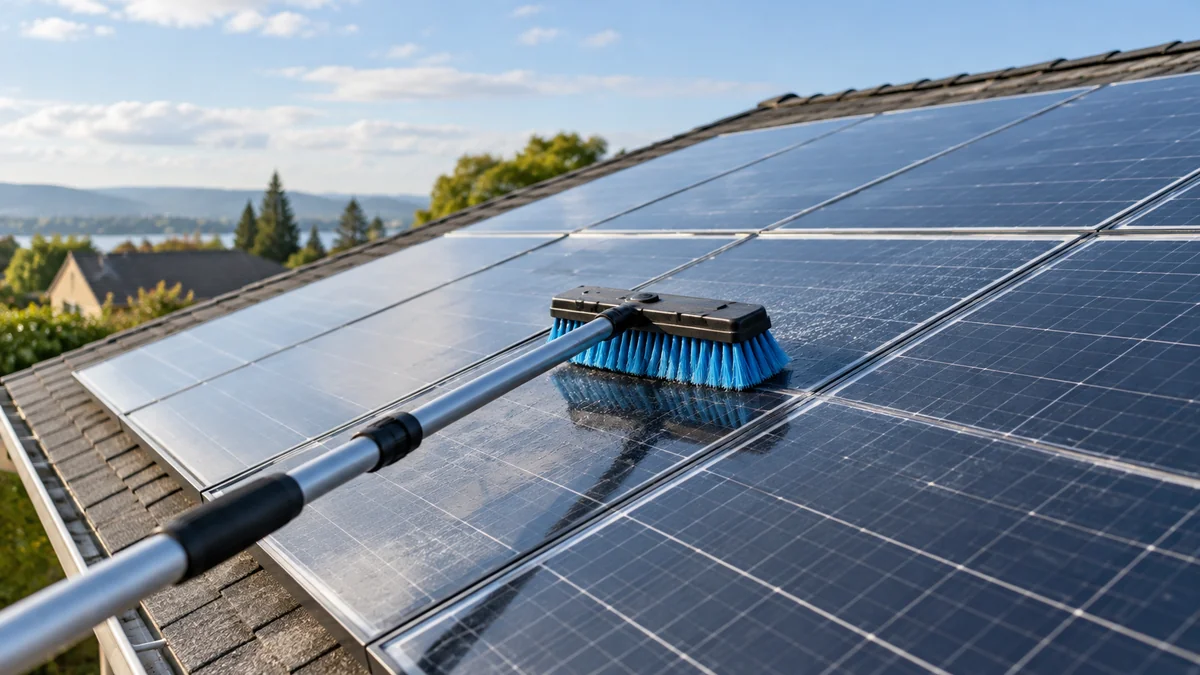
To clean solar panels on the roof without scratching them, work on cool panels, remove loose grit first, use a soft nonabrasive brush with clean water, and rinse with low pressure. Avoid roof access when the surface is steep, wet, fragile, or electrically unsafe. Most residential arrays take 30-90 minutes once the equipment is ready.
Key Facts at a Glance
Tempered photovoltaic glass resists ordinary contact, but abrasive grit, steel tools, and stiff bristles can create permanent micro-scratches.
A solar-panel system can still have hazardous DC voltage when the inverter or AC disconnect is switched off.
A garden hose is usually adequate for rinsing, but hard water can leave calcium deposits that require a deionized-water rinse.
Use a clean microfiber or purpose-made solar brush with nylon or soft flagged bristles, never a metal scraper or abrasive pad.
Typical residential cleaning costs range from $150-$350 professionally or about $30-$200 for basic homeowner equipment.
Clean when soiling measurably reduces production, not automatically after every rain.
What Makes Solar Panels Lose Output?
Solar panels lose output when dust, pollen, bird droppings, ash, salt, sap, or other film blocks light from reaching the photovoltaic cells. The effect is localized when one dropping shades part of a module, but widespread dust can reduce the array’s energy yield across many panels.
The actual loss varies by climate, rainfall, tilt, debris type, and time since cleaning. A frequently quoted 5%-30% range is possible in heavily soiled conditions, but it should not be treated as a universal loss for every home. A light film in a rainy suburb may have little financial effect, while agricultural dust or bird fouling can justify cleaning within weeks.
Solar-panel cleaning restores light transmission. It cannot repair degraded cells, inverter faults, cracked glass, failed bypass diodes, or shading from trees.
When Should You Clean Roof Panels?
Clean solar panels when visible soiling coincides with a measurable production decline, persistent bird fouling, or a seasonal contamination event. A practical starting interval is once or twice yearly, with quarterly cleaning more appropriate near construction, farms, unpaved roads, wildfire smoke, coastal salt, or dense bird activity.
Compare output under similar weather conditions before deciding. A cloudless day after cleaning is not a reliable test against a cloudy day before cleaning. Monitoring platforms from Enphase, SolarEdge, and other inverter manufacturers can help identify a sustained decline, but temperature and irradiance also affect readings.
Panels above roughly 10 degrees often shed loose dust during rain. Low-slope arrays retain dirty runoff at their lower frame, so they may need attention more often. Cleaning frequency should follow site conditions rather than a fixed calendar.
Is It Safe to Clean Solar Panels on a Roof?
Roof cleaning is safe only when the worker can maintain stable footing without stepping on modules, wet roofing, electrical components, or unsupported skylights. Switching off the inverter and AC/DC isolators reduces operating risk, but it does not guarantee that rooftop conductors are de-energized because sunlight can continue producing DC voltage.
Do not climb onto a steep, wet, fragile, or unfamiliar roof. Use a professional solar cleaner or qualified electrician when access requires a ladder beyond safe reach, roof anchors, fall protection, or work near overhead electrical lines.
Before beginning, check the system manual and these conditions:
- Do not stand or kneel on a solar module.
- Do not touch wiring, connectors, junction boxes, or the underside of panels.
- Keep water away from exposed electrical equipment and damaged enclosures.
- Follow the manufacturer’s shutdown sequence rather than guessing which switch to use.
- Stop if glass is cracked, a frame is loose, a cable is exposed, or water enters a junction box.
- Use a second person to stabilize a ladder and watch the work area.
- Wear footwear suitable for the roof surface, not smooth-soled household shoes.
The U.S. Occupational Safety and Health Administration treats residential roof work as a fall hazard; local requirements vary, but fall protection becomes especially important as roof height and pitch increase.
What Tools Prevent Solar-Panel Scratches?
The safest basic kit contains a telescoping pole, a purpose-made solar brush or clean microfiber head, a hose with a gentle spray pattern, a bucket, a clean rubber squeegee, and optional deionized-water equipment. Every tool touching the glass must be free from trapped grit and previously used on masonry, gutters, or vehicle wheels.
| Tool or material | Typical specification | Typical cost | Main limitation |
|---|---|---|---|
| Solar brush | Soft nylon, microfiber, or flagged bristle head | $20-$80 | Must be washed before use |
| Telescoping pole | 3-9 m, lightweight fiberglass or carbon fiber | $50-$250 | Long poles flex and reduce control |
| Garden hose | Low-pressure spray nozzle, 10-25 m hose | $25-$80 | Hard water can spot glass |
| Microfiber cloth | Clean, lint-free, dedicated to panels | $8-$25 | Unsafe for large roof areas without access |
| Rubber squeegee | Soft blade, 25-45 cm | $15-$40 | Can drag grit if the surface is not rinsed |
| DI filter | Inline resin cartridge, output below about 10 ppm TDS | $60-$250 | Resin replacement adds recurring cost |
A water-fed pole is useful because the brush and water reach the array from a safer position. It is not automatically safe on a steep roof: a long wet pole can pull the operator off balance, and hose drag can create a trip hazard.
Which Cleaning Solution Should You Use?
Use clean water alone for ordinary dust, pollen, and loose environmental film. If a detergent is necessary, choose a small amount of manufacturer-approved, pH-neutral solar-panel cleaner and follow its dilution instructions. Many residential jobs do not need soap.
Avoid bleach, ammonia, abrasive powder, laundry detergent, solvent-heavy glass cleaner, and concentrated dishwashing liquid. Residue can attract dust, interfere with coatings, or leave streaks. Manufacturer warranties differ, so the panel documentation takes priority over generic cleaning advice.
Use isopropyl alcohol only for a small, stubborn organic spot such as fresh tree sap, and test the panel manufacturer’s instructions first. A 70%-99% solution on a microfiber cloth can soften sap, but broad application is unnecessary and some sealants or frame finishes may react to solvents.
How to Clean Solar Panels on the Roof Without Scratching Them
The following six-step process is designed for a reachable, walkable roof with no visible electrical or structural damage. Allow 30-90 minutes for a typical residential array, plus setup and ladder time. The factor that most determines success is not scrubbing force, but removing abrasive grit before the brush touches the glass.
Before You Start
| Item | Practical target |
|---|---|
| Weather | Cool, dry, low wind; avoid active rain and strong sun |
| Work time | 30-90 minutes for a typical home array |
| Difficulty | Moderate on a low, walkable roof; high on a steep roof |
| Water | 20-60 liters for a typical rinse, depending on method |
| Brush | One dedicated soft solar brush or microfiber head |
| Rinse | Hose at low pressure, or DI water below about 10 ppm TDS |
| Access | Stable ladder, clear roof route, and safe fall protection |
| Electrical status | Follow the system manual and avoid all exposed conductors |
Step 1: Inspect the Roof and Array
Inspect the roof, panels, racking, cables, junction boxes, and nearby trees before setting up equipment. Photograph cracks, chips, loose clamps, nests, heavy lichen, and water stains so pre-existing damage is not mistaken for cleaning damage.
Do not clean a damaged module yourself. Cracked glass can allow moisture into the laminate, while loose racking can shift under light contact or hose movement.
You will know the step worked when: the array has a clear access plan and no unexplained damage is being treated as dirt.
Common mistake: beginning with a ladder placed against a gutter or panel frame instead of a structurally suitable access point.
Step 2: Follow the Manufacturer’s Shutdown Procedure
Use the inverter and disconnect sequence specified by the installer or equipment manual. Shut down the AC side and DC side only when the equipment is designed for homeowner operation, and never open electrical enclosures or disconnect plug connectors.
A shutdown reduces inverter operation and AC hazards, but sunlight can keep module strings energized. Treat every cable and connector as live, and keep water away from electrical interfaces.
You will know the step worked when: the inverter status matches the manufacturer’s shutdown instructions and all electrical components remain untouched.
Common mistake: assuming a dark inverter screen proves that rooftop DC voltage is absent.
Step 3: Remove Loose Debris Without Scrubbing
Remove leaves and loose dust with a blower used from the ground or with a soft brush held above the surface. Do not drag dry grit across the glass. If bird droppings are dry, soak them with water for at least 5-10 minutes before any wiping.
Use a low-pressure hose to rinse from the upper edge toward the lower edge. A fan spray is preferable to a concentrated jet. The rinse should carry grit away rather than drive it under a brush head.
You will know the step worked when: loose sand, leaves, and softened droppings are no longer visible before agitation begins.
Common mistake: using a dry squeegee to push dusty runoff across the panel.
Step 4: Wash With a Soft Brush and Clean Water
Wet the brush completely, then work from the top of each panel toward the bottom with light, overlapping passes. Use a separate bucket of clean water or a water-fed pole, and rinse the brush frequently so it cannot accumulate abrasive particles.
For normal dust, water and gentle agitation are sufficient. For greasy film, apply a diluted pH-neutral product approved for photovoltaic glass, then rinse promptly. Never increase pressure to compensate for a dirty brush.
You will know the step worked when: the glass has an even wet film with no visible grit, streaked droppings, or dry patches.
Common mistake: using a household window mop that previously touched a dirty floor, vehicle wheels, or masonry.
Step 5: Rinse With Low-Pressure Water
Rinse until no foam, loosened dirt, or detergent remains. Keep the nozzle several inches away from seals and frames, and do not use a pressure washer. Ordinary garden-hose pressure is generally adequate when the spray is broad and controlled.
Hard water contains calcium and magnesium that can dry into white spots. If the local water supply is hard, finish with deionized or reverse-osmosis water, or use a clean soft squeegee while the panels remain wet.
You will know the step worked when: runoff is clear and the wet glass has no visible detergent film.
Common mistake: allowing hard tap water to evaporate on a warm panel.
Step 6: Inspect the Drying Result and Restart Correctly
Inspect the panels from the ground and from the safe access point after rinsing. Look for white mineral spots, missed bird droppings, streaks, trapped debris at the lower frame, cracked glass, loose clips, or displaced cable management.
If the panel manufacturer permits squeegeeing, use a clean, soft rubber blade with overlapping strokes. Do not scrape dried residue with a razor. Follow the system’s documented restart sequence after the array and work area are dry.
You will know the step worked when: the glass is uniformly clean, no water is entering equipment, and the inverter resumes normal status.
Common mistake: restarting immediately while tools, hoses, or people remain near exposed electrical equipment.
Which Solar-Panel Cleaning Method Is Best?
A water-fed pole is the best option for a low, walkable residential roof when the homeowner can work without fall exposure. Professional cleaning is the safer choice for steep, high, fragile, or obstructed roofs. Robots make financial sense mainly on large commercial arrays or accessible ground-mounted systems.
| Method | Typical cost | Typical time | Best operating condition | Main risk |
|---|---|---|---|---|
| Water-fed pole | $150-$500 equipment | 1-2 hours | One- or two-story reachable roof | Fall and hose-trip hazard |
| Hose and soft brush | $30-$150 equipment | 1-2 hours | Low roof with soft water | Spots and poor reach |
| Professional service | $150-$350 per visit | 45-90 minutes | Steep, high, or complex roof | Service quality varies |
| Robotic cleaner | $3,000-$10,000 or more | 15-30 minutes per array | Large, uniform commercial array | Purchase cost and slope limits |
| Ground cleaning | $20-$120 equipment | 30-90 minutes | Ground-mounted or carport array | Incomplete reach |
Professional providers may use reverse-osmosis and deionization systems that produce low-TDS water, often near 0-10 ppm at the brush. Ask whether the company is insured, how it manages fall protection, whether it avoids high-pressure washing, and whether it documents pre-existing damage.
A “soft wash” label is not enough. Some contractors use chemical roof-washing methods that are suitable for shingles but inappropriate for photovoltaic glass, frames, seals, or roof runoff.
How Much Does Solar-Panel Cleaning Cost?
Typical professional cleaning costs $150-$350 per residential visit, with higher prices for steep roofs, difficult access, heavy contamination, travel, or multi-array systems. DIY costs about $30-$200 for a basic brush and hose setup, or $150-$500 for a complete water-fed pole system.
| Situation | Typical frequency | Typical cost approach | Economic note |
|---|---|---|---|
| Rainy suburban roof | 0-1 times yearly | DIY or occasional service | Cleaning may produce little extra output |
| Dusty rural property | 2-4 times yearly | DI filter plus pole | Frequent soiling can justify equipment |
| Coastal property | 1-3 times yearly | Soft brush and low-TDS rinse | Salt film needs thorough rinsing |
| Bird-heavy roof | Spot clean as needed | Professional for difficult access | Localized fouling can matter quickly |
| Commercial array | Monthly to quarterly | Robotic or contract service | Labor scale changes the calculation |
Estimate payback from measured production, not a generic percentage. If cleaning costs $250 and the expected annual value of recovered electricity is $100, the financial return is negative even if the panels look visibly cleaner. Safety, warranty protection, and preventing persistent deposits can still justify service.
What Should You Never Use on Solar Panels?
Never use a pressure washer, metal scraper, steel wool, scouring pad, stiff yard broom, abrasive powder, bleach, or unapproved strong solvent on photovoltaic modules. These tools can scratch the glass, damage anti-reflective surfaces, disturb frame seals, or leave residues that attract more dirt.
| Mistake | Likely consequence | Safer correction |
|---|---|---|
| Pressure washer at 1,000 psi or more | Seal damage, water intrusion, glass breakage | Use a low-pressure hose spray |
| Dry scraping bird droppings | Gouges or micro-scratches | Soak 5-10 minutes, then soften gently |
| Steel wool or abrasive pad | Permanent optical scratches | Use a clean soft solar brush |
| Bleach or strong detergent | Coating or seal compatibility problem | Use water or approved pH-neutral cleaner |
| Cold water on hot glass | Thermal stress and rapid evaporation | Work during cool conditions |
| Walking on modules | Cell microcracks and laminate stress | Work from the roof surface or ground |
| Dirty brush head | Grit dragged across glass | Rinse and inspect the brush repeatedly |
Cold water does not normally make an intact solar panel crack instantly. Thermal shock is a legitimate reason to avoid spraying very hot glass with cold water, especially when existing damage, manufacturing defects, or rapid temperature changes are present, but the more common scratch cause is trapped grit under a brush.
How Do You Fix Common Cleaning Problems?
White powdery residue usually comes from hard-water minerals left after evaporation. Re-wet the panel, remove the deposits with a clean microfiber head or approved cleaner, then finish with DI water or a soft squeegee before drying.
Tree sap should be softened rather than scraped. Apply a small amount of manufacturer-compatible spot cleaner or isopropyl alcohol to a microfiber cloth, work only on the affected area, and rinse the residue away. Do not use a razor blade.
Persistent lichen, moss, or bonded construction residue may require professional treatment. Aggressive scrubbing can cause more permanent damage than the original contamination, particularly when the substance has hardened around a frame edge.
Low-slope panels can retain muddy runoff at the lower frame. Clean the frame channel and confirm that the original drainage path is open. Do not install aftermarket drainage clips without checking the module-frame design, warranty terms, and local water-management requirements.
When Should You Avoid DIY Cleaning?
Avoid DIY cleaning when roof pitch, height, surface condition, weather, electrical damage, or equipment access makes a fall or electrical contact plausible. A professional visit is cheaper than a fall injury, broken module, roof leak, or damaged inverter.
Hire a qualified provider for:
- Multi-story roofs without safe ground-based reach.
- Steep roofs requiring harnesses, anchors, or specialized access.
- Tile, slate, brittle membrane, or visibly damaged roofing.
- Arrays with cracked glass, loose rails, exposed conductors, or failed seals.
- Heavy lichen, construction debris, ash, or chemical contamination.
- Systems with batteries, unusual disconnects, or unclear shutdown instructions.
- Roofs near overhead utility lines.
- Snow or ice conditions, high winds, lightning, or wet surfaces.
Ground-mounted arrays and carport systems are easier to clean because the fall hazard is lower, but electrical precautions still apply. A ground-mounted panel can still contain energized DC circuits and should not be treated like ordinary outdoor glass.
Frequently Asked Questions
Can Rain Clean Solar Panels Completely?
Rain removes some loose dust but rarely removes sticky pollen, bird droppings, salt film, sap, or muddy residue at the lower frame. Panels with a tilt above about 10 degrees usually shed water better than low-slope modules, but rainfall should not be treated as a complete cleaning cycle when output remains below normal.
Can I Clean Solar Panels From the Ground?
You can clean many one-story arrays from the ground with a long water-fed pole, provided the brush reaches without excessive force and the operator remains stable. Ground-based cleaning is preferable to unsafe roof access, but it may leave the upper frame, lower channel, or stubborn spots untreated.
Should Solar Panels Be Cleaned in the Sun?
Clean solar panels during a cool morning, evening, or overcast period. Direct sun heats the glass, dries water quickly, increases streaking, and can increase thermal stress when cool water contacts hot surfaces. Avoid windy conditions because airborne grit can settle on the wet surface.
Do Solar Panels Need Special Soap?
Most solar panels do not need soap for ordinary dust and pollen. Clean water and a dedicated soft brush are usually sufficient. If a greasy film persists, use only a small amount of a pH-neutral cleaner approved for photovoltaic modules, then rinse completely.
How Can I Tell Whether Cleaning Improved Output?
Compare production on similar clear days before and after cleaning, while accounting for irradiance, temperature, shading, and inverter limitations. A monitoring app can reveal a sustained change, but a single day’s output is not enough to prove that cleaning created a specific percentage gain.
Is a Squeegee Safe for Solar-Panel Glass?
A clean, soft rubber squeegee is generally safe when the panel has already been thoroughly rinsed and no grit remains. Use light pressure and inspect the blade for embedded particles. Never squeegee a dry or dusty module, because the blade can drag abrasive material across the surface.
The Bottom Line
The safest way to clean solar panels on the roof without scratching them is to work during cool conditions, follow the system shutdown instructions, remove loose grit with a low-pressure rinse, wash with a clean soft brush, and finish with low-TDS water or careful squeegeeing. Clean only when the roof and electrical conditions are safe; otherwise, hire an insured solar-cleaning professional.