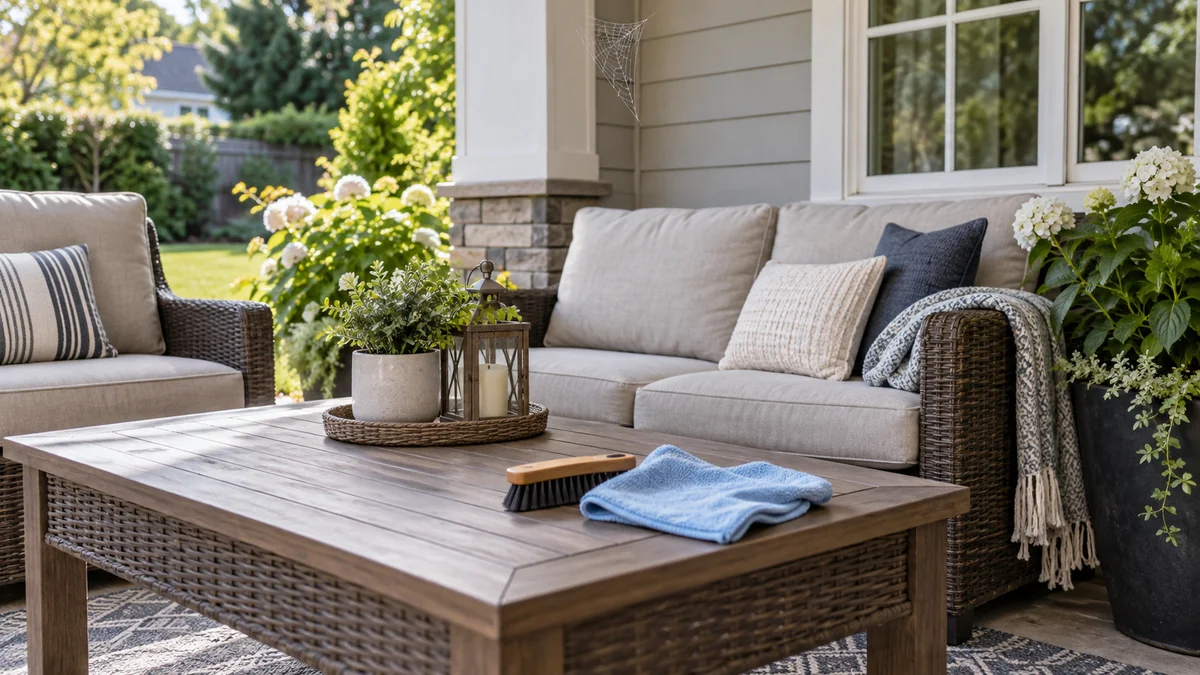
To keep spiders away from patio furniture, remove existing webs and egg sacs, clean hidden frame spaces, reduce insects around lights, and block access from nearby foliage. A thorough reset usually takes 20-45 minutes, followed by weekly inspection during warm weather. Physical cleaning and habitat reduction work more reliably than essential-oil sprays alone.
Key facts at a glance
Spiders stay near patio furniture mainly because it provides shelter and access to insects.
A 20-45 minute cleaning reset can remove webs, egg sacs, prey, and hiding debris.
Inspect furniture every 7 days during peak spider activity and after heavy rain or wind.
Warm-colored bulbs around 2,000-2,700 Kelvin generally attract fewer insects than cool white bulbs.
Essential oils and vinegar may provide short-lived odor deterrence, but outdoor evidence is limited.
Diatomaceous earth works only while dry and should not be applied where people or pets inhale the dust.
Why Spiders Choose Patio Furniture
Spiders choose patio furniture because joints, undersides, cushions, and covers create protected spaces close to flying insects. Patio lights, nearby vegetation, standing water, and undisturbed storage increase the food and shelter available within a small area.
Most outdoor spiders are not interested in the furniture itself. They are using the furniture as an elevated web site or daytime refuge. A chair frame beside a light can provide both a stable anchor and a steady supply of moths, mosquitoes, flies, and other arthropods.
The most productive inspection points are:
- Underside joints and welded corners
- Gaps beneath seat cushions
- Wicker loops and rattan weave
- Screw heads, drainage holes, and hollow tubing
- The back of furniture placed against a wall
- Cushion storage boxes and furniture covers
- Foliage touching chair backs or table legs
Spiders do not need a dirty patio. Even clean furniture can support webs if the location has prey, shelter, and little disturbance. Removing one factor helps, but combining cleaning, spacing, lighting, and storage produces the most consistent result.
What attracts insects to a patio?
Outdoor lights attract many flying insects, although the response depends on species, bulb spectrum, brightness, heat, and surrounding darkness. The U.S. Department of Energy identifies warm-color light-emitting diode bulbs as a practical way to reduce some insect attraction compared with cool, blue-rich lighting, although no household bulb eliminates insects completely.
Water also matters. Leaky planters, clogged drains, damp cushions, and saucers beneath pots can increase insect activity. Correcting those sources can reduce the prey base more effectively than repeatedly spraying furniture.
Before You Start: Tools, Time, and Cost
A basic patio-furniture reset takes 20-45 minutes for a small seating set and costs approximately $0-$25 if household tools are available. The required equipment is a vacuum or brush, mild dish detergent, water, microfiber cloths, gloves, and a suitable storage or cover solution.
| Item | Typical quantity or specification | Typical cost | Purpose |
|---|---|---|---|
| Hand vacuum | 1 unit with crevice attachment | $25-$100 | Removes webs from joints and seams |
| Firm cleaning brush | 1 nylon brush, 2-4 inches wide | $4-$12 | Clears wicker, frames, and textured surfaces |
| Dish detergent | 1 teaspoon per 1 gallon of water | $2-$5 | Cleans grime and insect residue |
| Microfiber cloths | 2-4 cloths | $3-$10 | Wipes frames without scratching |
| Nitrile or work gloves | 1 pair | $3-$15 | Protects hands during inspection |
| Breathable furniture cover | 1 correctly sized cover | $20-$80 | Limits shelter while allowing ventilation |
| Warm LED bulb | 1-4 bulbs, 2,000-2,700 K | $8-$40 | Reduces some light-related insect activity |
Do not begin with pesticide. Cleaning first reveals whether the problem is a few recurring webs or an active insect concentration that requires a different response.
How to Keep Spiders Away From Patio Furniture
The most reliable process has six steps: remove cushions, vacuum or brush webs, wash the frames, correct access routes, reduce insect attraction, and store or cover the furniture correctly. Allow 30 minutes for a typical four-chair set, then repeat the inspection after seven days.
Step 1: Remove cushions and loose items
Take cushions, pillows, throws, covers, planters, toys, and storage bins away from the seating area. Place soft items on a clean, bright surface where you can inspect seams, zippers, handles, and underside fabric.
Shake cushions outdoors away from doors and windows, then inspect them with a flashlight. Do not shake cushions over a bed, indoor sofa, or enclosed porch because spiders or other insects can fall into those spaces.
You will know this step worked when every cushion seam and hidden underside has been checked. A common mistake is inspecting only the visible top surface, while egg sacs and spiders remain beneath the cushion.
For removable fabric, follow the manufacturer’s washing instructions. Do not soak foam cushions unless the care label permits it, because trapped moisture can create mildew and attract insects.
Step 2: Remove webs, spiders, and egg sacs
Use a vacuum crevice tool or a firm, dry nylon brush on the underside, rear frame, legs, joints, and fabric seams. Dispose of vacuum contents in a sealed outdoor bin or bag, particularly if you find egg sacs.
Spider egg sacs vary by species, so they may look like white, tan, gray, or dusty silk clusters. A web alone does not prove that eggs are present. Remove visible silk carefully rather than crushing unknown spiders with bare hands.
For wicker or rattan, brush in the direction of the weave and use low suction around loose strands. For metal and hard plastic, a vacuum followed by a damp cloth is usually faster. A pressure washer can force water into cushions, loosen wicker strands, damage finishes, and spread debris into neighboring areas.
The checkpoint is simple: no visible silk remains in structural corners or beneath the seat. The common mistake is cleaning only the tabletop and cushion tops, where spiders rarely establish their main web anchors.
Step 3: Wash the furniture surfaces
Mix approximately 1 teaspoon of mild dish detergent with 1 gallon of warm water. Wipe metal, sealed wood, plastic, and hard synthetic frames with a damp cloth, then rinse residue with clean water and dry thoroughly.
Cleaning removes dust, insect fragments, pollen, and grime that can support small prey. However, the claim that soap reliably strips spider pheromone trails is not well established. Spiders do not use ant-like trails in the same simple way, so cleaning should be presented as sanitation and physical removal, not a guaranteed chemical reset.
Use less water on unfinished wood and woven furniture. Test the solution on a hidden area first, especially when the set has powder coating, painted surfaces, teak oil, or a fabric finish.
The checkpoint is a dry frame with no sticky residue, food debris, or damp crevices. The common mistake is covering or using the furniture while the underside remains wet, which creates a more favorable environment for insects.
Step 4: Remove bridges from vegetation and walls
Trim branches, vines, tall grass, and dense plants so they do not touch the furniture. As a practical target, maintain approximately 12-18 inches of separation between seating and foliage where space permits.
Move stacked firewood, cardboard, leaf piles, and unused pots away from chairs and tables. These objects provide daytime shelter and create easy routes onto furniture legs.
Inspect wall cracks, fence gaps, roof overhangs, and lighting fixtures near the seating area. You do not need a sterile patio. The objective is to prevent a continuous path from vegetation or building edges to the furniture.
The checkpoint is visible separation between furniture, plants, stored materials, and walls. The common mistake is treating the chair while leaving a hedge pressed against its back.
Step 5: Reduce insect attraction around the patio
Replace cool white or blue-rich bulbs with warm LEDs in the 2,000-2,700 Kelvin range where the fixture allows it. Turn lights off when the patio is unused, install a timer, or place necessary lighting farther from seating and direct it downward.
Warm light can reduce attraction for some insects, but it is not insect-proof. Yellow “bug” bulbs also vary by manufacturer, so brightness and placement remain important.
Repair dripping faucets, empty plant saucers, improve drainage, and clean food or drink spills. Keep trash lids closed and remove fallen fruit near the seating area.
The checkpoint is fewer insects gathering around the furniture after dusk. The common mistake is leaving bright lights on all night and expecting a spider spray to overcome the constant food supply.
Step 6: Store or cover furniture correctly
Store cushions indoors or in a sealed, dry deck box when the patio is unused for several days. Use a breathable, correctly fitted furniture cover for frames, and leave ventilation openings clear to prevent condensation.
A cover can reduce shelter only if it fits tightly enough to prevent large gaps and is removed periodically for drying. A loose tarp often creates a dark, still cavity that spiders prefer.
Inspect stored cushions every 7-14 days during warm weather. Do not place damp fabric into a sealed box. Dry cushions completely first, and clean the box interior when debris accumulates.
The checkpoint is dry storage with no folds, corners, or box seams containing webbing. The common mistake is using a cover as a substitute for cleaning, allowing webs and insects to remain underneath.
Which Spider Deterrents Are Worth Using?
Physical cleaning, vegetation separation, insect reduction, and correct storage provide the best first-line control. Peppermint oil, citrus oil, rosemary oil, vinegar, cedar, diatomaceous earth, and residual insecticides differ substantially in evidence, durability, and safety.
| Option | Typical cost | Outdoor persistence | Best use | Main limitation |
|---|---|---|---|---|
| Cleaning and vacuuming | $0-$25 | 7-14 days with inspection | Existing webs and egg sacs | Requires repeat labor |
| Warm LED lighting | $8-$40 per bulb | Months to years | Light-related insect activity | Does not remove all insects |
| Essential-oil spray | $5-$20 | Hours to several days | Short-term odor deterrence | Rain and sunlight reduce effect |
| Vinegar solution | $2-$6 | Hours to a few days | Cleaning hard surfaces | Can damage some finishes and plants |
| Cedar blocks | $10-$30 | Weeks to months | Enclosed, dry storage | Weak effect in open rain |
| Diatomaceous earth | $10-$25 | Until wet or disturbed | Dry cracks and protected edges | Dust inhalation and poor wet-weather performance |
| Labeled residual insecticide | $15-$50 | Label-dependent, often weeks | Persistent insect pressure | Pesticide exposure and runoff concerns |
Do peppermint and citrus oils repel spiders?
Peppermint and citrus oils may discourage some spiders temporarily, but outdoor evidence does not justify treating them as a dependable control method. Essential oils evaporate quickly, lose strength in sunlight, and wash away in rain; concentrated oils can irritate skin, damage finishes, and harm pets if misused.
If you use an oil product, follow its label and never apply concentrated oil directly to cushions, skin, food-contact surfaces, or pets. A homemade mixture of water, oil, and dish soap is not automatically safe or stable, because oil separates unless properly emulsified and detergent can stain fabric.
Essential-oil spray is most reasonable as a low-cost, short-lived supplement after cleaning. It is not a substitute for removing webs, reducing insects, or correcting vegetation contact.
Does vinegar keep spiders away?
Diluted vinegar may clean hard surfaces and produce a temporary odor that some people find unpleasant to spiders, but vinegar is not a durable outdoor spider barrier. A 1:1 water-to-white-vinegar mixture can damage natural stone, unfinished wood, some coatings, and nearby plants.
Never spray vinegar on cushions without a material test. Avoid mixing vinegar with bleach or other cleaning chemicals. Use mild detergent instead when the goal is removing dirt and insect residue from furniture.
Is diatomaceous earth a good choice?
Food-grade diatomaceous earth is a dry abrasive powder that can injure small arthropods when their bodies contact the particles, but it is not a reliable treatment for webs or airborne spiders. Rain, dew, and washing deactivate its practical effect, while airborne dust can irritate lungs.
If used, apply only a very thin amount in a dry, protected crack where the product label permits it. Keep children, pets, and people away during application, avoid breathing the dust, and never place powder on cushions or eating surfaces.
Diatomaceous earth is a poor choice for open patios exposed to weather. Cleaning and exclusion are safer and more useful in that setting.
When Should You Use Outdoor Insecticide?
Use an outdoor insecticide only when repeated cleaning, lighting changes, and habitat reduction fail and insect activity remains high. Select a product registered for the intended site, follow the label exactly, and never assume a product approved for lawns is approved for cushions, seating, food areas, or furniture.
Common active ingredients in outdoor products include bifenthrin, deltamethrin, cyfluthrin, and permethrin. Product concentration, application surface, re-entry interval, water restrictions, and permitted locations vary, so an active ingredient alone does not determine safe use.
| Situation | Preferred response | Avoid |
|---|---|---|
| One or two webs | Vacuum and wash | Routine pesticide spraying |
| Webs return near a lamp | Change bulb, timer, and placement | Spraying the lamp or electrical fitting |
| Heavy insects around drains | Correct water and sanitation source | Treating furniture alone |
| Persistent webs across the whole patio | Inspect perimeter, then consider a labeled treatment | Applying an indoor aerosol outdoors |
| Children or pets use the area | Cleaning and exclusion first | Wet residues on contact surfaces |
| Furniture borders a pond | Nonchemical control and professional advice | Runoff-prone pyrethroid application |
Do not spray cushions, tabletops, armrests, or food-contact surfaces unless the product label specifically permits that use. Never apply pesticides near fish ponds, storm drains, pollinator gardens, or open food without checking label restrictions.
A licensed pest professional is appropriate when spiders are numerous, identification is uncertain, bites are suspected, or webs extend into roofs, vents, electrical equipment, or occupied indoor spaces.
What Changes by Furniture Material?
Furniture material determines how much water, brushing, pressure, and product exposure the surface can tolerate. Metal and hard plastic are the easiest to clean, while wicker, unfinished wood, and fabric require controlled moisture and careful drying.
| Material | Cleaning method | Drying requirement | Main caution |
|---|---|---|---|
| Powder-coated metal | Mild detergent, damp cloth, soft brush | Dry joints and screw holes | Avoid abrasive powders that scratch coating |
| Hard plastic | Detergent, water, nonabrasive brush | Air-dry fully | Check for fading from strong solvents |
| Sealed wood | Damp cloth, soft brush, manufacturer cleaner | Dry immediately | Avoid soaking end grain and joints |
| Unfinished wood | Minimal moisture, dry brush | Rapid drying in shade or sun | Vinegar and oils can stain or alter finish |
| Wicker or rattan | Low-suction vacuum, soft brush, light damp wipe | Dry completely with airflow | Pressure washing can loosen fibers |
| Outdoor fabric | Vacuum seams, care-label washing | Complete drying before storage | Avoid unapproved oils and bleach |
Wicker furniture deserves special attention because spiders can anchor webs inside many small gaps, while pressure washing can force moisture into the weave. Use a brush or vacuum first, then a barely damp cloth and generous drying time.
Common Mistakes and How to Fix Them
Spraying only the visible top
Spider webs usually anchor beneath seats, behind backs, and inside frame joints. Repeat the cleaning process with the furniture tipped safely so the underside becomes accessible.
Leaving lights on overnight
Continuous lighting can maintain the insect supply that attracts spiders. Use a timer, motion sensor, lower brightness, or a warm LED placed away from seating.
Covering damp furniture
A sealed cover traps humidity and creates the dark shelter spiders prefer. Remove the cover, dry every surface, clean the interior, and use a breathable cover with ventilation.
Using a pressure washer on wicker
High-pressure water can loosen strands, drive dirt deeper, and wet cushions. Switch to low-suction vacuuming, dry brushing, and a controlled damp wipe.
Applying essential oils directly to fabric
Concentrated oils can stain textiles and irritate skin. Wash according to the care label and use no repellent on contact surfaces unless the product label permits it.
Assuming every spider indicates danger
Most patio spiders are nuisance web-builders rather than medically significant species. Avoid handling unknown spiders, but focus on habitat reduction rather than indiscriminate spraying.
Why Do Webs Return After Cleaning?
Webs return because the food source, shelter, or access route remains available, not necessarily because the cleaner failed. Inspect lights, vegetation, wall gaps, moisture sources, and nearby stored materials when webs reappear within 24-48 hours.
If webs recur in one corner, compare that location with the rest of the patio. A lamp, downspout, hedge, fence intersection, or roof overhang often explains the pattern. Remove the web, correct the nearby attractant, and inspect again after three nights.
If webs appear across every chair despite reduced lighting and clean surroundings, look for a broader insect problem. Flying insects may be emerging from drains, compost, standing water, or exterior lighting beyond the patio.
Do not respond by increasing spray frequency without identifying the cause. Repeated pesticide use can increase exposure while leaving the food source unchanged.
A Practical Maintenance Schedule
A weekly inspection is suitable for most patios during warm, active months. Increase checks after rain, strong wind, landscaping work, or a noticeable rise in flying insects.
| Interval | Task | Typical time |
|---|---|---|
| Each use | Shake cushions and scan seat seams | 1-2 minutes |
| Weekly | Vacuum webs, inspect undersides, wipe frames | 10-20 minutes |
| Every 2 weeks | Trim contact vegetation and clean storage | 15-30 minutes |
| Monthly | Check covers, drainage, lamps, and wall gaps | 20-30 minutes |
| After heavy rain | Dry cushions and inspect sheltered joints | 10-15 minutes |
| At season change | Deep-clean, dry, and store cushions | 30-60 minutes |
For a covered patio, prioritize frame joints, wall edges, and lighting. For an exposed patio, prioritize cushion drying, cover ventilation, and vegetation separation. For a rental, use removable measures such as cleaning, timers, warm bulbs, sealed storage, and movable planters.
Frequently Asked Questions
Are spiders attracted to dirty patio furniture?
Spiders are not attracted to dirt in the same way flies are attracted to food, but dirty furniture can retain insects, pollen, moisture, and hiding debris. Cleaning removes those conditions and exposes webs or egg sacs that would otherwise remain hidden.
How do I keep spiders away from patio cushions?
Vacuum cushion seams and undersides, keep cushions dry, and store them indoors or in a sealed dry box when unused. A breathable cover helps frames, but a loose tarp can create a dark shelter beneath it. Inspect cushions weekly during warm weather.
Can outdoor fans keep spiders off furniture?
Air movement can make web construction less stable and may reduce flying insects near seating, but a fan is not a complete spider-control method. Use a properly rated outdoor fan, protect electrical connections, and combine airflow with cleaning and lighting changes.
What smell do spiders dislike most?
Peppermint, citrus, eucalyptus, and vinegar are commonly promoted as spider-repellent smells, but outdoor persistence and effectiveness vary. No scent reliably replaces web removal, insect reduction, and exclusion. Treat fragrance products as optional, short-term supplements.
Should I kill spiders found on patio furniture?
Removing a spider is reasonable when it is in a high-contact area, but killing every spider does not address the reason webs return. Vacuum visible webs, relocate harmless spiders where practical, and correct nearby lights, vegetation, moisture, or storage problems.
When should I call pest control?
Call a licensed pest professional when spiders are numerous, the species is uncertain, activity extends indoors, or webs appear around roofs, vents, electrical equipment, or inaccessible structural gaps. Professional treatment is also appropriate when household members have experienced suspected medically significant bites.
The Bottom Line
The best way to keep spiders away from patio furniture is to remove webs and egg sacs, clean hidden frame spaces, separate furniture from vegetation, reduce insect-attracting light, and keep cushions dry and stored correctly. A 20-45 minute reset followed by weekly inspections usually outperforms repeated essential-oil or vinegar spraying. Use pesticide only for persistent, documented problems and only according to the product label.