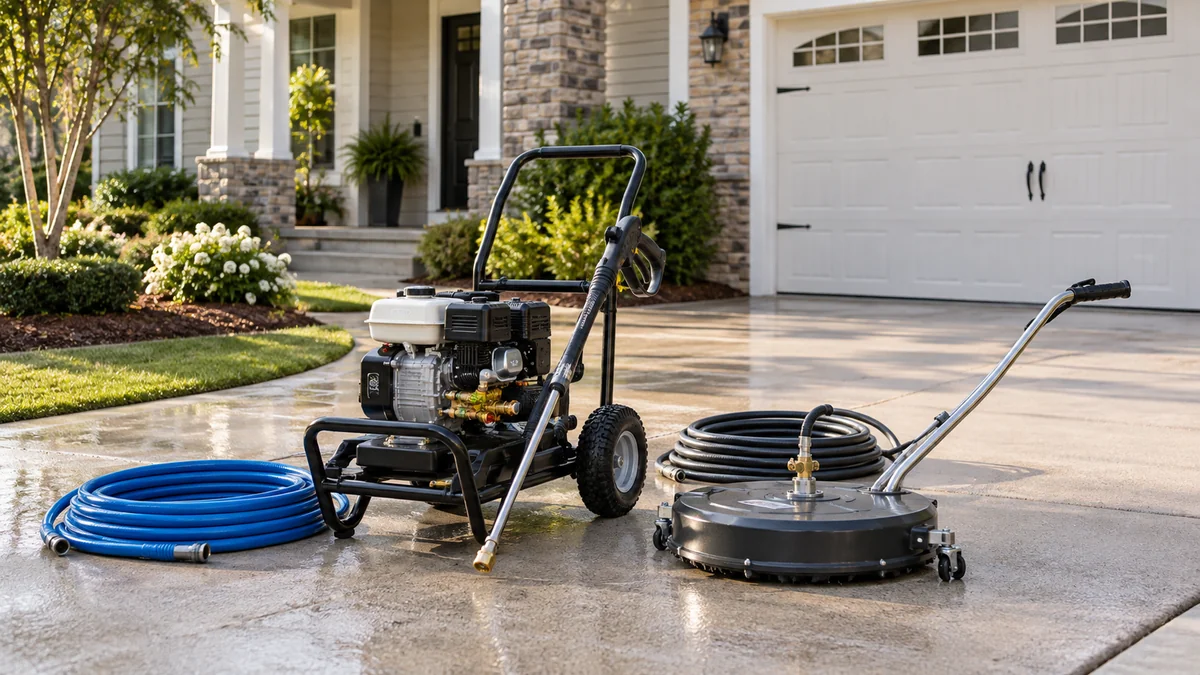
The benefits of soft washing over pressure washing are greatest on roofs, siding, stucco, painted wood, and other vulnerable surfaces because soft washing uses cleaning chemistry and controlled low pressure rather than force alone. It removes biological growth at its source, reducing damage and often extending the clean appearance, while pressure washing remains the better choice for sound concrete and some unpainted masonry.
Key Facts at a Glance
- Professional soft washing commonly applies solution at roughly 50-300 PSI, although equipment specifications vary.
- Pressure washing commonly operates at 1,500-4,000 PSI, but the pressure reaching a surface depends on nozzle, distance, flow, and technique.
- Sodium hypochlorite kills algae, mold, mildew, and other organic growth; water pressure mainly removes attached material.
- Soft washing is usually safer for asphalt shingles, vinyl siding, stucco, painted surfaces, and weathered wood.
- Pressure washing is usually more suitable for durable, unpainted concrete and some robust masonry.
- Soft washing can damage landscaping, metals, glass, and finishes when chemical concentration, wind, runoff, or rinsing is poorly controlled.
How Do Soft Washing and Pressure Washing Actually Differ?
Soft washing cleans primarily through a biocidal solution and uses low mechanical force, while pressure washing cleans primarily through high-velocity water. The difference matters because algae, mold, mildew, and moss are biological contaminants, not merely loose dirt; blasting their visible layer away may leave viable growth behind.
A soft-wash technician generally applies diluted sodium hypochlorite with surfactants, allows adequate dwell time, and rinses with low-pressure water. A pressure-washing technician uses a pump, hose, nozzle, and water impact to shear dirt, oxidation, loose paint, and growth from the substrate.
“Low pressure” has no single legal or industry-wide threshold. A dedicated soft-wash pump may operate below 100 PSI at the nozzle, while some contractors use higher-pressure equipment with a low-pressure application method. The meaningful question is whether the process can clean without forcing water under shingles, behind siding, into mortar joints, or through vulnerable coatings.
| Decision factor | Soft washing | Pressure washing |
|---|---|---|
| Primary cleaning action | Chemical treatment | Water impact |
| Typical application pressure | 50-300 PSI | 1,500-4,000 PSI |
| Typical flow | 4-12 gallons per minute | 2-8 gallons per minute |
| Organic growth control | Kills growth when correctly formulated | Often removes surface growth |
| Best common surfaces | Shingles, siding, stucco, painted wood | Concrete, curbs, robust masonry |
| Main failure risk | Chemical or runoff damage | Etching, stripping, or water intrusion |
What Pressure Is Really Involved?
Soft washing is defined by low surface impact and chemical action, not by a universal number such as 500 PSI. A technician can damage a delicate surface with a narrow nozzle at a seemingly modest pressure, while a wide fan and greater distance can reduce impact substantially.
Pressure at the pump is also different from pressure at the surface. Hose length, nozzle orifice, elevation, flow rate, and standoff distance all alter the final force. Responsible contractors should describe their application method and test a small inconspicuous area instead of promising that a particular PSI automatically makes a job safe.
Why Are the Benefits of Soft Washing Over Pressure Washing Most Noticeable on Delicate Surfaces?
Soft washing protects vulnerable substrates because the method does not depend on concentrated water impact to produce the cleaning result. Lower impact reduces the chance of lifted shingles, forced water, stripped paint, splintered wood, and etched finishes when the operator also controls chemical exposure.
Roofing manufacturers and trade organizations generally warn against aggressive cleaning methods on asphalt shingles. The Asphalt Roofing Manufacturers Association recommends avoiding power washing because high pressure can remove granules and shorten roof life. The exact warranty language belongs to the roof manufacturer, so homeowners should check the installation and maintenance documents before cleaning.
| Surface | Preferred method | Main reason | Important limitation |
|---|---|---|---|
| Asphalt shingles | Soft washing | Limits granule loss and removes algae | Do not walk unnecessarily or use aggressive rinsing |
| Vinyl siding | Soft washing | Avoids forcing water behind panels | Rinse oxidized surfaces carefully |
| Stucco or EIFS | Low-pressure cleaning | Reduces cracking and water intrusion risk | Inspect cracks and seal failures first |
| Painted wood | Low-pressure cleaning | Reduces paint stripping and fiber damage | Test for lead paint and failing coatings |
| Concrete driveway | Pressure washing | Durable surface tolerates mechanical cleaning | Excess pressure can etch or expose aggregate |
| Brick masonry | Low-pressure washing | Protects mortar and fired face | Old or soft brick may need specialized testing |
| Cedar siding | Low-pressure cleaning | Limits splintering and raised grain | Strong chemistry can discolor wood |
| Metal roofing | Low-pressure cleaning | Reduces coating and seal damage | Protect fasteners, gutters, and exposed metal |
Which Surfaces Should Not Receive Routine High Pressure?
Routine high-pressure cleaning is a poor choice for asphalt shingles, fragile stucco, EIFS, painted wood, deteriorated mortar, and siding with open seams. High pressure can drive water behind cladding, remove protective granules, widen existing defects, or expose bare substrate that then deteriorates faster.
Pressure washing is also risky around window seals, electrical fixtures, soffit vents, door thresholds, and exterior insulation systems. A surface may appear durable while its joints and coatings are not. Experienced operators clean the assembly, not just the visible face.
Does Soft Washing Remove Mold, Algae, Moss, and Mildew More Completely?
Soft washing usually controls biological growth more completely because an appropriate disinfecting solution reaches the organisms attached to the surface. Pressure washing can remove staining and growth quickly, but mechanical removal alone does not reliably neutralize remaining spores, roots, or biofilm in pores and joints.
The result is not guaranteed to last a fixed number of months. Shade, humidity, tree cover, roof orientation, nearby vegetation, drainage, and surface porosity determine regrowth. A shaded north-facing roof in a humid climate may need attention sooner than a sun-exposed wall in a dry region.
Soft washing also cannot repair failed flashing, leaking gutters, cracked stucco, rotten wood, or defective roof ventilation. Cleaning removes contamination; it does not correct the moisture conditions that caused the contamination.
How Long Do the Results Last?
A typical soft-washed exterior remains visibly cleaner for about 1-3 years, while a pressure-washed surface may show organic regrowth sooner when the underlying contamination was not treated. These are practitioner ranges, not universal guarantees; climate and substrate condition can move either interval substantially.
Roofs under dense tree cover may need inspection every 6-12 months. Siding in a damp, shaded environment may require cleaning every 12-24 months. Concrete with good drainage may remain acceptable for 1-3 years, but oil, tire marks, rust, and irrigation stains require different treatments.
Which Method Should You Choose by Surface?
Soft washing is the default for biological staining on delicate exterior materials, while pressure washing is the better fit for durable horizontal hardscapes with embedded soil. The correct choice depends on substrate condition, contaminant type, drainage, nearby landscaping, and the consequences of surface damage.
| Cleaning situation | Recommended approach | Typical pressure approach | Why |
|---|---|---|---|
| Black algae on asphalt shingles | Soft wash | 50-150 PSI application | Reduces granule disturbance |
| Green growth on vinyl siding | Soft wash | 50-200 PSI application | Cleans seams with less intrusion |
| Mold on painted trim | Low-pressure chemical wash | 50-150 PSI application | Protects coating and joints |
| Mud on sound concrete | Pressure wash | 2,000-3,000 PSI | Mechanical force removes mineral soil |
| Oil on concrete | Degreaser plus pressure rinse | 2,000-4,000 PSI | Chemistry breaks oil before rinsing |
| Efflorescence on brick | Specialized low-pressure cleaning | 100-800 PSI, tested | High force can damage mortar |
| Moss on a steep roof | Soft wash by trained operator | Low-pressure application | Reduces walking and substrate impact |
| Rust on metal | Appropriate acidic treatment | Low-pressure rinse | Pressure alone rarely removes oxidation |
Is Pressure Washing Ever Better?
Pressure washing is better for sound concrete, some unpainted aggregate, heavy mud, and certain hardscape projects where mechanical force is appropriate. It can also provide a faster visual result when the contaminant is loose mineral soil rather than living growth.
Pressure washing is not automatically wrong because it uses force. The mistake is applying the same pressure, nozzle, and distance to every surface. A skilled operator may use several settings on one property, including low-pressure chemical cleaning on siding and controlled pressure on the driveway.
How Much Does Each Method Cost?
Typical residential soft-washing prices range from $300-$600 for house siding and $400-$900 for a standard roof, while concrete pressure washing commonly costs $150-$350 for a driveway and adjacent walkway. Local labor rates, access, height, contamination, water supply, plant protection, and wastewater controls can change the final estimate.
| Project | Typical size | Soft-wash price | Pressure-wash price |
|---|---|---|---|
| House siding | 1,500-2,500 square feet | $300-$600 | $250-$550 |
| Asphalt-shingle roof | 1,500-2,500 square feet | $400-$900 | Not recommended |
| Concrete driveway | 600-1,200 square feet | $150-$350 | $150-$350 |
| Patio or walkway | 200-600 square feet | $125-$300 | $100-$300 |
| Stucco exterior | 1,500-2,500 square feet | $350-$750 | $300-$700 |
| Deck or painted wood | 200-500 square feet | $200-$500 | $150-$450 |
Soft washing may cost more than a quick pressure rinse because the quote can include solution, plant protection, dwell time, access equipment, runoff control, and detailed rinsing. The relevant comparison is total service life, not only the first invoice. A cheaper method that damages paint or causes rapid regrowth may create a larger repair bill.
Does Soft Washing Use Less Water?
Soft washing often uses less water for chemical treatment, but no universal water-saving percentage applies. Flow rate, dwell time, rinsing requirements, equipment design, and the size of the surface determine total consumption.
Pressure washing can use substantial water while the operator slowly cleans a surface with repeated passes. Soft washing can reduce rinse demand when the solution works efficiently, but professionals still need enough clean water to protect vegetation, windows, metals, and soil.
What Does a Professional Soft-Washing Process Include?
A professional soft-washing service includes inspection, surface-specific mixing, plant protection, controlled application, dwell time, rinsing, runoff management, and a final inspection. The cleaning solution should match the material and contaminant rather than follow one fixed recipe for every property.
Step 1: Inspect the Property
The technician identifies substrate, coating condition, biological growth, roof age, loose materials, electrical fixtures, water entry points, drainage, and sensitive landscaping. A test patch confirms that the chosen solution will not create unacceptable discoloration.
Step 2: Protect Plants and Nearby Property
Plants, soil, windows, vehicles, outdoor furniture, ponds, and painted metals require protection. Professional practice commonly includes pre-wetting vegetation, covering vulnerable items when appropriate, redirecting runoff, and post-rinsing plants with clean water.
Step 3: Mix and Apply the Solution
Sodium hypochlorite is often the active ingredient, with surfactants used to improve cling and coverage. Typical applied strength varies by surface and contamination, but stronger is not automatically better; excessive concentration can bleach wood, corrode metals, damage foliage, or discolor finishes.
Step 4: Allow Dwell Time
The solution commonly dwells for 5-20 minutes, depending on drying conditions and contamination. The surface should remain visibly wet without drying, because a dry chemical film can create uneven results and increase the chance of finish damage.
Step 5: Rinse and Inspect
The operator rinses with controlled pressure from top to bottom, checks gutters, windows, trim, and landscaping, and repeats treatment only where growth remains. A successful rinse leaves no visible residue, streaking, chemical odor near occupied areas, or plant stress.
How Are Plants, Metals, and Runoff Protected?
Soft-washing chemicals can injure plants and corrode metals when overspray or runoff is ignored, so plant protection is a core technical requirement rather than an optional courtesy. Pre-wetting, controlled spraying, immediate rinsing, wind monitoring, and appropriate runoff handling reduce risk but do not eliminate it.
A contractor should avoid application during strong or shifting winds. Wind speed limits vary by equipment and site, but postponing work when spray cannot be controlled is safer than relying on a longer nozzle.
Storm drains deserve special attention. Local rules may prohibit untreated wash water from entering a storm system because stormwater often flows directly to creeks, lakes, or coastal waters. Contractors should explain how they contain, divert, recover, or otherwise manage runoff.
Which Chemicals Are Commonly Used?
Sodium hypochlorite is common for organic growth, surfactants help solution cling, and specialty detergents or acidic products may address mineral, rust, or oil contamination. No single chemical is safe for every substrate, and mixing incompatible products can create toxic gases or damaging reactions.
Never mix sodium hypochlorite with acids, ammonia, or unknown cleaners. A contractor should disclose the active ingredients, dilution method, first-aid procedure, and protection plan for occupants, pets, plants, and aquatic features.
Is DIY Soft Washing Sensible?
DIY soft washing is reasonable for a small, ground-level vinyl surface when the homeowner uses a labeled consumer product, follows the label, protects vegetation, and avoids roof access. Roofs, tall structures, strong concentrates, electrical hazards, and complex runoff conditions justify professional service.
Homeowners often underestimate chemical drift and overestimate the safety of a garden sprayer. Respiratory exposure, eye injury, ladder falls, damaged plants, stained windows, and corroded fixtures can cost more than a professional cleaning.
Do not walk on an unfamiliar roof to clean it. Asphalt shingles become slippery, and foot traffic can dislodge granules even when water pressure is low.
What Are the Most Common Soft-Washing Mistakes?
The most common soft-washing mistakes are excessive chemical strength, inadequate rinsing, poor wind control, unprotected plants, and treating all materials with one formula. Each mistake can produce visible damage even when the surface looks cleaner immediately afterward.
| Mistake | Likely damage | Immediate response |
|---|---|---|
| Strong solution on foliage | Leaf burn or plant stress | Rinse leaves and soil with abundant clean water |
| Chemical dries on glass | Streaks or mineral residue | Rinse promptly and clean with compatible glass product |
| Overspray on bare aluminum | Oxidation or discoloration | Flush immediately and inspect coating |
| High pressure on shingles | Granule loss or lifted tabs | Stop work and photograph affected areas |
| Runoff into a pond | Aquatic toxicity | Stop discharge and contact local environmental authority |
| No test patch on old paint | Uneven fading or coating failure | Stop, document, and reassess the entire method |
What Should a Contractor Never Promise?
A contractor should not promise that soft washing will permanently prevent regrowth, remove every stain, repair a roof, or work safely at one fixed pressure on every material. Honest estimates identify the contaminant, surface, limitations, expected maintenance interval, and conditions that could change the result.
A contractor also should not guarantee plant safety without inspecting vegetation, wind exposure, irrigation, and runoff paths. Even careful work carries risk around delicate foliage and aquatic environments.
How Should You Compare Soft-Washing Companies?
Compare contractors by surface knowledge, insurance, chemical controls, runoff planning, and documented process rather than by price alone. A credible company can explain its equipment, test-patch procedure, plant-protection steps, and response plan for accidental overspray.
Ask these questions before hiring:
- Which surfaces will receive soft washing, pressure washing, or another method?
- What active chemical will be used, and how will it be diluted?
- How will plants, ponds, windows, vehicles, and storm drains be protected?
- Will the company perform a test patch?
- What pressure and nozzle type will be used on each material?
- Does the estimate include rinsing, runoff control, and cleanup?
- Is the company insured for property damage and worker injury?
- Will the contractor document pre-existing damage?
- How does the company handle lead-painted or historic surfaces?
- What result and maintenance interval does the written estimate actually guarantee?
Which Customers Benefit Most From Soft Washing?
Homeowners with algae-stained roofs, moldy siding, painted exteriors, stucco, or dense landscaping usually benefit most from soft washing. Property managers also gain consistency when a documented, low-impact process reduces repeat damage across multiple buildings.
Concrete-focused projects benefit less from a chemical-first approach. A driveway with embedded soil, oil, or tire marks may need detergents and controlled pressure, although biological staining may still require a treatment step.
FAQ
Can Soft Washing Remove Black Streaks From Asphalt Shingles?
Soft washing can remove many black streaks caused by algae on asphalt shingles without the granule loss associated with aggressive pressure washing. The technician should use a roof-compatible solution, avoid unnecessary foot traffic, control runoff, and follow the shingle manufacturer’s maintenance guidance.
Is Soft Washing Safe for Painted Surfaces?
Soft washing is generally safer for sound painted surfaces than high-pressure cleaning because it reduces impact and paint stripping. Failing paint, lead paint, chalky oxidation, and weak wood still require testing; chemical strength and dwell time must be adjusted before full application.
Can Soft Washing Remove Oil From Concrete?
Soft washing alone is usually insufficient for deep oil stains in concrete. Oil normally requires a compatible degreaser, agitation or absorption, and a controlled pressure rinse, with repeated treatment when the contaminant has penetrated the slab.
How Often Should a House Be Soft Washed?
Many homes need soft washing every 1-3 years, but shaded, humid properties may need inspection every 6-12 months. Tree cover, roof orientation, drainage, surface porosity, and local climate influence regrowth more than a fixed calendar interval.
Does Soft Washing Void a Roof Warranty?
Soft washing does not automatically void every roof warranty, but the method must follow the roofing manufacturer’s maintenance requirements. Homeowners should review the warranty, confirm acceptable chemicals and procedures, and retain the contractor’s written scope and documentation.
What Is the Main Disadvantage of Soft Washing?
The main disadvantage of soft washing is chemical and runoff risk when the operator lacks surface knowledge or environmental controls. The process also may not remove oil, heavy mineral deposits, or deeply embedded hardscape contamination as efficiently as pressure washing.
The Bottom Line
The benefits of soft washing over pressure washing are clearest when the target is biological growth on a vulnerable surface. Soft washing treats algae, mold, mildew, and moss with chemistry while reducing the mechanical force that can strip paint, damage shingles, erode mortar, or force water behind siding.
Pressure washing remains the better tool for many sound concrete and hardscape applications. Choose the method by substrate and contaminant, require a written protection plan, and judge the contractor by controlled technique rather than by PSI or the lowest quote.