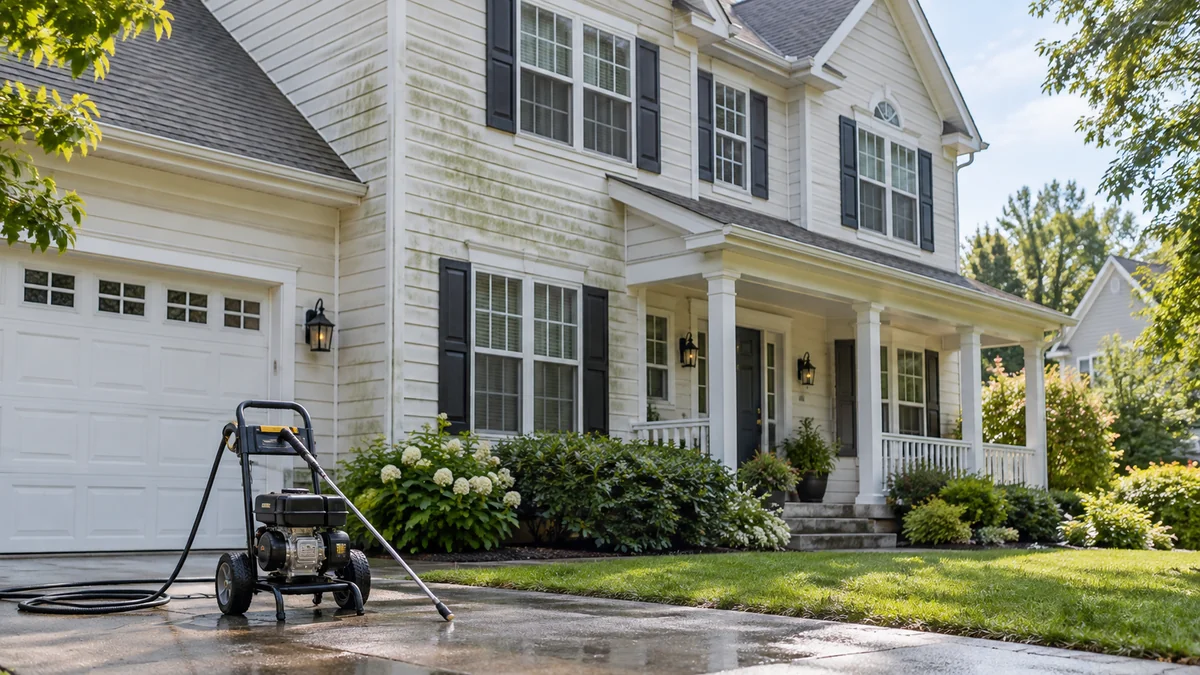
Most houses should be professionally washed about once every 12 months, but the correct interval ranges from every 3 months to every 2 years. Humidity, coastal salt, tree shade, traffic pollution, biological growth, and siding material determine the schedule. Visible algae, mildew, heavy staining, or corrosive deposits justify cleaning sooner than the calendar requires.
Key Facts at a Glance
A typical residential house needs exterior cleaning every 12 months.
Humid, shaded, or coastal homes commonly need cleaning every 3-6 months.
Dry, low-shade homes with vinyl or composite siding may need washing every 12-24 months.
Soft washing, not high-pressure spraying, is the safer method for most siding, stucco, painted trim, and asphalt roofing.
Never direct water upward beneath siding laps, window seals, soffits, or roof shingles.
Pressure washing removes contamination; it does not permanently prevent algae, mildew, salt, pollen, or dust from returning.
How Often Should You Pressure Wash Your House?
The correct house-washing frequency is usually once per year, with environmental conditions moving the interval shorter or longer. A coastal house surrounded by trees may need a low-pressure wash every 3-6 months, while a dry suburban house with composite siding may remain presentable for 18-24 months.
Annual cleaning is a practical starting point because exterior contamination accumulates gradually. Organic growth can spread across siding, while airborne grit, soot, and salt remain attached to paint, metal fixtures, masonry, and glass. Waiting until stains become thick often requires stronger chemicals, longer dwell time, or more agitation.
The calendar is only one indicator. Wash sooner when green or black growth is expanding, when salt deposits appear near the ocean, or when pollen and dust form a bonded film. Wash later when the exterior remains dry, clean, shaded only briefly, and free of visible biological growth.
What Is the Fastest Way to Set a Schedule?
Use the 12-month baseline, then adjust for moisture, shade, salt, pollution, and material sensitivity. Two or more high-exposure conditions usually justify a 6-month inspection and a 6-12-month cleaning interval.
A simple maintenance rule works well:
- Start with 12 months.
- Move to 3-6 months for coastal salt, persistent humidity, or dense shade.
- Move to 6-12 months for trees, traffic pollution, irrigation overspray, or frequent rain.
- Move to 12-24 months for dry climates, low shade, and nonporous siding.
- Clean immediately when growth or corrosive residue is visibly spreading.
Inspection is more useful than an automatic contract. Walk around the north and west walls, shaded foundations, downspouts, window sills, and areas beneath trees. Those locations usually show the earliest problems.
Which Conditions Require More Frequent House Washing?
Moisture, shade, airborne salt, and pollution shorten the cleaning interval because they either support biological growth or increase the amount of bonded residue. A dry wall exposed to sunlight may stay clean for 18 months, while a shaded wall under trees can develop algae within one season.
| Condition | Typical interval | Main contaminant | Practical adjustment |
|---|---|---|---|
| Oceanfront or salt-heavy air | 3-6 months | Salt film and corrosion residue | Rinse exposed elevations quarterly |
| Humid subtropical climate | 6-12 months | Algae, mildew, mold | Inspect shaded walls every 6 months |
| Dense tree canopy | About 6 months | Sap, pollen, leaves, organic growth | Clean after major pollen season |
| Busy road or dirt-road exposure | 6-12 months | Soot, dust, mud, tire residue | Prioritize front-facing walls |
| Dry, arid neighborhood | 12-18 months | Dust, sand, mineral film | Rinse before deposits harden |
| Low-shade temperate climate | 12-24 months | General dirt and pollen | Inspect annually before deciding |
Coastal properties need a distinction between rinsing and washing. A clean-water rinse can remove loose salt before it bonds aggressively, while an annual detergent or soft-wash service addresses the broader film. A quarterly rinse does not replace a full cleaning.
Wildfire smoke, construction dust, and unusual storm events also change the schedule. Fine particles can settle into textured siding and window tracks even when the house does not look visibly dirty from the street.
Does Rain Clean House Siding?
Rain removes loose dust but rarely removes bonded algae, mildew, soot, or salt film. Rainwater can also keep shaded walls damp, creating conditions that help organic growth return.
Rain is therefore not a substitute for exterior washing. A roof overhang, textured stucco finish, or recessed siding profile can retain contamination after several storms. Examine lower siding courses and sheltered elevations rather than judging cleanliness from exposed walls alone.
How Often Should Different Siding Materials Be Washed?
Siding material determines how much pressure, heat, chemical strength, and agitation the surface can tolerate. Vinyl and composite panels generally tolerate routine low-pressure cleaning, while aged wood, historic brick mortar, stucco, and painted surfaces require more conservative methods.
| Exterior material | Typical interval | Preferred method | Main risk |
|---|---|---|---|
| Vinyl siding | 12-24 months | Detergent plus low pressure | Water entering laps or damaged seams |
| Fiber-cement siding | 12-18 months | Low-pressure wash | Paint failure at joints and caulked areas |
| Composite panels | 12-24 months | Detergent and broad rinse | Surface oxidation or finish dulling |
| Painted wood | 12-24 months | Soft wash and gentle brushing | Peeling paint, raised grain, moisture entry |
| Stucco | 6-18 months | Low-pressure soft wash | Cracking, water intrusion, surface erosion |
| Brick with sound mortar | 12-36 months | Low-pressure detergent wash | Mortar erosion and trapped moisture |
| Historic lime mortar | As needed, often 24+ months | Specialist low-pressure cleaning | Irreversible mortar loss |
| Painted metal siding | 12-24 months | Low-pressure detergent wash | Chipped coating and oxidation streaks |
Wood siding may need cleaning at the same calendar interval as vinyl, but the procedure is different. High pressure can roughen the grain, drive water behind boards, and remove paint. Soft washing followed by limited soft-bristle agitation is safer.
Brick is durable, but brick does not make mortar indestructible. A narrow stream can remove weathered joints, especially on older homes using lime-based mortar. Historic masonry should be assessed by a contractor familiar with preservation work.
Should You Pressure Wash Stucco or Wood?
You should not use ordinary high-pressure house washing on stucco or wood siding. Low-pressure soft washing, controlled rinsing, and material-specific detergents reduce the chance of surface erosion, paint damage, and water intrusion.
A contractor should test a small inconspicuous area before treating the full wall. The test should check color stability, coating adhesion, runoff behavior, and whether the surface needs brushing rather than additional pressure.
Is Soft Washing Safer Than Pressure Washing?
Soft washing is safer for most residential siding because it uses cleaning chemistry and water flow rather than concentrated impact to remove organic contamination. High-pressure washing is better reserved for durable, unpainted hardscape such as concrete, some stone, and heavily soiled masonry with sound joints.
| Method | Typical pressure or temperature | Best applications | Poor applications |
|---|---|---|---|
| High-pressure cold water | 1,500-4,000+ PSI | Unpainted concrete, durable hardscape | Vinyl, wood, stucco, roofs |
| Hot-water power washing | Up to about 200°F | Grease, oil, gum, industrial residue | Painted siding and delicate sealants |
| Soft washing | Commonly under 500 PSI | Siding, stucco, trim, roofs | Heavy concrete oil removal |
| Garden-hose rinse | About 40-80 PSI at the outlet | Loose dust and salt | Bonded algae and mildew |
Pressure is only one equipment specification. Cleaning performance also depends on gallons per minute, nozzle angle, distance, temperature, detergent concentration, surface porosity, and operator control.
A 4,000-PSI machine can damage siding within seconds, while a low-pressure system can clean effectively when the correct detergent dissolves organic residue. For houses, the safer question is not “What is the strongest washer?” but “What removes the contaminant with the least force?”
What PSI Is Safe for House Siding?
There is no universal safe PSI for every siding product, but residential siding is generally treated with low pressure, often below 500 PSI and sometimes substantially lower. The nozzle should remain broad, the wand should stay moving, and the operator should test the surface first.
Manufacturer instructions take priority over generic ranges. Damaged caulk, loose panels, failed paint, cracked stucco, and brittle window seals can fail at pressures that would not harm an intact surface.
As a practitioner rule, never use a zero-degree nozzle on house cladding. A 25-degree or 40-degree fan pattern is less concentrated, but even a broad tip can damage a surface when held too close.
What Is the Safest Way to Wash a House?
The safest process is preparation, low-pressure detergent application, controlled dwell time, gentle agitation where needed, and a thorough top-down rinse. A typical 2,000-square-foot house takes a professional crew about 1.5-3 hours, excluding difficult access or extensive surface repair.
Step 1: Inspect and Prepare the Property
Close windows and doors, identify damaged siding, remove fragile decorations, and cover exterior outlets, cameras, doorbells, and electrical fixtures. Wet nearby plants and grass with clean water before applying detergent.
Check whether downspouts discharge near a foundation, pond, storm drain, or vegetable garden. Cleaning chemicals should not be allowed to concentrate in those locations. Move vehicles and outdoor furniture away from the work area.
Success checkpoint: Every opening is closed, electrical fixture is protected, and damaged areas are documented.
Common mistake: Starting at the highest wall without checking whether water can enter a failed window seal.
Step 2: Select the Method and Test the Surface
Choose low-pressure soft washing for siding, painted trim, stucco, and roof materials. Reserve high-pressure cleaning for compatible hardscape, and test detergent and pressure on an inconspicuous section.
A test patch should dry before final evaluation because wet siding can hide streaks, oxidation, or color changes. Stop if paint lifts, a coating clouds, or mortar begins to erode.
Success checkpoint: The test area loses contamination without losing finish.
Common mistake: Increasing pressure when the real problem is insufficient dwell time or incorrect detergent.
Step 3: Apply Detergent From Bottom to Top
Apply a compatible detergent from the bottom upward so runoff does not create irregular clean streaks across dry, dirty sections. Use a low-pressure soap application system and keep the surface uniformly wet.
Dwell time is commonly 5-10 minutes, but direct sun, wind, temperature, and product instructions can change that period. Keep the detergent wet by misting additional solution or working in smaller sections.
Success checkpoint: Organic staining begins to loosen and the detergent remains wet.
Common mistake: Allowing chemical solution to dry, which can create white haze, streaks, or uneven cleaning.
Step 4: Rinse From Top to Bottom
Rinse from the roofline downward with broad, low-pressure passes. Keep the stream angled downward, especially on horizontal siding, because upward spray can force water beneath overlapping panels.
Rinse window frames, ledges, trim, and foundation edges until no visible detergent remains. Use clean water around plants and hardscape after the main rinse to dilute residual runoff.
Success checkpoint: Water runs clear, no foam remains, and the wall has an even appearance.
Common mistake: Holding the nozzle close to windows or directing water into vents and soffit openings.
Step 5: Inspect After Drying
Allow the exterior to dry before deciding whether a second pass is needed. Look for missed areas beneath eaves, behind downspouts, around hose bibs, and on shaded elevations.
Do not solve a missed stain by automatically increasing pressure. Some marks are oxidation, rust, tannin, efflorescence, or permanent coating damage rather than removable dirt.
Success checkpoint: The surface is uniformly clean without stripped paint, damaged joints, or cloudy windows.
Common mistake: Rewashing a permanent stain until the substrate is damaged.
How Much Does House Washing Cost?
Typical professional house washing costs about $200-$400 for a one-story home and $300-$600 for a two-story home, while a combined exterior package can cost $500-$1,500 or more. Actual pricing depends on access, height, siding condition, regional labor rates, chemical requirements, and included surfaces.
| Service or cost item | Typical range | Typical duration | Main price variable |
|---|---|---|---|
| One-story house wash | $200-$400 | 1.5-2.5 hours | Wall area and access |
| Two-story house wash | $300-$600 | 2-3 hours | Height and ladder or lift work |
| House plus driveway | $350-$800 | 2.5-4 hours | Concrete size and staining |
| Whole-property package | $500-$1,500+ | 4-8 hours | Roof, deck, walls, and hardscape |
| Electric washer purchase | $70-$200 | Homeowner-dependent | Flow rate and durability |
| Gas washer purchase | $300-$1,000 | Homeowner-dependent | PSI, GPM, and maintenance |
| Equipment rental | $40-$100 per day | Setup dependent | Local rental market |
Square-foot pricing of roughly $0.15-$0.75 can be useful for comparison, but a low quote may exclude trim, soffits, difficult elevations, chemical treatment, or travel. Ask whether the quote includes plant protection, window rinsing, runoff control, and return visits for missed areas.
DIY work may appear inexpensive, but a homeowner typically spends 4-8 hours on setup, washing, repositioning, and cleanup. The financial calculation should include detergent, protective equipment, hose requirements, replacement nozzles, and the cost of repairing damaged siding or a broken window seal.
Should You Wash the House Yourself or Hire a Professional?
DIY cleaning is reasonable for a small, one-story property with intact vinyl siding and safe ground access. Professional service is the better choice for multi-story walls, roofs, fragile materials, electrical complications, historic masonry, or widespread biological growth.
| Decision factor | DIY approach | Professional approach |
|---|---|---|
| Typical direct cost | $60-$260 including supplies | $200-$600 for house washing |
| Typical time | 4-8+ hours | 1.5-3 hours |
| Safe working height | Ground and short-reach areas | Multi-story access equipment |
| Equipment flow | Often 1.2-2.0 GPM | Commonly 4.0-8.0 GPM |
| Damage exposure | Owner bears repair cost | Insured contractor may cover qualifying damage |
| Best material range | Intact vinyl and hardscape | Wood, stucco, historic masonry, roofs |
A pressure washer does not become safe merely because it is marketed for homeowners. Falls, electrical contact, flying debris, chemical exposure, and water intrusion are the main hazards, not just the machine’s engine.
Do not climb a ladder while operating a pressure washer. The recoil from the trigger, wet footing, hose movement, and shifting center of gravity create a poor combination. Use a professional when the cleaning area requires roof access or unstable ladder positioning.
What Can Go Wrong During House Washing?
The most expensive mistakes involve concentrated pressure, upward water movement, dried detergent, and cleaning an incompatible surface. Damage may appear immediately as stripped paint or etched concrete, or later as trapped moisture, rot, corrosion, or failed window seals.
| Failure mode | Likely cause | Corrective action |
|---|---|---|
| White or cloudy streaks | Detergent dried on siding | Rewet, gently brush, and rinse thoroughly |
| Fuzzy or rough wood | Excessive pressure or close nozzle | Stop, allow drying, and assess coating loss |
| Water inside wall or window | Upward spray or failed seal | Stop washing and inspect the opening |
| Missing roof granules | High-pressure roof cleaning | Replace damaged sections if necessary |
| Green growth returns quickly | Surface remained shaded and damp | Improve drainage and use appropriate treatment |
| Low pressure from washer | Clogged tip or inlet filter | Depressurize, clean tip, and inspect filter |
| Brown stains after washing | Rust, tannin, or runoff contamination | Use a stain-specific treatment, not more pressure |
A zero-degree nozzle concentrates force into a tiny impact area and has no place on ordinary siding. A red nozzle can scar vinyl, cut wood fibers, remove paint, and damage soft masonry.
Roof shingles deserve separate treatment. High pressure can strip asphalt shingles’ protective mineral granules, shorten roof life, and force water beneath laps. Asphalt roofs should generally be treated with a roof-safe soft-wash process by a qualified operator.
When Should You Wash Before Painting or Selling?
Wash a house before exterior painting when the surface contains dirt, chalk, mildew, pollen, or loose contamination, then allow sufficient drying before preparation and coating. For a sale, schedule washing several days before photography or open-house activity so the exterior and landscaping can dry completely.
Cleaning before painting improves inspection of peeling paint, failed caulk, damaged trim, and substrate deterioration. Washing cannot repair those defects. Scraping, sanding, priming, and caulking remain separate preparation steps.
For real-estate presentation, a house may benefit from targeted cleaning of the front elevation, walkway, entry steps, driveway, and visible foundation. A full wash is more appropriate when buyers can see widespread staining or growth around the entire property.
How Can You Build a Personal Washing Schedule?
Build a personal schedule by combining the home’s exposure, material, and visible contamination rather than copying a neighbor’s annual routine. Record the last cleaning date, photograph shaded elevations, and inspect again after the wettest or pollen-heavy season.
Use this practical profile guide:
- Coastal home: Rinse salt-exposed walls every 3 months and schedule a full low-pressure wash every 6-12 months.
- Humid home with trees: Inspect every 6 months and wash when algae or mildew begins spreading.
- Dry suburban home with vinyl: Inspect annually and wash every 12-24 months if the siding remains clean.
- Historic brick or wood home: Clean only when needed, using a preservation-aware contractor and the gentlest effective method.
- Home beside a dirt road: Plan for 6-12-month cleaning, with extra attention to the road-facing elevation.
- Home with irrigation overspray: Correct the sprinkler pattern first, then clean mineral deposits with a material-safe treatment.
The best schedule prevents contamination from becoming established without washing surfaces unnecessarily. More frequent cleaning is not automatically better, especially for painted wood, old mortar, fragile stucco, and deteriorated sealants.
FAQ
Can Pressure Washing Remove Mold and Mildew Permanently?
Pressure washing can remove visible mold, mildew, algae, and dirt, but it cannot permanently prevent regrowth. Moisture, shade, poor drainage, and organic residue determine how quickly contamination returns. Correct the moisture source and use an appropriate soft-wash treatment rather than relying on stronger pressure.
Should You Pressure Wash in Winter?
Winter washing is practical only when temperatures remain safely above freezing and the surface can dry before ice forms. Frozen water can damage masonry, create slippery walkways, and interfere with detergents. In cold climates, late spring through early fall usually provides safer drying conditions.
Can You Pressure Wash Windows?
You can rinse exterior window glass with low pressure, but concentrated pressure can damage seals, screens, glazing putty, and fragile panes. Keep the nozzle several feet away, use a broad fan pattern, avoid direct spray into frame joints, and use a dedicated window-cleaning method for mineral deposits.
Does House Washing Damage Landscaping?
House washing can damage landscaping when concentrated detergent runoff or overspray reaches dry plants, ponds, or garden soil. Wet vegetation before cleaning, control runoff, avoid strong solutions near sensitive plants, and rinse foliage after the work. Plant protection is part of safe washing, not an optional finishing step.
How Long Should You Wait to Wash After Painting?
Wait until the paint manufacturer’s cure period has passed before washing a newly painted surface, commonly at least 2-4 weeks for exterior coatings depending on weather and product. A gentle rinse may be possible sooner, but detergent, pressure, and repeated wetting can mark uncured paint.
Is Pressure Washing Necessary Every Year?
Pressure washing is not necessary every year for every house. Annual inspection is sensible, but cleaning should occur when contamination, climate exposure, or material condition warrants it. Many dry-climate homes with intact vinyl or composite siding can safely use a 12-24-month interval.
The Bottom Line
For most homes, pressure washing or soft washing once every 12 months is a reliable starting point. Use a 3-6-month interval for coastal, humid, shaded, or heavily polluted properties, and a 12-24-month interval for dry homes with low-porosity siding and little biological growth.
The method must match the material. Use soft washing for siding, stucco, painted trim, wood, and asphalt roofing, while reserving higher pressure for compatible hardscape. Never direct water upward beneath siding or roof materials, and hire a professional when height, fragile construction, or historic materials make mistakes expensive. That approach answers how often should you pressure wash your house without turning a maintenance schedule into a damage schedule.