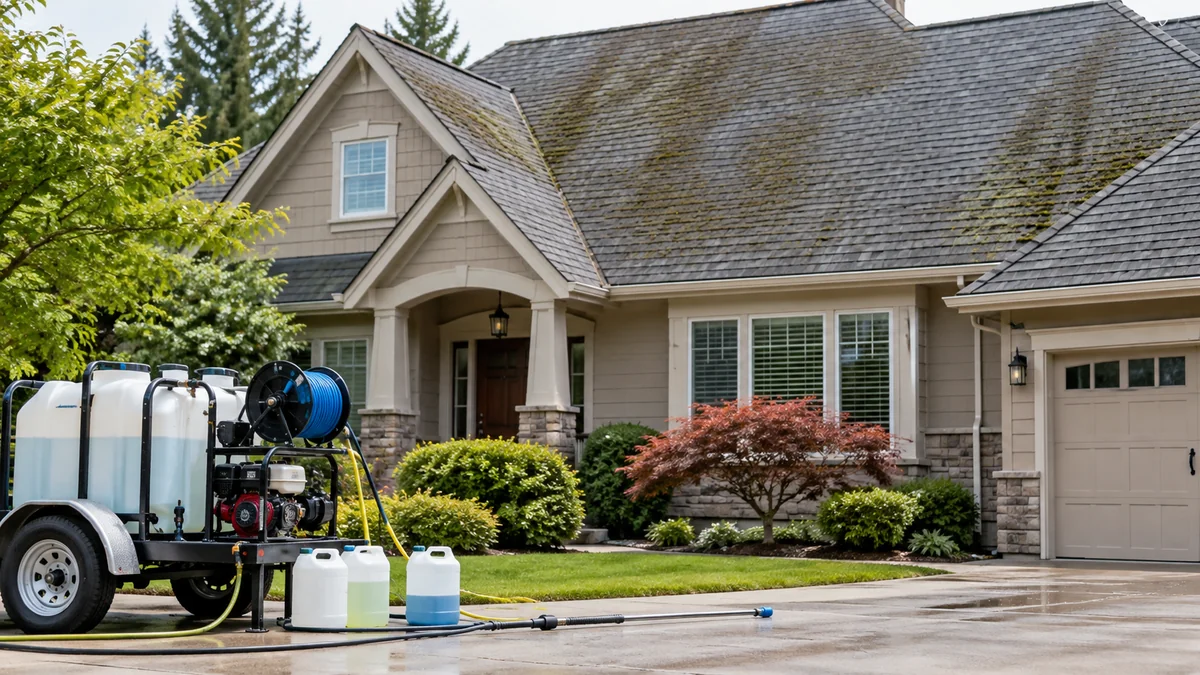
Roof soft wash chemicals are primarily biocides and cleaning additives applied with low pressure, not forceful water. Sodium hypochlorite is the common professional treatment for organic staining on asphalt shingles, while sodium percarbonate offers a slower oxygen-based alternative. The correct choice depends on roof material, growth type, weather, runoff controls, and applicator safety.
Key Facts at a Glance
- Sodium hypochlorite rapidly treats algae, mold, mildew, and many organic roof stains, but can damage plants, metals, coatings, and aquatic environments.
- Sodium percarbonate is generally milder and slower than sodium hypochlorite, making it more suitable for light staining and selected sensitive situations.
- Sodium hydroxide and potassium hydroxide are degreasers, not default roof biocides; their high alkalinity can damage roofing materials.
- A surfactant improves wetting and cling, but it does not replace the active disinfecting or oxidizing chemical.
- Roof-cleaning chemicals must never be mixed with acids, ammonia, vinegar, or other incompatible products because toxic gases or violent reactions can result.
- Professional roof cleaning commonly costs about $0.30-$0.75 per square foot, although pitch, access, roof material, region, and contamination can move the price substantially.
What Are Roof Soft Wash Chemicals?
Roof soft wash chemicals are low-pressure cleaning solutions designed to break down biological growth and stains without relying on abrasive water force. A typical system uses an active treatment chemical, water, and sometimes a compatible surfactant that helps the solution wet sloped shingles.
“Soft wash” describes the application method, not a single chemical formula. A pump may deliver the solution at far below pressure-washing levels, but the actual pressure depends on the equipment, nozzle, elevation, and operator. The objective is to avoid stripping granules, forcing water beneath shingles, damaging flashing, or driving water into wall assemblies.
The Asphalt Roofing Manufacturers Association recommends cleaning methods that avoid damaging asphalt shingles, but it does not mean every chemical mix, pressure setting, or contractor process is universally approved. Roof warranties also vary. The manufacturer’s maintenance instructions should control whenever they conflict with a generic cleaning formula.
What does the chemistry do?
Sodium hypochlorite oxidizes organic pigments and damages microorganisms through reactive chlorine chemistry. That reaction can remove the visible color of black streaks, often associated with cyanobacteria such as Gloeocapsa species, but visual whitening does not prove that every embedded organism or lichen holdfast has disappeared.
Surfactants reduce surface tension. They help a liquid spread across granules and remain in contact with a sloped surface longer, although surfactants cannot prevent all runoff. Dwell time depends on temperature, sunlight, wind, roof porosity, contamination, and whether the surface remains wet.
Which Roof-Cleaning Chemical Is Best?
For common black streaks on sound asphalt shingles, a properly controlled sodium hypochlorite treatment is usually the most effective professional option. Sodium percarbonate is a more conservative alternative for light contamination, while hydroxide products belong primarily on compatible commercial surfaces with grease or soot.
| Chemical | Primary function | Typical use | Main limitation |
|---|---|---|---|
| Sodium hypochlorite | Oxidizing biocide | Black streaks, algae, mildew, mold | Plant, metal, coating, and runoff damage |
| Sodium percarbonate | Oxygen-releasing cleaner | Light algae and mild stains | Slower action and weaker heavy-growth performance |
| Sodium hydroxide | Caustic degreaser | Grease, oils, soot, animal fats | Can damage shingles, coatings, skin, and vegetation |
| Potassium hydroxide | Alkaline degreaser | Commercial grime and oils | Requires material compatibility and careful rinsing |
| Bleach-stable surfactant | Wetting and cling additive | Sloped surfaces and controlled dwell | Does not kill growth by itself |
Sodium hypochlorite
Sodium hypochlorite, often abbreviated SH, is the usual active ingredient for organic roof staining. Commercial liquid products may be sold at concentrations around 10%-12.5%, while household bleach is often weaker and may contain additives that make it unsuitable for professional equipment or roofing work.
Concentration declines during storage. Heat, sunlight, air exposure, contamination, and age reduce available chlorine, so a label percentage may not represent the current strength. A professional should use a current product label, a calibrated proportioning system, and a roof-material-specific procedure instead of assuming that every container performs identically.
Sodium hypochlorite is not a universal roof cleaner. It will not dissolve rust, remove all oil contamination, repair deteriorated shingles, or restore granules already lost through age or pressure damage.
Sodium percarbonate
Sodium percarbonate releases hydrogen peroxide and sodium carbonate when dissolved in water. The resulting oxygen-based chemistry can help with light organic staining, but it generally requires more contact time and may need agitation or repeated treatment.
The term “eco-friendly” needs qualification. A product may break down more readily than chlorine chemistry, yet the complete formulation, runoff concentration, soil pH, and detached biological material still affect the environment. Oxygen bleach is not automatically harmless to every plant, aquatic organism, coating, or roof substrate.
Hydroxide degreasers
Sodium hydroxide and potassium hydroxide are effective at saponifying fats and loosening heavy oils. That makes them useful on selected commercial roofs near kitchens, exhaust systems, or industrial operations, after compatibility testing.
These chemicals are poor default choices for residential asphalt shingles. Strong alkalinity can affect coatings, sealants, painted metals, skin, eyes, and aluminum components. A degreaser may need a separate treatment sequence, but it should not be added casually to a hypochlorite solution.
Surfactants
A roof surfactant improves coverage and may slow drainage from a pitched surface. The correct product must be compatible with the active chemical, pump, hose, roof material, and downstream wastewater controls.
Dishwashing detergent is not an equivalent substitute. Household detergents may contain fragrances, solvents, builders, ammonia compounds, or other ingredients that create excessive foam, interfere with treatment, or increase plant and drainage impacts.
How Do the Main Chemical Options Compare?
Sodium hypochlorite wins for speed on dark biological staining, while sodium percarbonate wins when a slower, less aggressive oxygen-based process is appropriate. Hydroxide wins only for a defined grease problem, and surfactant wins as an additive rather than as a standalone cleaner.
| Decision factor | Sodium hypochlorite | Sodium percarbonate | Hydroxide | Surfactant |
|---|---|---|---|---|
| Visible response | Minutes to hours | Hours to days | Minutes to hours on grease | No cleaning response alone |
| Best target | Algae and mildew | Light organic staining | Oils and soot | Coverage and cling |
| Typical pH | About 11-13 | Alkaline solution | Often above pH 12 | Product-dependent |
| Plant risk | High when concentrated | Lower, not zero | High | Low to moderate |
| Metal risk | Corrosion and discoloration | Usually lower | Corrosion and etching risk | Formula-dependent |
| Heavy lichen | Limited holdfast removal | Usually inadequate | Not a biological solution | No effect |
| Main control | Runoff and overspray | Contact time | Material compatibility | Bleach stability |
What Concentration Should Be Used?
There is no safe universal roof-cleaning percentage because the correct strength depends on the active product, roof material, contamination, climate, application method, and manufacturer instructions. Professional references often discuss approximately 1%-6% available sodium hypochlorite in the working solution, but those figures are not a DIY prescription.
A 12.5% product diluted at a 1:1 ratio with water is approximately 6.25% before accounting for product age, measurement error, and the volume of any additive. A 1:3 product-to-water ratio is approximately 3.125% under the same simplified calculation. Actual field performance can differ.
Use the product label and a trained operator’s written procedure. Never increase concentration to compensate for a dirty roof, hot weather, poor coverage, or an unverified product. Higher strength increases the probability of plant injury, metal corrosion, chemical burns, and shingle or coating damage.
Why do online mix ratios conflict?
Published formulas often use different definitions. One source may report the concentration of the original container, another may report available chlorine in the final solution, and a third may describe a proportioner setting rather than a measured batch.
Roof area also creates measurement errors. A 2,000-square-foot roof may require very different solution volumes depending on pitch, porosity, overlap, growth density, and application efficiency. Treating a roof by square footage alone can create under-application, excessive runoff, or an unnecessarily strong mixture.
How Is a Roof Chemical Applied?
A professional roof treatment begins with inspection and containment, then uses a controlled low-pressure application that keeps the surface wet without creating unnecessary runoff. The total job commonly takes about 2-4 hours for an accessible residential roof, excluding difficult access, extensive rinsing, or repairs.
Step 1: Inspect the roof and surroundings
Identify the roofing material, age, brittle areas, exposed underlayment, loose flashing, skylights, solar equipment, gutters, downspouts, wells, ponds, pets, and sensitive plants. Do not chemically clean a roof that is unsafe to access or too deteriorated to withstand the work.
Step 2: Remove loose debris
Use a ground-based blower or a soft tool where safe. Avoid aggressive scraping because granule loss and shingle breakage can create permanent damage before the chemical treatment begins.
Step 3: Protect landscaping and drainage
Pre-wet plants, cover sensitive items where practical, redirect downspouts, and maintain a continuous supply of fresh water for immediate rinsing. Pre-wetting dilutes incidental contact, but it does not make concentrated chemical overspray safe.
Containment bags can help with limited gutter sections, but they can also overflow. A worker must monitor them continuously and manage collected liquid according to local wastewater rules.
Step 4: Apply from a safe position
Use a wide fan pattern and the lowest effective pressure. Application from the ground or a secured ladder is preferable to walking on a wet roof. A chemical-coated roof can become dangerously slick within seconds.
The operator should apply enough solution for uniform wetting, not enough to create visible streams flowing over eaves. Work in manageable sections so the surface does not dry before the planned inspection.
Step 5: Monitor dwell time
Many professional treatments remain in contact for approximately 10-30 minutes, but weather and product instructions control the actual interval. Keep the surface from drying prematurely, especially in direct sun and low humidity.
A successful treatment may make dark staining fade quickly. Moss and lichen can remain physically attached after they die, and forcing them off with pressure can damage shingles.
Step 6: Rinse selectively and flush the system
Some roofs require a gentle rinse; others benefit from allowing dead growth to release through weather. Rinse gutters and affected exterior surfaces thoroughly while preventing concentrated discharge into storm drains, ponds, or garden beds.
Sodium thiosulfate can neutralize residual chlorine in appropriate applications, but it should not replace source control, dilution, containment, or professional wastewater handling. Neutralizers must be used according to their labels.
How Are Landscaping and People Protected?
Landscape protection depends on preventing contact, diluting accidental contact immediately, and controlling runoff. No pre-wetting routine can guarantee plant safety if a concentrated solution lands on dry foliage or remains in the root zone.
Follow these controls:
- Water vegetation before, during, and after application.
- Assign one worker to monitor plants, gutters, hoses, and wind direction.
- Stop work when wind carries spray toward sensitive areas.
- Keep pets and children away until surfaces and drainage areas are rinsed.
- Remove or protect outdoor furniture, fabric, untreated wood, and decorative metals.
- Flood accidentally contacted foliage with fresh water immediately.
- Do not discharge concentrated wash water into storm drains or surface water.
A respirator is not a substitute for ventilation, correct chemical selection, or label compliance. Chemical-resistant gloves, eye and face protection, protective clothing, and footwear are basic controls. Respiratory protection requires a proper workplace hazard assessment and a fit-tested program, not an improvised cartridge choice.
Which Chemicals Suit Different Roof Materials?
Asphalt shingles tolerate some controlled cleaning procedures, but cedar, tile, metal, coatings, and membranes require separate compatibility decisions. A chemical suitable for algae on asphalt may stain, strip, corrode, or embrittle another roofing system.
| Roof material | Common concern | Preferred decision path | Avoid |
|---|---|---|---|
| Asphalt shingle | Granule loss and aging | Manufacturer-approved low-pressure treatment | High-pressure washing and harsh scraping |
| Cedar shake | Wood fibers, tannins, moisture | Cedar-specific cleaner and test patch | Strong oxidizer without approval |
| Clay tile | Glaze, cracks, fragile laps | Tile manufacturer guidance and gentle rinse | Walking and aggressive pressure |
| Concrete tile | Porosity and coating loss | Compatibility test and controlled treatment | Unverified high-alkaline degreaser |
| Painted metal | Finish discoloration and corrosion | Neutral or approved cleaner, controlled contact | Prolonged hypochlorite on exposed metal |
| Synthetic membrane | Seam and coating compatibility | Membrane manufacturer instructions | Solvent or oxidizer not listed by manufacturer |
What about solar panels?
Solar panels should be isolated from overspray and runoff wherever possible. Roofing chemicals can stain frames, affect seals, and leave deposits on glass, while panel manufacturers commonly specify their own cleaning procedures.
What about rainwater collection?
Do not send chemically treated roof runoff into a rainwater harvesting tank. Disconnect or bypass collection during treatment, confirm that all chemical residues are flushed, and follow the tank and filter manufacturer’s reactivation procedure.
Can Homeowners Apply These Chemicals?
Homeowners should generally avoid chemical roof cleaning when the roof is steep, wet, fragile, near overhead wiring, adjacent to sensitive landscaping, or accessible only by unsafe climbing. A ground-applied, label-directed product on a low-slope structure may be manageable, but the hazards remain chemical and fall-related.
Professional service is particularly appropriate when the roof has thick lichen, multiple levels, solar equipment, a cistern, a pond, delicate landscaping, or visible shingle deterioration. A reputable contractor should identify the chemical, explain runoff controls, provide proof of insurance, and follow the roofing manufacturer’s maintenance guidance.
Never combine hypochlorite with vinegar, acids, ammonia, acidic toilet cleaners, or unknown products. Chlorine gas or chloramines can cause severe respiratory injury and death.
What Does Chemical Roof Cleaning Cost?
Professional roof cleaning typically costs about $0.30-$0.75 per square foot, or roughly $300-$800 for many accessible residential projects. The chemical itself is only one cost component; labor, insurance, access equipment, plant protection, travel, containment, and wastewater management often determine the final price.
| Job variable | Typical range | Price effect |
|---|---|---|
| Accessible 2,000-square-foot roof | $300-$800 | Baseline residential service |
| Chemical working solution | 20-40 gallons | More material for porous or dense growth |
| Crew time | 2-4 hours | Longer with steep access and protection |
| Repeat treatment interval | 2-5 years | Shorter in humid, shaded climates |
| Heavy moss or lichen | 1-3 visits | More labor and slower visual improvement |
A low quote may omit plant protection, gutter flushing, repairs, or safe access equipment. Ask whether the price includes those items before comparing contractors.
Common Failure Modes
The roof looks clean, but growth returns quickly
Recurring staining often reflects shade, moisture, overhanging trees, clogged gutters, or incomplete treatment. Cleaning does not correct the environmental conditions that support regrowth.
Plants turn brown after treatment
Dry foliage, concentrated overspray, or contaminated runoff can injure plants. Immediate, prolonged fresh-water rinsing offers the best chance of reducing damage, although sensitive leaves may still be lost.
Granules appear in the gutters
Granules may come from normal aging, but excessive pressure, scraping, foot traffic, or brittle shingles can accelerate loss. A chemical treatment cannot restore missing granules.
The chemical dries before it works
Hot roofs, wind, low humidity, and direct sun accelerate evaporation. Stop, reassess weather conditions, and avoid increasing concentration as a substitute for controlled application.
Moss remains attached
Dead moss can remain anchored for weeks. Do not use a pressure washer to create an instant cosmetic result; the force can remove granules and shorten roof life.
How Long Do Results Last?
A professionally treated roof may remain visibly cleaner for approximately 2-5 years, with shorter intervals in humid, shaded, wooded, or coastal environments. Longevity depends more on moisture exposure, shade, contamination severity, and treatment completeness than on chemical strength alone.
Black streaks may fade during the initial treatment, but the underlying roof can still be damaged or near the end of its service life. Cleaning should not delay replacement when shingles are curling, brittle, delaminated, leaking, or losing substantial granules.
FAQ
Is roof-cleaning bleach the same as household bleach?
Both products can contain sodium hypochlorite, but concentration, additives, freshness, and labeling differ. Household bleach is often weaker and may contain thickeners or fragrances. A professional should use a labeled product compatible with the equipment and roof procedure rather than assume that every bleach is interchangeable.
Can I use vinegar to remove roof algae?
Vinegar is an acid and should never be mixed with sodium hypochlorite or chlorine-containing products. It is also an inconsistent roof treatment and may affect metals, coatings, plants, and runoff chemistry. Use a roof-specific product approved for the roofing material instead.
Does sodium hypochlorite kill lichen roots?
Sodium hypochlorite can damage visible lichen and organic material, but “root destruction” is an overconfident description. Lichen attaches through holdfasts, and dead material may remain bonded to the roof. Gentle weathering and follow-up treatment are safer than aggressive scraping.
Are roof-cleaning chemicals safe around pets?
Pets should remain away from the work area, wet surfaces, concentrated products, gutters, and runoff until the contractor confirms that rinsing and drying are complete. Store containers securely and prevent pets from drinking collected water or licking treated surfaces.
Should a roof be cleaned before it is sold?
Cleaning can improve appearance and reveal the roof’s actual condition, but it does not repair leaks, restore granules, or extend a failing roof indefinitely. Obtain a roof inspection when the roof is older, visibly damaged, or part of a property transaction.
Why did black streaks return after cleaning?
Black streaks can return when shaded, damp roof areas retain moisture or when treatment coverage was incomplete. Nearby trees, clogged gutters, and persistent humidity also shorten the clean appearance. Correcting moisture conditions and scheduling maintenance usually works better than repeatedly increasing chemical strength.
Conclusion
The best roof soft wash chemicals depend on the roof material, biological growth, weather, runoff exposure, and operator controls. Sodium hypochlorite is usually the fastest option for organic staining on compatible asphalt shingles, while sodium percarbonate offers a slower alternative and hydroxide belongs mainly to defined grease-cleaning applications. Safe roof cleaning requires manufacturer guidance, low-pressure application, plant protection, chemical compatibility, and disciplined wastewater control.