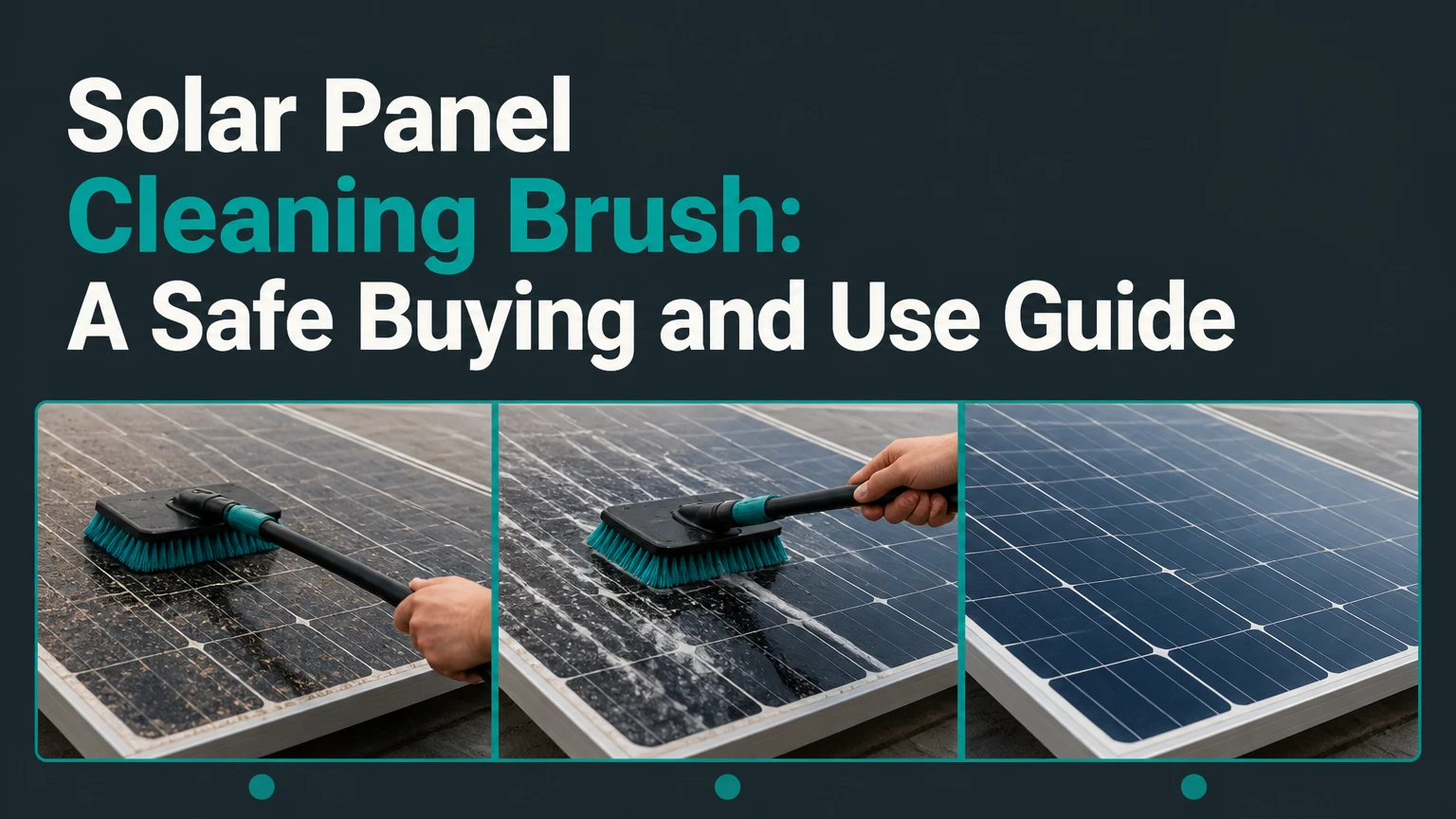
A solar panel cleaning brush is a specialized soft-bristle tool for removing dust, pollen, bird droppings, salt, and other deposits from photovoltaic module glass. The safest effective systems combine low-pressure pure water with a non-abrasive brush, allowing the operator to clean from the ground without walking on panels or applying damaging force.
Key Facts at a Glance
- A solar panel cleaning brush should use soft nylon, polyester, microfiber, or manufacturer-approved hybrid bristles, never wire or abrasive pads.
- Water-fed poles typically consume about 1.5-3 liters per minute, while dry robotic systems can use no water.
- Reverse-osmosis and deionized water reduce spotting because dissolved minerals are removed before the rinse dries.
- Manual poles commonly clean 10-15 panels per hour, while rotary systems may handle 30-60 panels per hour under favorable conditions.
- Typical equipment prices range from $50-$250 for basic DIY kits to $10,000-$40,000 or more for utility-scale robotic units.
- Cleaning can recover lost production, but the gain depends on soiling, rainfall, panel angle, shading, and the time since the last wash.
What Is a Solar Panel Cleaning Brush?
A solar panel cleaning brush is a brush head, usually mounted on a telescoping pole, designed for photovoltaic glass rather than ordinary household surfaces. The tool loosens contaminants through controlled mechanical agitation while water carries the loosened material toward the lower edge of the module.
Most residential systems are water-fed poles. A hose runs inside or alongside an aluminum, fiberglass, or carbon-fiber pole and supplies water through jets near a rectangular brush head. The operator works from the ground or a secure roof position, using overlapping strokes instead of aggressive scrubbing.
Solar modules have tempered glass, an anti-reflective surface treatment, an aluminum frame, silicone seals, and electrical junction components. The brush must therefore clean the glass without grinding grit across the surface, forcing water into seals, or catching on module edges.
The brush is not a repair tool. It cannot correct cracked glass, delamination, failed bypass diodes, hot spots, or permanent mineral etching. Those conditions require an installer or qualified solar technician.
How Does a Solar Panel Cleaning Brush Work?
A solar panel cleaning brush combines soft mechanical agitation, controlled water flow, and telescopic reach to remove deposits without abrasive contact. Pure water lubricates the bristles and dries with fewer mineral marks, while the brush breaks the bond between dust or droppings and the module glass.
Loose dust can often be removed by water alone. Bird droppings, dried pollen, salt film, and insect residue usually need several gentle passes because their adhesion is stronger than ordinary airborne dust.
A rectangular brush head distributes pressure over a larger area than a narrow hand brush. Dual-trim bristles can reach shallow surface irregularities, while a gooseneck adapter keeps the head flat against a panel when the pole is extended.
The operator should pull or push with the pole rather than lean body weight onto the brush. Excessive force increases the chance of scratching trapped grit across the glass, bending a lightweight pole, flipping the brush head, or damaging bristle tips.
Which Brush Specifications Matter Most?
The most important specifications are bristle material, head width, pole length, weight, water connection, and replacement-part availability. A lightweight brush with soft bristles is usually safer for a homeowner than a motorized unit that adds torque and operating weight.
| Specification | Typical residential value | Commercial value | Why it matters |
|---|---|---|---|
| Brush width | 10-16 inches | 18-30 inches | Wider heads cover more glass per stroke |
| Pole length | 20-30 feet | 40-60 feet | Determines ground-level reach |
| Pole material | Aluminum or fiberglass | Carbon fiber | Carbon fiber reduces flex at long extension |
| Water flow | 1.5-3 L/min | 2-5 L/min | Higher flow improves rinsing but uses more water |
| Dry brush weight | 1-3 pounds | 3-8 pounds | Weight affects fatigue and pole control |
| Bristle profile | Dual-trim nylon | Nylon or hybrid | Profile affects edge access and contact softness |
A soft brush is not automatically safe if it retains sand. Rinse the head before every use, especially after cleaning a dusty ground-mount array, because one trapped stone can create a visible scratch.
Which Solar Panel Cleaning Brush Type Should You Choose?
Manual water-fed poles are the best choice for most homes, rotary brushes suit frequent commercial cleaning, and robotic systems make economic sense mainly where labor, roof access, or panel count justifies their higher capital cost. Array size alone does not determine the answer.
| System type | Typical price | Coverage rate | Typical water use | Best operating situation |
|---|---|---|---|---|
| Manual water-fed pole | $50-$1,500 | 10-15 panels/hour | 1.5-3 L/min | 10-100 accessible panels |
| Battery rotary brush | $1,500-$5,000 | 30-60 panels/hour | 2-5 L/min | 100-1,000 commercial panels |
| Hydraulic rotary brush | $1,500-$5,000 | 30-60 panels/hour | 3-5 L/min | Sites with suitable pumps |
| Dry robotic crawler | $10,000-$40,000+ | 100-500+ panels/hour | 0 L/min | Large, regular, dry arrays |
| Wet robotic crawler | $10,000-$40,000+ | 100-500+ panels/hour | 1-5 L/min | Utility sites with water logistics |
Manual Water-Fed Poles
Manual systems have the lowest entry price and the simplest maintenance. An aluminum pole works for short residential reach, fiberglass offers electrical isolation advantages in some work environments, and carbon fiber provides better stiffness at 40 feet or more.
The limitation is operator fatigue. A pole that weighs only a few pounds at ground level can become difficult to control when fully extended, particularly in wind. A homeowner should not use a long pole near overhead power lines, unstable roof edges, or a steep surface that requires standing on wet tiles.
Rotary and Motorized Brushes
Rotary brushes use a spinning cylindrical or disc head to increase cleaning speed and reduce repetitive manual scrubbing. Electric models need a battery or generator, while hydraulic models depend on compatible water pressure and flow.
Rotary action is useful for repeated commercial work, but the rotating head can move grit across glass faster if the operator fails to pre-rinse the panel. It also adds weight, noise, maintenance, and the possibility of a motor or drive failure.
Robotic Cleaning Systems
Robotic cleaners use wheels, tracks, cylindrical brushes, sensors, and either water sprays or dry microfiber contact. Dry robots are particularly relevant in arid regions where hauling water costs more than the cleaning equipment’s operating energy.
Robots need suitable module spacing, surface geometry, edge detection, and transport procedures. They are not universally safer: a crawler can fall from an array edge, stop on a panel, or fail to cross a gap. Site-specific manufacturer limits remain mandatory.
How Do You Choose Safe Bristles and Pole Reach?
Choose a soft, non-abrasive brush with a protective bumper, a level contact face, and a pole long enough to reach the array without unstable overextension. The brush should be sold for solar modules, windows, or other coated glass, with replacement heads available from the manufacturer.
Avoid kitchen brushes, stiff deck brushes, wire bristles, melamine foam, and any head with exposed metal fasteners. A brush designed for masonry or vehicle tires has the wrong contact pressure even if its shape appears convenient.
Pole reach should include the operator’s standing position and the array’s height, not the manufacturer’s maximum collapsed-to-extended figure alone. A 30-foot pole may reach a two-story roof from the ground, but wind, hose drag, and the angle of the roof can make its practical working height lower.
Carbon fiber is valuable at long reach because it flexes less than many aluminum poles. Aluminum generally costs less, but its greater weight can increase fatigue during a full cleaning session.
How Much Does Solar Panel Cleaning Equipment Cost?
Solar panel cleaning equipment typically costs $50-$250 for a basic DIY kit, $500-$1,500 for a professional carbon-fiber pole package, $1,500-$5,000 for a rotary system, and $10,000-$40,000 or more for a robotic platform. Total ownership cost also includes filters, resin, brushes, batteries, transport, and maintenance.
| Purchase level | Equipment included | Typical upfront cost | Recurring cost |
|---|---|---|---|
| Basic DIY | 10-20 ft pole and soft brush | $50-$250 | $20-$80/year for brush or filter parts |
| Advanced home | 20-30 ft pole, hose, DI cartridge | $250-$800 | $50-$200/year for resin and parts |
| Contractor | 40-60 ft carbon-fiber pole and cart | $500-$1,500 | $150-$600/year for resin, hoses, heads |
| Rotary commercial | Motorized head and power system | $1,500-$5,000 | $200-$1,000/year for batteries and wear parts |
| Robotic utility | Crawler, charger, controls | $10,000-$40,000+ | Site-specific service and consumables |
For a small home array, equipment ownership is not always cheaper than hiring a cleaner. Compare the purchase price with local service visits, roof access risk, water treatment expense, and the number of cleanings required annually.
How Often Should Solar Panels Be Cleaned?
Most residential panels need inspection rather than automatic monthly cleaning. A practical starting schedule is one inspection after the dry season and another after major pollen, dust, construction, wildfire-smoke, or bird activity, followed by cleaning only when deposits affect output or remain visibly concentrated.
Rain removes loose dust but does not reliably remove oily pollution, bird droppings, salt deposits, or baked-on pollen. Panels with a tilt of roughly 20 degrees or more often shed water and dust better than nearly flat modules, although local conditions matter more than angle alone.
The National Renewable Energy Laboratory has documented that soiling losses vary substantially by climate and site conditions. Industry guidance often cites 5%-30% recoverable loss in heavily soiled situations, but that range is not a guaranteed result for every array.
A useful decision rule is to compare production against the same weather period, using the inverter portal or monitoring system. Cleaning is easier to justify when output falls beyond normal seasonal variation and the panel surface visibly carries deposits.
How Do You Clean Solar Panels With a Brush?
A safe manual cleaning session usually takes 30-90 minutes for a small residential array, depending on access, panel count, and contamination. The decisive factors are cool glass, low mineral water, gentle contact, and a stable working position.
Before You Start
- Time: 30-90 minutes for 10-30 panels.
- Difficulty: Moderate, with roof work requiring professional judgment.
- Equipment: Soft water-fed brush, telescoping pole, hose, pure-water filter, gloves, eye protection, and a soft blower.
- Water: Approximately 1.5-3 liters per minute for a manual system.
- Conditions: Early morning, evening, or overcast weather with low wind.
- Prerequisites: Read the module manufacturer’s cleaning instructions and inspect the array from ground level.
Step 1: Inspect the Array and Work Area
Look for cracked glass, lifted frames, exposed conductors, loose cables, damaged roof surfaces, bird nests, and overhead power lines. Do not clean a damaged module or climb onto a roof that is wet, steep, fragile, or inaccessible without fall protection.
You will know the inspection is complete when every panel and the intended operator position have a documented access decision. The common mistake is treating cleaning as routine roof maintenance when the actual hazard is electrical or fall-related.
Step 2: Shut Down According to Manufacturer Instructions
Use the system’s normal shutdown procedure, which may include turning off the inverter and designated AC and DC isolators. Shutdown does not make panels electrically dead in daylight, because photovoltaic modules can still produce voltage when illuminated.
A qualified electrician should handle uncertain disconnects, damaged wiring, or commercial systems with unusual switching arrangements. The common mistake is assuming that pressing an inverter button eliminates all DC voltage.
Step 3: Remove Loose Debris
Use a soft blower or a clean, dry solar brush to remove leaves, twigs, heavy dust, and grit. Do not drag dry sand across the glass with pressure, because dry abrasion can damage the surface treatment.
You will know this step worked when loose material no longer rolls ahead of the brush. The common mistake is wetting a thick layer of dry dirt and turning it into a muddy abrasive film.
Step 4: Pre-Rinse the Upper Panel Row
Begin at the highest row and rinse downward with low-pressure water. Use reverse-osmosis or deionized water when possible, particularly in regions where tap-water hardness creates visible deposits.
The water should wet the surface without striking the module like a pressure washer. The common mistake is starting at the bottom, which allows dirty runoff to cross already-cleaned panels.
Step 5: Brush With Light, Overlapping Strokes
Place the brush flat on the glass and use overlapping vertical or horizontal strokes in a consistent grid. Let water lubricate the contact area, and apply only enough force to maintain contact.
You will know the brush is positioned correctly when the head stays flat and the pole remains controllable without bending sharply. The common mistake is pushing harder when a deposit persists; instead, soak the area, wait several minutes, and make another light pass.
Step 6: Rinse From Top to Bottom
Rinse each completed row with clean water before moving lower. Maintain enough flow to carry loosened material away, but avoid directing water toward junction boxes, cable entries, frame gaps, or damaged seals.
The row is complete when runoff appears clear and no visible brush lines remain from the working angle. The common mistake is stopping after the first rinse while mineral-rich or dirty water remains on the glass.
Step 7: Inspect and Record the Result
View the panels from a low angle in reflected light, then check inverter output after the system returns to normal operation. Record the cleaning date, visible contamination, water method, and any panel defects.
A clean surface should show no persistent white spots, greasy film, or bird-dropping residue. The common mistake is judging success only from ground-level appearance without checking difficult lower edges and production data.
What Water Should You Use?
Pure water with low dissolved-mineral content is the preferred rinse for streak-free photovoltaic glass. A reverse-osmosis system removes most dissolved solids, while a deionization cartridge removes remaining ions; the correct setup depends on incoming water hardness and the equipment manufacturer’s target.
A TDS reading below approximately 10 parts per million is a common professional target for spot-free water, although local conditions and drying speed influence the result. A basic hose filter may improve sediment but cannot reliably produce spot-free water in hard-water regions.
Do not add dish soap automatically. Detergent residue can leave a film, attract dust, or conflict with the module maker’s instructions. If a manufacturer permits a cleaning solution for oily contamination, use the specified concentration and rinse completely.
What Are the Most Common Cleaning Mistakes?
The most damaging mistakes are abrasive contact, high-pressure water, cleaning hot glass, and allowing mineral-rich water to dry on the module. Each mistake has a different recovery path, and repeated abrasion cannot always be reversed.
| Failure mode | Likely cause | Immediate correction | Prevention |
|---|---|---|---|
| White spots | Hard tap water dried on glass | Re-rinse with low-TDS water | Use RO or DI water |
| Scratches | Grit, stiff bristles, excess force | Stop and inspect under angled light | Pre-rinse and use soft bristles |
| Brush flips | Incorrect gooseneck angle | Flatten the head and reduce pressure | Adjust before full extension |
| Bristles splay | Pole weight or downward force | Replace damaged head | Store bristles upward |
| Seal leakage risk | Direct high-pressure spray | Stop spraying frame gaps | Use low-pressure flow |
| Streaks | Dirty runoff or incomplete rinse | Rewash from top to bottom | Work in small completed rows |
The solar industry has a counterintuitive rule: more water pressure does not produce a safer or cleaner result. Pressure can drive water toward seals and junction boxes while leaving bonded contamination untouched.
Another practitioner rule is to clean the brush head before cleaning the array. A perfectly soft brush becomes unsafe when it carries grit from a driveway, roof membrane, or unwashed storage container.
Can You Pressure-Wash Solar Panels?
Pressure-washing solar panels is generally unsuitable because concentrated spray can damage seals, frames, connectors, and junction-box interfaces. A low-pressure hose rinse is safer, while a soft water-fed brush supplies the mechanical action needed for stubborn deposits.
Pressure washing may also force water beneath frame components or across cable entries. The panel can continue operating after this damage, so the absence of an immediate fault does not prove that the method was safe.
Do not use hot water on panels heated by direct sun. Rapid temperature change can stress glass, especially where one portion of a module is shaded and another remains hot.
What Should You Use Instead of a Solar Panel Cleaning Brush?
A professional cleaning service is the best alternative when panels sit on a steep roof, access requires fall protection, the array is damaged, or the system exceeds the operator’s safe reach. A blower alone can remove loose leaves, but it cannot remove bonded bird droppings or mineral film.
A fixed rinse system may suit a large commercial roof with adequate water treatment, while dry microfiber equipment can suit water-limited utility sites. Ordinary window squeegees are acceptable only when their rubber and frame are approved for coated glass and the operator can work without excessive pressure.
| Alternative | Removes loose dust | Removes bonded droppings | Typical cost or resource | Best use |
|---|---|---|---|---|
| Soft blower | Yes | No | $50-$300 | Leaves and dry debris |
| Professional service | Yes | Yes | Local service-rate dependent | Unsafe roofs or large arrays |
| Fixed rinse system | Yes | Sometimes | $500-$5,000+ installation | Regular commercial maintenance |
| Dry microfiber robot | Yes | Limited | $10,000-$40,000+ | Arid utility arrays |
| Approved glass squeegee | Yes | Yes with pre-soak | $20-$150 | Accessible low arrays |
Which Brush Is Best for Your Situation?
A homeowner with 10-20 panels should usually select a 20-30-foot water-fed pole, a soft dual-trim brush, and a portable DI or RO system. The equipment should be light enough to control fully extended and should not require roof walking.
A small contractor cleaning 100-1,000 panels benefits from carbon-fiber reach, replaceable brush heads, a water-quality meter, spare hose sections, and a purification cart. A rotary head can increase throughput, but the operator should retain a manual brush for edges, split arrays, and delicate areas.
A utility operator with more than 1,000 panels should compare robotic systems by terrain, row spacing, edge detection, water logistics, and service support rather than advertised speed alone. Dry cleaning can reduce water use to zero, but dry systems may be less effective against oily residue or hardened bird deposits.
Coastal sites need more frequent inspection for salt film. Agricultural sites may require additional cleaning after pollen or dust events. Construction near an array can produce fine cement or silica dust that should be removed promptly by a qualified service provider rather than aggressively scrubbed.
FAQ
Does rain clean solar panels well enough?
Rain removes loose airborne dust, but it does not reliably remove bird droppings, salt deposits, oily pollution, or dried pollen. Panels with a moderate tilt usually shed rain better than nearly flat panels. Inspect the glass and compare monitored output before scheduling a separate wash.
Can I use tap water on photovoltaic modules?
You can use tap water for an initial rinse, but mineral-rich water may leave calcium and magnesium spots when it dries. Use reverse-osmosis or deionized water for the final rinse, particularly when local water hardness is high or panels dry quickly in direct sunlight.
Do solar panels need detergent?
Most routine cleaning does not require detergent. Pure water and a soft brush are sufficient for ordinary dust and pollen. Use a cleaning solution only when the module manufacturer permits it for a specific contaminant, and rinse thoroughly to prevent residue and future dust adhesion.
Will cleaning increase solar panel output?
Cleaning can restore output lost to surface soiling, but the improvement varies by site. Typical recoverable loss may range from a few percent to 30% in heavily contaminated conditions. Compare production with weather-adjusted historical data rather than assuming every visible mark represents an equal electrical loss.
Is a solar panel cleaning brush safe for a pitched roof?
A solar panel cleaning brush does not make a pitched roof safe to walk on. Use ground-based reach when practical, and hire trained personnel when roof access requires fall protection, ladders near electrical conductors, or movement across wet, fragile, or steep surfaces.
How should I store the brush head?
Rinse the brush after use, remove trapped grit, allow it to dry, and store it with the bristles facing upward or hanging. Do not leave a heavy brush resting on its bristles, because prolonged compression causes splaying and uneven contact.
The Bottom Line
The right solar panel cleaning brush is usually a soft water-fed head on a controllable telescoping pole, paired with low-mineral rinse water and a cool-weather cleaning schedule. Choose manual equipment for small arrays, rotary equipment for recurring commercial volume, and robotic systems only when scale, safety, or water logistics justify the investment. Always inspect first, avoid abrasive force and pressure washing, and treat damaged modules as electrical maintenance rather than cleaning work.