Cleaning cloths for windows are usually low-lint microfiber or tightly woven glass cloths designed to lift dust, oils, and moisture from glass without scratching or streaking. For most homes, one medium-pile absorbent cloth for the first pass and one smooth, dry polishing cloth for the finish provide better results than using one towel for every stage.
Key Facts / At a Glance
- A two-cloth system separates dirt removal from final polishing and reduces residue transfer.
- Flat-knit microfiber is usually best for fingerprints, mirrors, and interior glass.
- Waffle and fishscale weaves handle more moisture or textured exterior grime, but neither removes mineral scale by itself.
- A 70/30 polyester-polyamide blend is a useful buying benchmark, not a universal performance standard.
- GSM describes fabric weight, not cleaning quality; weave, fiber fineness, edging, and laundering also determine results.
- Never wash glass cloths with fabric softener, dryer sheets, greasy towels, or lint-shedding cotton.
What Are Window Cleaning Cloths?
Window cleaning cloths are purpose-built wiping fabrics for glass, mirrors, glazed doors, and similar smooth surfaces. Their useful attributes are low lint release, fine fibers, controlled absorbency, and a surface that does not drag grit across the pane.
Microfiber is the common choice because split synthetic fibers create many contact edges and small spaces that can hold loosened soil. A glass cloth is not automatically better because it feels softer or has a higher GSM rating. A thick automotive drying towel can retain substantial water yet leave too much moisture on a small pane.
A window cloth also has limits. It cannot safely dissolve heavy calcium deposits, remove cured paint, or substitute for a scraper designed for a particular glass surface. Abrasive particles trapped in any cloth can scratch glass, especially when pressure is applied.
Why does microfiber work on glass?
Microfiber works through contact, capillary movement, and mechanical pickup rather than through a special glass-cleaning chemical. Split fibers increase surface area, while narrow spaces between fibers draw in small amounts of water and suspended soil.
Dry microfiber can also collect loose dust through friction-related electrostatic effects, but the charge is not reliably or universally positive. Humidity, fiber composition, surface contamination, and washing conditions change the electrical behavior. The practical rule is simpler: use a dry cloth for loose dust and a slightly damp cloth for oily or bonded soil.
The U.S. Environmental Protection Agency distinguishes cleaning from disinfecting, and the Centers for Disease Control and Prevention states that “cleaning with products containing soap or detergent reduces germs on surfaces.” For ordinary household windows, the main objective is soil and film removal, not disinfection.
How Do Material and GSM Affect Results?
The best window cloth balances fiber fineness, weave, absorbency, and handling size; no single polyester-polyamide ratio or GSM value guarantees a streak-free result. A 70/30 blend is a sensible benchmark because polyamide generally improves softness and water uptake, while polyester contributes structure and durability.
Manufacturers do not use one universally enforced “industry standard” for window-cloth composition. Some products use 80/20 microfiber, recycled polyester, blended yarns, or cotton-based fabrics. Treat specifications as comparison data rather than proof of performance.
Which specifications matter when buying?
Look for a dense, low-lint weave, cut or bound edges that do not shed, and a size large enough to fold into several clean faces. A 30 x 30 cm cloth is convenient for mirrors, while 40 x 40 cm provides more working area for large panes.
| Specification | Practical window range | Best implication | Limitation |
|---|---|---|---|
| Polyester-polyamide blend | 70/30 or 80/20 | 70/30 generally feels softer and absorbs more | Ratio does not reveal yarn quality |
| Fabric weight | 200-350 GSM | Medium weights balance drying and handling | GSM alone cannot predict lint or streaking |
| Small cloth size | 30 x 30 cm | Mirrors, interior panes, detailing | Saturates sooner on large windows |
| Large cloth size | 40 x 40 to 50 x 70 cm | Patio doors, wide panes, professional work | More expensive and slower to dry |
| Fiber profile | Fine, split microfiber | High contact area and low lint potential | Poor manufacturing can still shed fibers |
| Edge construction | Ultrasonic, laser-cut, or soft bound edge | Reduces hard seams and loose threads | A damaged edge should be retired |
A practitioner rule of thumb is to avoid choosing the thickest towel available. High-pile cloths often hold more liquid than a pane needs, and excess liquid is a common cause of drying marks.
What does GSM mean for window cleaning?
GSM means grams per square meter, so it measures fabric mass and approximate density. Around 200-300 GSM often suits general glass polishing, 300-450 GSM can help with heavier moisture, and very thick towels are better reserved for bulk drying than final glass finishing.
Those ranges are typical buying guidance, not a scientific optimum. A 250 GSM waffle cloth and a 250 GSM flat-knit cloth can behave very differently because their loop structure and contact pattern are different.
| GSM range | Typical role | Drying behavior | Main risk |
|---|---|---|---|
| 150-200 GSM | Dusting and final buffing | Dries quickly, holds little water | Saturates during dirty first passes |
| 200-300 GSM | General interior glass | Balanced moisture control | Requires folding and frequent face changes |
| 300-450 GSM | Exterior moisture and detailing | Holds more rinse water | Can over-wet small panes |
| 450+ GSM | Bulk drying and spill control | Very high capacity | Often inefficient for final polishing |
Which Weave Should You Choose?
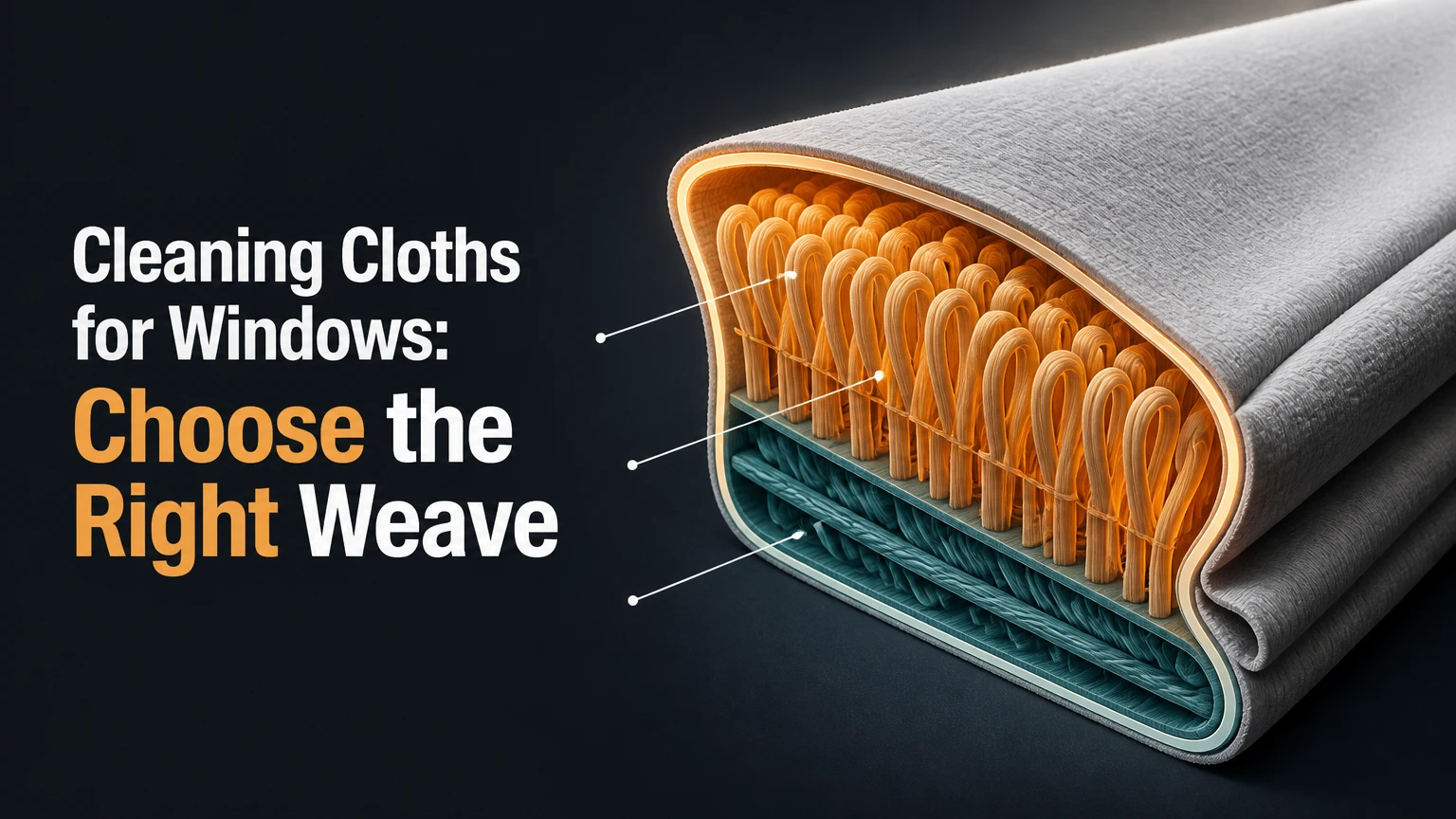
Flat-knit microfiber is the most versatile choice for interior windows and mirrors, waffle weave is better for absorbing substantial water, and fishscale or diamond weave is useful when exterior glass has more bonded debris. Cotton scrim remains practical for professional edge detailing, but it needs careful laundering and usually more preparation.
| Cloth type | Best surface | Typical size and weight | Strength | Limitation |
|---|---|---|---|---|
| Flat-knit glass cloth | Interior panes and mirrors | 30 x 30 cm, 200-300 GSM | Low-pile polishing and low lint | Limited bulk-water capacity |
| Fishscale or diamond weave | Exterior windows | 30 x 40 cm, 250-350 GSM | More mechanical contact with grime | Can feel stiff and catch damaged edges |
| Waffle weave | Wet first pass and large panes | 40 x 40 cm, 250-450 GSM | High liquid-holding capacity | Grid can retain grit if poorly rinsed |
| Cotton scrim | Squeegee edges and frames | 45 x 60 cm or larger | Durable, flexible, reusable | Requires breaking in and can lint |
| Smooth suede-style cloth | Final polish and fingerprints | 30 x 30 cm, 200-300 GSM | Excellent dry finishing | Poor choice for muddy exterior glass |
Is flat-knit microfiber the best all-purpose option?
Flat-knit microfiber is the best default for a home that mainly has fingerprints, dust, and light cleaner residue on interior glass. Its low pile provides consistent contact and makes it easier to see whether the cloth is leaving lint.
Flat-knit cloth is not the best tool for a muddy exterior pane. Grit can remain on the surface instead of sinking into a deeper weave, so the cloth must be rinsed or replaced frequently. Use a separate utility towel for frames and sills.
When is waffle weave better?
Waffle weave is better when the pane carries more water than oil, such as after rinsing a patio door or cleaning a large conservatory roof section. Its recessed pockets increase holding capacity without requiring a very thick pile.
Waffle weave does not neutralize mineral deposits. Hard-water spotting must be dissolved with a compatible acidic cleaner or removed through a method approved for the glass and coating. Scrubbing harder with a waffle towel increases scratch risk if abrasive crystals remain.
What is fishscale weave useful for?
Fishscale or diamond weave is useful for exterior pollen, light insect residue, and more resistant surface soil because its raised pattern creates additional mechanical contact. The cloth should still be used with lubrication and light pressure, not as a dry abrasive pad.
Fishscale cloth is a poor choice for loose grit. Pre-rinse or pre-dust the glass first, because dragging sand or masonry dust across the pane can create scratches regardless of microfiber quality.
How Do You Use Window Cloths Without Streaks?
Use a clean two-cloth system, remove loose grit before wetting, apply only enough liquid to suspend soil, and polish before the remaining film dries. A typical residential job takes 10-20 minutes for six to eight accessible panes, excluding heavy mineral deposits.
Before you start
| Item | Typical quantity | Purpose | Replacement rule |
|---|---|---|---|
| Absorbent cloth | 1 per 2-4 panes | Damp cleaning pass | Replace when it drags or becomes saturated |
| Dry flat-knit cloth | 1 per 2-3 panes | Final polish | Use a fresh face after each pane |
| Clean water | 500-1,000 ml | Rinsing and dampening | Change when visibly cloudy |
| Mild glass detergent | 2-5 ml per litre | Loosening oily film | Omit when pure water is sufficient |
| Utility towel | 1-2 | Frames, tracks, and sills | Keep separate from glass cloths |
| Soft brush or vacuum | 1 | Tracks and loose grit | Use before liquid reaches the frame |
Time: 10-20 minutes for six to eight panes.
Difficulty: Easy for accessible interior glass; moderate for exterior or high windows.
Cost: Typically $0.50-$3 per cleaning when reusable cloths are already owned.
Prerequisite: Check the manufacturer’s instructions for tinted film, low-E coatings, acrylic glazing, and treated glass.
Step 1: Clean frames and sills first
Remove cobwebs, grit, and soil from tracks, seals, frames, and sills with a brush, vacuum, or utility towel. Work from the top of the window downward so dislodged debris does not land on finished glass.
You will know the step worked when the sill no longer transfers visible dirt to a white towel. A common mistake is using the final polishing cloth on the frame, which contaminates the cloth with oily dust.
Step 2: Dry-dust the pane
Fold a dry flat-knit cloth into quarters and make overlapping straight passes across the glass. Use a fresh face when the working face collects dust, and do not press hard over visible grit.
The pane is ready for wet cleaning when loose pollen and hair have disappeared. A common mistake is spraying immediately onto a dusty surface, which turns dry particles into a gritty slurry.
Step 3: Prepare a controlled solution
Add 2-5 ml of a mild, residue-free glass detergent to 1 litre of water when fingerprints or kitchen film are present. For light dust, clean water is often enough. Spray the cloth lightly or dampen it and wring until it is wet but not dripping.
Applying liquid to the cloth gives better control on interior panes and reduces runoff into seals. Never mix ammonia, bleach, acids, or other cleaners unless the product label specifically permits the combination.
Step 4: Wipe the glass systematically
Use overlapping horizontal or vertical passes, working from the top corner toward the bottom. For a stubborn fingerprint, make a short additional pass with the damp cloth rather than increasing pressure across the entire pane.
You will know the step worked when the glass has an even wet film without isolated puddles. A common mistake is using circular motions for the whole pane, because changing directions makes residual film harder to diagnose.
Step 5: Turn to a clean cloth face
Refold the damp cloth whenever the working section becomes visibly dirty, then follow with a separate dry flat-knit cloth. Keep the dry cloth away from frames, handles, kitchen surfaces, and cleaning bottles.
A clean face should remove the remaining moisture in one or two passes. If the dry cloth smears, the pane is either too wet, chemically overloaded, or being polished with a contaminated towel.
Step 6: Inspect in reflected light
View the pane from two angles, especially against a bright window or dark interior background. Correct isolated marks immediately with a barely damp corner followed by a dry corner.
A successful finish has no continuous haze, lint trail, or edge puddle after two minutes of drying. Do not inspect only from straight on, because reflected light reveals films that ordinary room light conceals.
How Do Microfiber Cloths Compare With Alternatives?
Microfiber is usually the most efficient reusable option for ordinary glass, while a squeegee is faster on large wet panes and cotton scrim remains useful for edges. Paper towels are convenient for small spills but commonly leave lint and require repeated sheets.
| Alternative | Typical cost per use | Best application | Main drawback |
|---|---|---|---|
| Microfiber cloth | $0.10-$0.75 after reuse | Interior glass and detailing | Requires dedicated washing |
| Squeegee with washer | $0.20-$1.00 | Large wet windows | Needs technique and edge detailing |
| Cotton scrim | $0.15-$0.80 | Frames and professional finishing | May lint before breaking in |
| Paper towel | $0.50-$2.00 | Small spills and emergencies | Waste, lint, and weak wet strength |
| Newspaper | $0.20-$0.60 | Inconsistent household alternative | Ink, residue, and poor durability |
| Melamine foam | $0.25-$0.75 | Selected marks on frames | Abrasive and unsuitable for many coatings |
A squeegee is the better primary tool when a large pane is fully wet, because the rubber blade removes liquid in a continuous channel rather than redistributing it through fabric. A cloth remains necessary around muntins, seals, corners, and edges.
Which Surfaces Need Extra Care?
Standard uncoated glass tolerates ordinary low-lint microfiber, but window film, acrylic, polycarbonate, anti-glare treatments, and some factory coatings require gentler handling. Follow the glazing or film manufacturer’s instructions before using vinegar, ammonia, scrapers, or textured cloths.
Coated and tinted glass
Use clean water or a coating-approved detergent with a soft, smooth cloth. Avoid aggressive pressure and abrasive particles, because a coating can be damaged even when the underlying glass is intact.
Acrylic and polycarbonate
Plastic glazing scratches more readily than glass. Use a manufacturer-approved plastic cleaner and a clean, non-abrasive cloth; never assume a fishscale weave is safe merely because it is labeled microfiber.
Screens and insect mesh
Do not treat screens like panes. Vacuum or brush them gently first, then use a lightly damp cloth with minimal pressure, because wet scrubbing can deform mesh and push soil into the fibers.
High windows and exterior access
Do not lean from a window or use an unstable chair. Use an appropriate extension tool or hire a window cleaner when safe access cannot be maintained; a perfect cloth cannot compensate for fall risk.
What Should You Do About Difficult Deposits?
Hard-water scale, paint specks, silicone, and construction dust require diagnosis before treatment. A microfiber cloth can lift loose residue, but it cannot safely dissolve every deposit and may spread crystalline minerals across the pane.
| Problem | First response | Avoid | Typical extra time |
|---|---|---|---|
| Fingerprints | Mild detergent on damp cloth | Dry rubbing with pressure | 1-2 minutes |
| Bird droppings | Wet dwell for 2-5 minutes | Scrubbing while dry | 3-8 minutes |
| Hard-water scale | Coating-approved mineral remover | Vinegar on unknown coatings | 5-20 minutes |
| Wet paint | Follow paint and glass guidance | Dry scraping with a blade | 5-30 minutes |
| Construction grit | Vacuum, rinse, then wipe | Dragging dry grit | 10-30 minutes |
| Persistent oily haze | Fresh solution and cloth faces | Reusing a saturated towel | 3-10 minutes |
For bird droppings, place a damp cloth over the area for several minutes to soften it, then lift the residue without grinding it into the glass. For hard-water deposits, test a small inconspicuous area first and stop if the surface changes.
Boiling a microfiber cloth is not a general restoration method. High heat can distort synthetic fibers, damage edging, or set unknown residues. Wash the cloth according to its care label instead.
Why Are Streaks, Haze, or Lint Appearing?
Streaks usually result from excess liquid, detergent residue, a saturated cloth, contaminated glass, or polishing after the film has partly dried. Lint usually indicates a low-quality or damaged cloth, laundering with cotton, or a cloth that has collected fibers from other tasks.
| Symptom | Likely cause | Recovery |
|---|---|---|
| Water is pushed around | Cloth is saturated | Wring it out or replace it |
| Uniform cloudy film | Excess detergent or wax | Rinse glass and use a fresh damp cloth |
| Small fuzzy specks | Lint contamination or shedding | Launder separately and retire shedding cloth |
| Marks only at edges | Wet frame or seal runoff | Dry edges before final polishing |
| Haze returns after drying | Cleaner buildup or mineral film | Repeat with approved cleaner and clean water |
| Scratches or fine lines | Trapped grit or abrasive tool | Stop cleaning and assess the surface |
A new cloth should be washed before its first use because manufacturing residue and loose fibers can transfer to glass. If a cloth continues shedding after several washes, replacement is safer than trying to boil or chemically strip it.
How Should You Wash and Store Them?
Wash window cloths separately from cotton, fleece, grease-soaked items, and heavily soiled cleaning rags. Use the care-label temperature, a modest amount of detergent, no fabric softener or dryer sheets, and complete drying before storage.
Fabric softener leaves conditioning agents on fibers, which can reduce water uptake and transfer a film to glass. The Rag Company and other microfiber suppliers commonly warn against softener because residue changes microfiber performance, although exact wash-life claims vary by product and laundering conditions.
Typical consumer microfiber cloths cost $10-$20 for a six-to-twelve-pack, while professional cloths commonly cost about $4-$8 each. A practical service life is often 100-300 washes, but 300-500 washes should be treated as a manufacturer or product-specific claim, not a universal guarantee.
Store clean cloths in a dry, closed container with separate color coding:
- Blue for interior glass and mirrors.
- Gray or green for exterior glass.
- Red or brown for frames, tracks, and dirty utility work.
- White for final inspection and polishing.
Replace a cloth when its edge unravels, it remains greasy after washing, it releases visible lint, or it drags despite being clean and correctly dampened.
Which Cloth Setup Fits Your Situation?
A two-cloth arrangement is the most reliable setup for most households: choose a 250-300 GSM absorbent cloth for the damp pass and a 200-300 GSM flat-knit cloth for polishing. Different situations require changing the first cloth, the solution, or the access method.
| User situation | First cloth | Finishing cloth | Typical quantity |
|---|---|---|---|
| Apartment interior windows | 250 GSM waffle | 250 GSM flat-knit | 2-4 cloths |
| Large exterior panes | 300-350 GSM fishscale | 250-300 GSM flat-knit | 4-8 cloths |
| Mirrors and fingerprints | 200-250 GSM flat-knit | Smooth low-pile cloth | 2 cloths |
| Professional squeegee work | Cotton scrim | Flat-knit detailing cloth | 6-12 cloths |
| Coated or acrylic glazing | Smooth approved cloth | Smooth approved cloth | 2-4 cloths |
Choose flat-knit microfiber if the main problem is fingerprints. Choose waffle weave if water volume is the problem. Choose fishscale only when the surface is sound, pre-rinsed, and carrying more bonded exterior soil.
FAQ
Can I clean windows with only water?
Yes, clean water and a suitable microfiber cloth can remove dust, light fingerprints, and fresh soil from many panes. Water alone is less effective against oily kitchen film, nicotine residue, adhesive, and mineral deposits, so use a compatible low-residue cleaner when plain water leaves a film.
How many cloths do I need for a house?
A small home typically needs six to twelve dedicated cloths for a complete window-cleaning session. Use at least one damp cloth and one dry finishing cloth, then add replacements when the working faces become dirty or saturated.
Are expensive window cloths worth the price?
Professional cloths can justify higher prices when they have consistent weave, durable edging, low lint, and predictable washing performance. For occasional household cleaning, a well-made $10-$20 multipack often performs adequately if it is reserved for glass and washed correctly.
Can microfiber scratch a window?
Microfiber fibers themselves are unlikely to scratch ordinary glass, but trapped sand, construction grit, metal fragments, or a damaged edge can create scratches under pressure. Pre-dust or rinse the pane, inspect the cloth, and use light pressure on coated or plastic surfaces.
Should I use vinegar on window glass?
Diluted vinegar can help with some mineral or cleaner residues on compatible uncoated glass, but it is not automatically safe for every frame, film, seal, coating, or plastic glazing. Check the manufacturer’s guidance and test a hidden area before treating the whole window.
Why does my clean cloth leave streaks?
A clean cloth can still streak when it is overloaded with water, detergent, oil, or residue from previous laundering. Use less solution, switch to a clean face, rinse the pane with compatible water, and finish with a dry low-pile cloth.
The Bottom Line
The best cleaning cloths for windows are selected by task, not by the highest GSM or the most elaborate weave. For most homes, pair a 200-300 GSM waffle or medium-density microfiber cloth for controlled damp cleaning with a clean flat-knit cloth for dry polishing, keep glass towels separate from utility rags, and treat coatings, mineral deposits, and access hazards as separate problems.