How to Clean Unfinished Basement Walls Safely
How to clean unfinished basement walls means identifying the wall material and contaminant, removing loose deposits mechanically, washing with a compatible cleaner, rinsing without flooding the masonry, and drying it completely. Concrete, block, brick, and stone require different pressure and chemical choices, especially when mold, recurring seepage, or deteriorated mortar is present. Key Facts / […]
How to Remove Etched Water Spots From Car Paint Safely
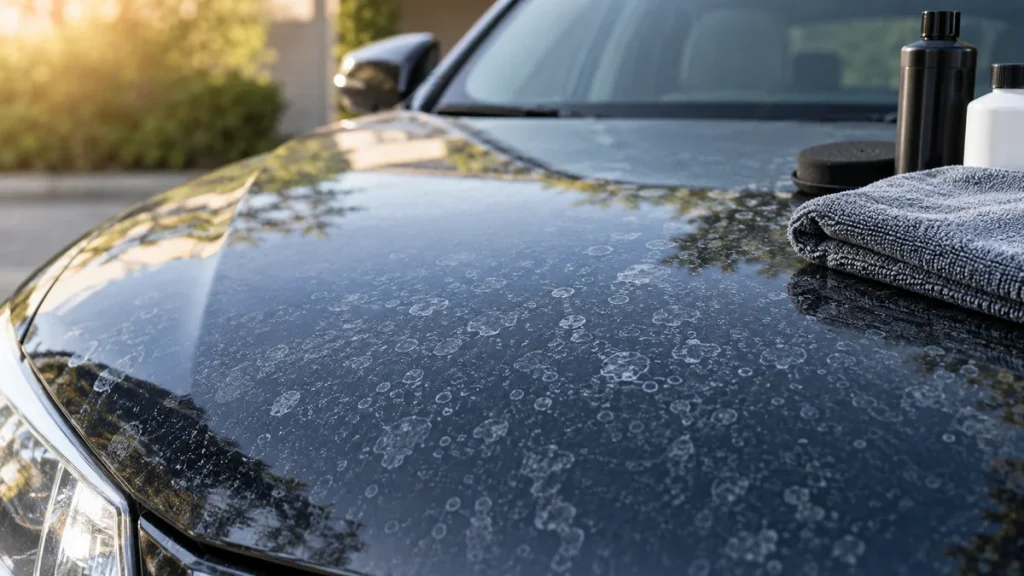
To remove etched water spots from car paint, first dissolve and rinse away mineral deposits, then polish only the remaining clear-coat crater with a dual-action machine. Fresh deposits may disappear in 10-30 minutes; true etching requires paint correction and may be unsafe to remove completely if the depression is deep. Key Facts at a Glance […]
How to Remove Mold From Under Silicone Caulk Safely
How to remove mold from under silicone caulk depends on whether the seal remains intact. Surface mold may respond to a labeled bathroom cleaner, but mold beneath loose, stained, or separated silicone usually requires cutting out the entire bead, cleaning the joint, drying the substrate, and applying new 100% silicone. Bleach cannot restore failed adhesion. […]
How to Remove Silicone Sealant Without Damage
Silicone sealant is a flexible, waterproof polymer that cures into rubber and bonds tightly to glass, tile, porcelain, metal, plastic, and other smooth surfaces. To remove silicone sealant, cut both edges of the cured bead, peel away the bulk, lift the remaining film with a compatible tool or remover, then clean and dry the joint […]
How to Remove Mold From Walls Without Bleach Safely
How to remove mold from walls without bleach depends on the wall material, the affected area, and the moisture source. For small patches on sound, painted walls, detergent, white vinegar, or 3% hydrogen peroxide can remove surface growth when applied with protective equipment and adequate dwell time. Porous, swollen, or repeatedly wet drywall often requires […]
How to Clean Raw Wood Before Staining Evenly
How to clean raw wood before staining means removing dust, glue, oils, wax, resin, and loose fibers, then sanding the surface uniformly without burnishing it. The reliable sequence is scrape, sand with the grain, vacuum, inspect under angled light, use a compatible wipe only when needed, and let the wood dry completely before applying stain. […]
How to Prep Wood for Stain After Sanding: Even Color
How to prep wood for stain after sanding means removing dust and contamination, checking the surface under solvent or water, correcting defects, and choosing conditioning based on wood species and stain chemistry. The finished surface should be clean, uniformly abraded, dry, and tested on scrap before stain touches the project. Key Facts / Quick Answer […]
How to Get Rid of Mould on Walls Permanently
How to get rid of mould on walls permanently means removing visible fungal growth and correcting the moisture that feeds it. Cleaning alone cannot provide a lasting result when condensation, plumbing leaks, penetrating damp, or porous wall materials remain wet. The durable solution is moisture control, safe removal, complete drying, and suitable surface restoration. Key […]
How to Remove Mold From Shower Caulking With Vinegar Safely
How to remove mold from shower caulking with vinegar starts with white distilled vinegar, usually containing about 5% acetic acid, applied full-strength to clean, dry caulk. Keep the surface visibly wet for about 60 minutes, scrub gently, rinse, and dry completely. Vinegar can clean surface growth, but it cannot reliably remove mold embedded inside deteriorated […]
How to Clean Unfinished Basement Stairs Safely
Unfinished basement stairs are raw, unsealed wood that collects construction dust, soil, spills, mold residue, and splinters inside open pores. The safest method is a dry-to-wet process: vacuum and scrape first, use only controlled damp cleaning, scrub with the grain, and dry the lumber quickly before sanding or sealing. Key Facts / Quick Answer Typical […]